|
||||||||
| AHYMSIN NEWSLETTER, ISSUE - November 2020 | ||||||||
|
||||||||
|
|
||||||||
Dear Yoga Mentor, My Question Is…Sometimes students have written to or asked Swami Veda Bharati, Swami Ritavan Bharati, and other senior teachers in our tradition questions about practice. This is one such “Question and Answer,” or Q&A. Question:Kindly help me. Fear has made me not able to do my work. It has caused fatigue and tiredness. It's been a few years like this. This anxiety has been very debilitating. Answer:Lalita Arya (Ammaji), Michael Smith, and Carolyn Hume have responded to this question. From Lalita Arya (Ammaji):On FEAR My first experience of dealing with Fear as I remember was as a young child. We lived near the rain forests in a rustic area where flushed toilets were unknown and it would have been considered impure to have them in the homes, in any case, in those days. So we had outside latrines. Before going to bed we were advised to go there so we did not have to disturb the parents in the middle of the night. However, in the tropics night comes quickly. There is hardly twilight. So when it was time to go to bed, if we had an early dinner it was fine to go by oneself. But if it got to nighttime, that became a problem. As one evening started to fade into darkness, I stood by the door wanting to visit the latrine that was about 5 minutes walk away from the house. I stood in the doorway in my pajamas peering into the darkness, waiting and watching; I have no idea what for. My Mom came by and asked, "What are you waiting for, go?" I looked at her and said "I'm scared, please come with me." She smiled and said, "What are you afraid of?" I said "I don't know." So she paused and said, "Look at me. You have fear in your mind, but if you give your mind something else to think about, the fear will disappear." I kind of grinned and said, "What do you mean?" She answered, "Do you remember Gayatri mantra?" Well, of course, I did as that was the first mantra we were taught. She continued, "Hold my hand start reciting the Gayatri, and go boldly out there with nothing to fear,” as she loosened her grip. I stepped out, turned to look at her, she smiled and shook her head and pointed towards the outhouse. I kept looking here and there, reciting silently went and did what I had to do, came back still reciting, back into her open arms. To this day I have never been afraid of the dark. Here is another family incident. One of our daughters, Saumya was having teenage nightmares, and when she told me, I directed her to her father. He tried all the lectures on fear, etc., but she would not listen. He finally said, OK, go and read the novel Dune by Frank Herbert (1965) and there is a poem on Fear. She did not pay attention. Many years after he was with students in Minneapolis at The Center, and she now an older teen was with me in the kitchen as I made tea for him. I asked her to take it up to him where he was teaching in his room. He took the tea, and introduced her to the students and said, "At one time she came to me complaining of nightmares and I advised her to read Dune, the novel. But she doesn't listen to me." So Saumya smiled at him, recited the entire poem on Fear, and then the Gayatri mantra, gave a bow and left him with his mouth open. Here is the Poem:
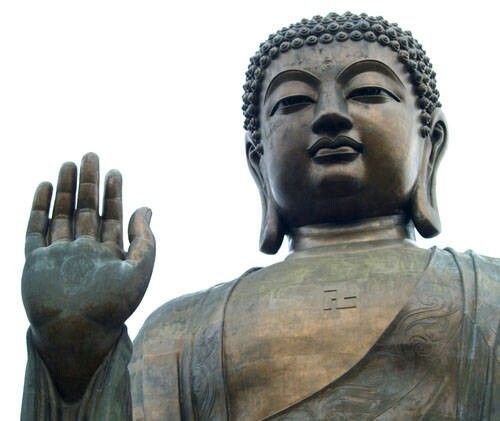
There are many writings on this subject, in our philosophical texts, but I thought these two practical experiences might help. A good picture to view before meditation to help conquer fear is the Abhaya mudra of the Buddha. The Abhaya mudra (fearless gesture) is a mudra that is a gesture of safety, bestowing divine protection and bliss in eastern philosophies. The right hand is held up facing outwards. (Photo taken from internet)
From Michael Smith:It would be helpful to know what you feel is the SOURCE of the fear. There might be some external situation that you feel is scary – some future event that you feel you can’t deal with — or you are in a situation where you have a great deal of responsibility with very little control over the outcomes. The important thing to know is that you can only do the best you can in the present moment, so worry is not helpful in any way. There are many helpful books and articles on how to cope with fear. Sometimes people need to change their diet, or change their job, or get away from a toxic environment that is unhealthy or even noisy. Dr. Phil Nuernberger’s Freedom from Stress has some helpful suggestions about “psycho-social stress” as does Dr. Stephen (Stoma) Parker’s Clearing the Path. Sometimes people ask what they can do right now, during a panic attack or an anxiety episode. What would be some kind of emergency measures? For myself, I always feel better if I take a walk in the woods or someplace out in nature. Nature is always in balance, so I kind of open myself to the natural harmony of the trees, plants, water and sky. And I always go inside and check to see how I am breathing. Here are some things that might be helpful:
What was written above was mainly about stop-gap measures for stress etc. There is a whole other aspect to working with fear which necessitates on-going sadhana and gradually changing the entire fabric of the mind so it is less susceptible to “threatening” events. Swami Veda talked about “smoothing out the rough edges of the mind,” so that instead of walking around on a bed of nails, it’s possible to walk on memory foam and have built-in resiliency. With sadhana, there is also a gradual disidentification with the ego (the small fragile self) and, instead, an expansion of the personality – to identification others, with all living beings, and eventually with one’s essential nature. One does not “react” to daily situations as much as “respond” to them from a higher, deeper perspective. Swami Nijananda said, also, that with mantra initiation into a spiritual tradition (and the habit of mantra-japa), one has a “plexiglas shield” between you and external events. Some people have said that FEAR is the dominant emotion with human beings. I think it comes with “localization” — when Adam and Eve ate the Apple and were separated from the totality – strangers in a strange land. There’s a Sufi saying: “After the first sin there is no other.” Leonard Perlmutter has written: “The ignorance of believing that I am an individual mind-body-sense complex leads to my separation from the whole. This division always leads to fear, and fear invites danger.” From Carolyn HumeI agree with Michael that fear basically comes from identification with the finite. There can be examination of one's fears. Witnessing the fear, not identifying with it. Swami Rama has written,
Diaphragmatic breathing can be helpful. When one becomes fearful, one can re-establish diaphragmatic breathing and practice breath awareness. The 2 minute meditation could be a tool, which also includes a short progressive relaxation. Swami Veda Bharati has written, "Relax your forehead. It is not possible for thoughts of worries, anxieties, fears, aggression and so forth to arise in the mind if the forehead is kept relaxed." (Meditation: The Art and Science) Also sometimes we do not readily identify fear as fear, or a basis of other emotions. Also "Mantra for Freedom from Fear" by Swami Veda popped into my mind:
Editor’s Note:If you have a question about spiritual practice, you can use the "Contact the Spiritual Committee" link on the AHYMSIN website to ask it. Previous columns can be read at “Dear Yoga Mentor, My Question Is…” |
||||||||