Guru-Purnima: 9th July 1998

Dear Fellow Initiate,

To shape the disciple’s mind into a beautiful vessel for the divine name,

To wash off the darkening shadows of spiritual sunsets of karmas with the brilliant light of the full moon of knowledge,

To suffer for the disciple to uplift him/her from the mirages and quagmires of sorrowful bondage – as we recall –

This is the Guru’s work within the eternal lineage in which compassionate grace is the primary link.

At this sacred time we pay homage in gratitude to the divinity that takes the form of an incarnate being, to us a personal guide, from time to time – in whose grace our being as a spirit can breathe again, to aspire to realise its luminosity. May we continue to meet him daily.

Blessings
Swami Veda Bharati

An Invitation to Return Home – AHYMSIN Sangha Gathering 2019

We are members in the spiritual body of the Gurus. Their life-force, their grace flows through us. Our own minds grow in this grace only when we remember that in all our work we are serving as members, as organs, of that Spirit. – Swami Veda Bharati

As constituents of this Sangha, this body of the Guru, we aspire to come together regularly for the pursuit of our spiritual goals, to take stock of our progress, as well as chart the way ahead to prepare ourselves for a deeper commitment to our sadhana, and to the Mission.

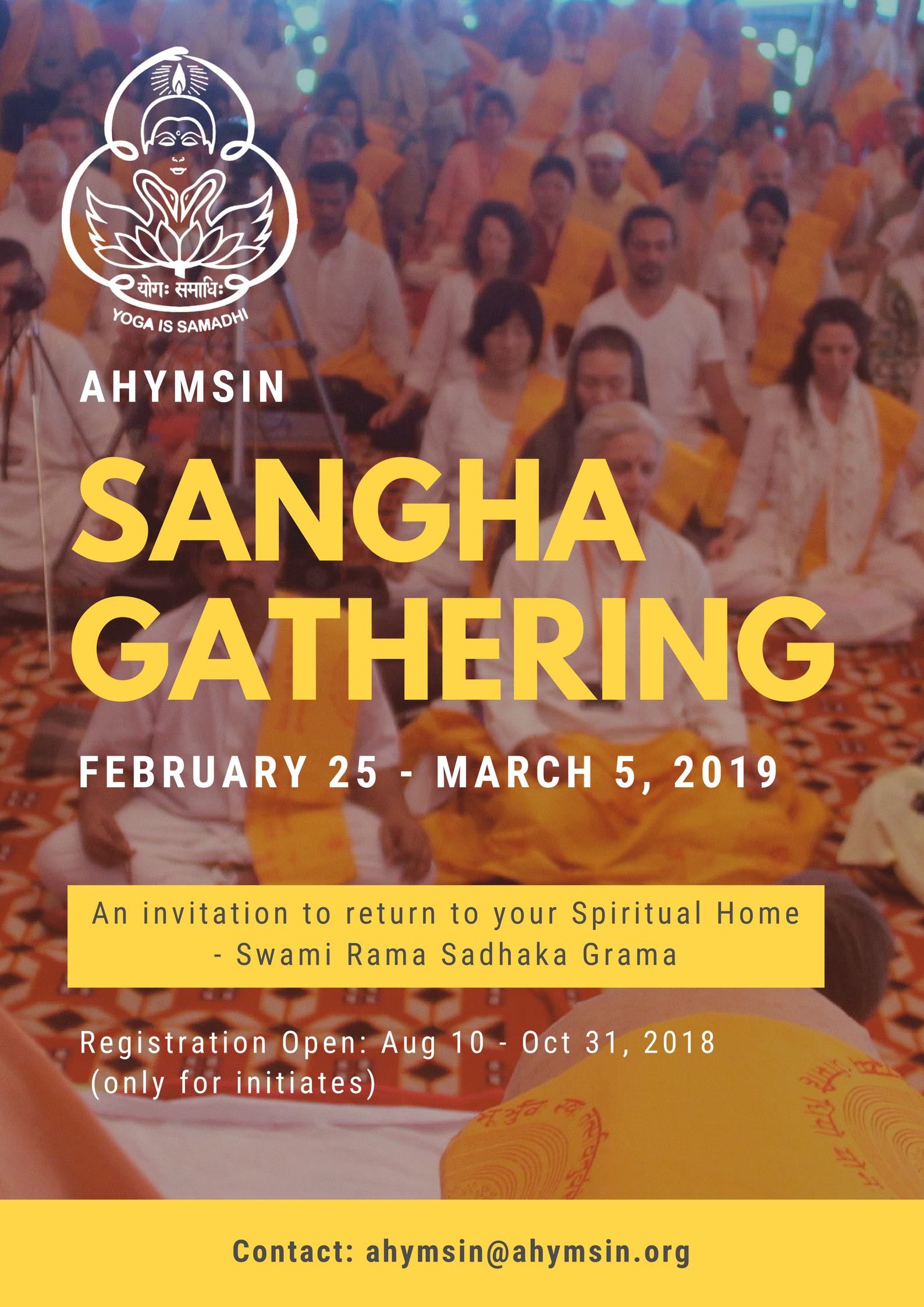
AHYMSIN Sangha Gathering 2019

Swami Ritavan Bharati extends his personal invitation to all members of the Guru family to gather at Swami Rama Sadhaka Grama between February 25 – March 5, 2019, to immerse ourselves into the triad of ‘Love, Serve, Remember’ which Swami Rama enjoined and the principles given to us by our beloved Swami Veda through his writing on “Perennial in the Millennium”.

There will be special lectures, group discussions, and workshops, on “Love, Serve, Remember, Perennial in the Millennium, and Unifying Streams in Religion”. There will be advanced classes on Hatha yoga, Pranayama, Contemplative Walking, and Guided Meditations led by Swami Ritavan and other senior teachers during the gathering.

Swami Ritavan will guide the AHYMSIN Sangha into the next set of practices for the next 3 years, in preparation for the 2022 Kumbha Mela.

We would also have the AHYMSIN executive committee elections at the same time.

The 9-day Sangha Gathering will be shared in the following manner:
• February 25 – 27, 2019: The theme of Love
• February 28 – March 2, 2019: The theme of Serve
• March 3 – 5, 2019: The theme of Remember. March 4 is also the Mahashivaratri and there will be all-night celebrations on that day.

We also take this opportunity to express our encouragement to participants who would like to arrive a couple of days prior to, and/or to stay beyond, the gathering to deepen their practice. There will also be special parallel workshops on Dance of Transformation, and Self-Regulation and Biofeedback from March 6 – 9, 2019.

Registration for the gathering will open (only for initiates) from August 15 – October 31. We regret that accommodation will be limited and is subject to a first-received-first-serve basis. To know more about attending the Sangha Gathering, please write to ahymsin@ahymsin.org

We look forward to the pleasure of your divine presence at the gathering.

In service of the Guru Lineage,
AHYMSIN Office, Swami Rama Sadhaka Grama


 Editor’s Note:

For more about the 2019 Sangha Gathering that will take place at Swami Rama Sadhaka Grama (SRSG) 25th February – 5th March 2019, please read these three articles written by Swami Ritavan Bharati:

2019 Sangha Gathering and Preparations
2019 Sangha Gathering
Guru Purnima Letter

Swami Ritavan has written in the Guru Purnima Letter, “Please again read through the daily inspirations for the 40-day Spiritual Festival of Peace and choose your top 10; then select the three that you will commit to practice for the next six months. At that time (February 2019), we will gather for our special AHYMSIN Sangha in Rishikesh, with prayer and contemplation to discover and apply the steps of Spiritual Peace, within, and for our global family.”

More about the Spiritual Festival can be read at: Annual Festival of Spiritual Peace.

“The Perennial in the Millennium” by Swami Veda Bharati is available in Kindle from Amazon and Amazon.in. For inquiries about purchasing it in booklet form, please contact Himalayan Yoga Publications Trust (HYPT) at hyptbooks@gmail.com.

The Perennial in the Millennium,” a poem by Swami Veda Bharati can be read by clicking on the title.

“The Unifying Streams in Religion” is available as a booklet at the online bookstore of The Meditation Center. This bookstore ships nationally and internationally. It is available in Kindle at Amazon and Amazon.in

A New Cycle of Construction and Restoration at SRSG

[Editor’s Note: 

Please see: “Construction Project at SRSG” by Pandit Priyadarshan (Pierre Lefebvre) – The largest construction project at Swami Rama Sadhaka Grama in more than a decade.

Please see: “Updates on Renovation at SRSG” by Rabindra Sahu.]

Swami Rama Sadhaka Grama has been said to be the heart center of our beloved Swami Veda Bharati-ji, and embodies his vision for a spiritual home to which our Guru brothers and sisters could return for their sadhana, with their families and children. It has been nearly two decades since it was first realized in brick and mortar.

The buildings, though old, are imbued with stories of every meditation with Swami Ji, of all the Gurukulam lectures, of every teacher in training, of Ma Tara and Sadhakeshwar Mahadeva, of Mother Mary and the Buddha Himself, of joy and laughter, of stillness and silence, and resonate with Swamiji’s voice and the mantras which continue to be strengthened each day.

While the intangibles remain ever fresh, the limitations of matter mean that the old buildings are in need of some repairs now, and as they are being renovated, the ashram looks almost as though it has been temporarily converted into a construction site!

The old dining hall and kitchen now prove inadequate for our growing family. We are rebuilding the kitchen next to the Gurukulam, and the old kitchen and dining hall are being renovated and combined into one big dining hall that may accommodate up to 200 people.

If you have been to the ashram recently, you would probably remember the long and steep gravel pathway between the Mandala office and the Knowledge Center/Dining Hall. That is now being renovated so it has a solid foundation topped with a brick pathway.

Something guests do not always notice is the risk factor with constant soil erosion behind guest cottages 22-30. A retaining wall is being built to fix the problem.

The guest toilets in the main building and next to the dining hall needed serious repairs. We are now reconstructing separate toilets for men and women at both the places. The new toilets in the main building are already fully functional, while the construction is underway for the ones near dining hall.

The global headquarters of the AHYMSIN Office at the ashram needed a new renovated office space, and we have happily moved in already.

During the monsoon season, water would often get into the Shiva Temple and the floor around the temple had sunk. Construction work is underway to strengthen that space, and also to lift Nandi Ji! Our construction contractor – Sh. Dheeraj Bhatia Ji – has been kind enough to sponsor this work himself.

The old garbage disposal unit near the STP was difficult to maintain partly because of its structure and partly because the ground was uneven. It has now been dismantled and the nearby ground has been leveled with soil filling, secured with pillars and a retaining wall up to the STP.

In line with the government requirements and to ensure the safety and security of the ashram, especially with apartment buildings coming up nearby, the ashram will soon be equipped with CCTV cameras.

The immediate plans for further repair and renovations include – renovation of the New Block Building and Sadhana Cottages to stop water leakage, with waterproof rooftops, a brick pathway from the main gate to the Mandala Office, a brick pathway between the guest cottages, a new garbage disposal unit, and the renovated bookstore with a memorabilia section dedicated to our beloved Swami Veda. [Note: Please see photos at the end of this article.]

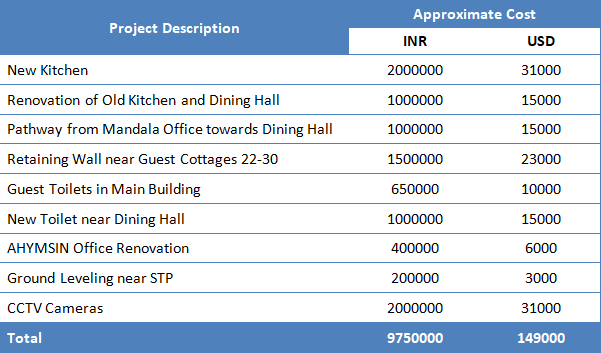
Project Description and Cost

In order to meet these essential expenses for the maintenance of this peace enclave called Swami Rama Sadhaka Grama, we need your loving support. The current cost of just maintaining the facilities at the ashram (not including all the programs, or any of the repair work) runs at approximately INR 1,800,000 (USD 26,200) per month.

You may decide to give a pledge of whatever amount per year or per quarter. Kindly get in touch with Mayanne Krech for foreign donations and Rabindra Sahu for Indian donations at ahymsin@ahymsin.org.

Yours in service of Gurudeva,
Sadhana Mishra (General Secretary, DMT and AHYMSIN), Rabindra Sahu (General Manager, SRSG)

“The dakshina (love-offering) and seva (selfless service) offered unto the Guru’s Mission, will ensure that the manifest form of this spiritual sanctuary can continue to flourish and serve in line with Swami ji’s vision, while further strengthening one’s unending connection with the Guru Parampara.” – Swami Ritavan Bharati

Footnote: Guru Dakshina / Love Offering by Swami Veda Bharati

Renovation of Old Kitchen and Dining Hall

26 June 2018 – New Kitchen

26 June 2018 New kitchen 1

17 June 2018 – Old Dining Hall Rooftop

17 June 2018 old dining hall roof top

5 July 2018 – Old Dining Hall Rooftop

5 July 2018 old dining hall roof top 1

16 July 2018 – Old Dining Hall Rooftop

16 July 2018 old dining hall roof top

Pathway from Mandala Office towards Dining Hall

20 July 2018 – New Pathway

20 July 2018 New Pathway

Retaining Wall near Guest Cottages 22-30

17 June 2018 – Retaining Wall

17 June 2018 Retaining Wall

22 June 2018 – Retaining Wall

22 June 2018 Retaining Wall

12 July 2018 – Retaining Wall

12 July 2018 Retaining Wall

 Guest Toilets in Main Building

22 May 2018 – New Toilets

22 May 2018 New toilets

21 July 2018 – New Toilets

21 July 2018 2 New toilets

Shiva Temple

22 June 2018 – Shiva Temple

22 June 2018 Shiva Temple

19 July 2018 – Shiva Temple

19 July 2018 Shiva Temple

Materials for Work

Materials for work

Guru Purnima Letter

Dear Initiates and Students,

30 years ago [in 1988] we were reminded of the purpose of life. Each of us can reflect on how life has unfolded, karmic debts paid, dharma fulfilled. And now set the course with renewed intention, sankalpa, living each day with that awakened spirit, and finding joy in a life well-lived and well-loved.


Swami Rama’s address to The Meditation Center by phone on Guru Purnima, July 29th, 1988:

I pray to the Divinity in you.

This day, the day of Guru Purnima, is considered to be the holiest day for the students of life; for those that have been treading the path of light; for those aspiring to attain enlightenment in this lifetime.

They remember this day and celebrate it by becoming aware [that] the purpose of life is to attain enlightenment; the state of mind, internal state, that makes one free from all pains and miseries.


As Gurudev reminds us: “As fire purifies the gold, unconscious mind, and entire reservoir, thus the storehouse can be purified by offering all that I have stored within to the fire of knowledge by saying: ‘Om Guruve Namah.’ Everything belongs to the Light of Light. When nothing belongs to me … I am free.”

Please again read through the daily inspirations for the 40-day Spiritual Festival of Peace and choose your top 10; then select the three that you will commit to practice for the next six months. At that time (February 2019), we will gather for our special AHYMSIN Sangha in Rishikesh, with prayer and contemplation to discover and apply the steps of Spiritual Peace, within, and for our global family. Further details are upcoming.

Om Shanti, May Peace fill your hearts.

Swami Ritavan Bharati,
on behalf of the spiritual guides of AHYMSIN


Editor’s Note:

For more about the 2019 Sangha Gathering that will take place at Swami Rama Sadhaka Grama (SRSG) 25th February – 5th March 2019, please read these two articles written by Swami Ritavan Bharati:

Daily inspirations were put out on social media by Divya Gupta – Facebook AHYMSIN Group, Facebook AHYMSIN, Twitter, and Instagram.

More about the Spiritual Festival can be read at: Annual Festival of Spiritual Peace.

This letter was also published in the July 2018 edition of the AHYMSIN Newsletter.

2007 New Year Blessing

LIKE THE NEXT LINE OF A POEM
THAT YOU ARE COMPOSING
BE YOUR COMING YEAR.

LIKE THE NEXT BUD TO BURST INTO BLOSSOM
IN THE GARDEN YOU HAVE BEEN TENDING
BE YOUR COMING YEAR.

LIKE THE NEXT CYCLE OF THE SONG
IN THE RAGA YOU ARE IMPROVISING
BE YOUR COMING YEAR.

LIKE THE NEXT FRIEND TO GREET
IN THE CIRCLES OF AMITY YOU ARE EXPANDING
BE YOUR COMING YEAR.

MAY YOU BE THE ILLUMINATION
TO A WORLD DARKNESS-INFESTED
SO YOU GRANT THE LIGHT OF WISDOM TO THOSE WHO GROPE IN THE DARK,
A PROFOUND PEACE TO YOUR MIND
AND THEREBY TO ALL WORLDS.


During this Year also read:

1. Spirituality: Transformation Within & Without by Swami Rama
2. Perennial in the Millennium by Swami Veda

These will become the theme for the 40-Day Spiritual Festival 20th June through Guru Purnima 30th July 2007.

Love-mantra

[This from a hard copy made and distributed in 2008.]

Lady of the universe invites you to her mansion
just above the heart gorge
Over full cups of ambrosia she grants your three eyes
her vast grandeur’s vision
View of magnificent worlds stretched out as far as
soul-falcon’s wings can fly
Eternity!- She says – and all this, too, Soul,
Is, had been your own estate, you forgot?

LOVE, she names this grandeur-sharing of Herself with you
and thenceforce
the only word gods living secretly in your ears can hear is
LOVE

Hairtip Mandala

[This from a hard copy made and distributed in 2008.]

I saw
The sun and the moon
Slide down through the sky
And dive into a bindu.
Bindu was a tip of Brahma’s hair,
the centre of a mandala drawn there.

Yes, I saw with mine own eyes
How the sun and the moon merged
Into this, Mother’s Lion’s lair.
Lights rippled layer upon layer,
Slide down through inside the Brahma’s hair.

The sun and the moon
merged into one
superimposed,
at first sight.
That is how they made their
– at this other end
parted into two –
a man and a woman
as they each other woo.
Then from their union
Emerged one galaxy, and many more,
And, that is how the cosmos
got recreated that we see
below and above, and aft and fore,
from the other side, stretched to this shore.
All of it is true
Forever after,
Forever before,
Only in my heart’s core.

May you become a curved petal
In the mandala that is drawn
On the tip of Brahma’s one hair.

How the Guru taught

[This from a hard copy made and distributed in 2008.]

I was an old papyrus, a birch bark, a palm leaf
Half crumpled, unwritten upon.
He picked me up, smoothed and polished me,
Wrote on me
A mere dot.

From the dot I emerged
A full person,
The dot undeleted
Shown yet brighter.

I now spend life times
Reading the dot
Written upon me

And I go searching for other half-crumpled
Unwritten upon
Papyri, birch-barks, palm leaves
To write the dot on
So that other full persons may emerge
To read the dots,
And to write them on again.

Vasudeva Principle, Toronto, 2004

In the Bhagavad Gita, we read “vasudeva sarvam”. That indwelling One is All. There is no other in relation-to, or conditioned-by. What do we mean by the indweller, the indwelling force? One of the many ways, the word “vasudeva” is translated in Bhagavad Gita is the “indwelling deity”. This is closely related to the word “vasu”, meaning, “all places”, for all places are dwelling places of divinity. Vasu is also the “hamsa”, that swan of the universal prana dwelling every-where in every-thing. Vasu-mana is also one of the thousand names of Shiva in the Mahabharata. Vasu-mana means beautiful mind, a mind that dwells as light in Being, and therefore, Vasu is the beautiful, light-filled, indwelling force.

May your mind be vasu-mana. Not this “me”, this little individuated mind, but mind as it is linked to the minds of the whole universe. When one mind-wave meets another mind-wave and a continuum is experienced that is called “mind as an energy field”. One mind-wave meeting another mind-wave in this oceanic-wave-field, and the two become one. When your individual mind touches that universal mind, “samasthi-chitta”, the senses of time and space dissolve. There is a force that acts through the force-field called “mind”, where space and time cease and some other force flows.

The practical application of that is in the principle called ahimsa. Until you learn to practice ahimsa you will never understand what cosmic mind is. You will not understand without the practice of non-violence, because according to the tradition, when you are hurting someone, being angry at someone, you are hurting and harming yourself. Each time people hurt themselves they express any form of violation, and this extends up to the entire cosmic mind, that cosmic mind of which you are a part. That is why among the yamas and niyamas the first yama is ahimsa.

What is ahimsa? First, you should know the Sanskrit word, “Sarvata”, meaning in all possible ways, in all possible modes. Of the many names for God, one of Her names is Sarvam, “All”. That All is indivisible, without division, not divided. Among all the divisions we experience, the “All” – Sarvam, remains full, undivided, complete in Her nature, and that is your true nature.

Ahimsa is associated with words, with thoughts, with actions. Doing it yourself, causing someone else to do it, someone else committing a violent act and you consent to it with words or silently. “Sarvata,” means at all times, in all ways, there is the intention to hurt, harm or injure. Not having the intention to hurt is ahimsa.

Of these 10 yamas and niyamas, after ahimsa, the remaining nine: satya, asteya, brahmacharya, aparigraha. saucha, santosha, tapas, swadhyaya, ishwara-pranidhana are all rooted in the first, ahimsa. They are there to help accomplish the perfection of ahimsa. They simply describe some aspect of ahimsa, and to make ahimsa perfect the other nine are included and necessary.

So if you want your prayers, your meditations, your silence, leading to your serenity, your quest for serenity, leading to your quest for peace of mind, yet, all the time you are committing himsa, all the time you are committing violence with your mind, where will your peace of mind be? For this reason, I am suggesting that you apply these kriyas, these applications of your yoga beginning with ahimsa and next, aparigraha.

This second practice (kriya) is aparigraha, non-attachment, not grasping or holding, possessing one’s object of desire beyond the “need” for which it fulfills. It is because of your lack of aparigraha that so much himsa is taking place and collection destruction of species is happening. Scale down your desires, and learn to remove your attachments to practice aparigraha. Take less, and let-go more. Keep to your practice of aparigraha and ahimsa.

These two, ahimsa and aparigraha are two closely related, but I want you to now add, Ishwara-pranidhana. What is the in-dwelling spirit – Ishwara in the butterfly? What about the Ishwara in the ocean or rivers that you have filled with plastic or muck? And when you take a shower or wash your hands remember the water you are using is now reduced, less for others. Be conscious, be aware, aware you are committing indirect violence. In many of your actions you are committing violence. Learn to enjoy more of less, and the world will be saved. These are all interlinked, the Ishwara pradhidhyana and your aparigraha and ahimsa are all linked. In this way, the amount of water you are using will reveal an understanding of Isha, the One Lord, practicing the presence of God, Ishwara pradhidhyana.

Practicing these kriyas will provide an “attitude-adjustment,” and thereby with a purified mind, you will experience a quietness and a sense of satisfaction. This mental-pacification is the essence of spirituality, this is the essence of dharma, this is the teaching that will elevate you and alleviate so many burdens of your mind.

Another part of Ishwara-pranidhana is “surrender to the Lord.” This indwelling principle, the indwelling Lord is Ishwara. Ishwara is that aspect of God which in relationship with the universe and its beings. And, Dhyana means to surrender, to merge your individual mind into the universal mind consciousness. Your individuated ego into the divine presence. Learn to connect with the lineage with Guru Parampara and at that moment the Guru Parampara lifts you and carries you.

When a Guru, yogishwara, divine Lord, Ishwara, graces you with attention, that is called Ishwara pranidhana. The devotee’s dhana is responding to by the divine (Ishwara) pranidhana. You will understand that only when you experience that connection through Samashti-chitta and through the Ishwara pranidhana principle, the Mahabharata explains, You only have to remember him.

Whatever I say, please go home and examine your life, examine your choices in life. Plan your spiritual life as you plan your worldly life. You plan for your finances, you plan for your business, you plan for what kind of house you will buy, you plan for what kind of car you will buy, you plan for what kind school you will send your kids to, you plan what kind of clothes you will buy for Christmas or Diwali, plan for your spiritual life.

You plan for insurance. Plan how much japa you will finish in five years. Plan for how much you will reduce your direct or indirect violence in the next five years or in the next one year. Plan that. Plan for how you can increase the time you sit for your prayers and your meditation. You will make a difference. Take it seriously. Plan for the moment of dying. Plan for the kind of body you want next time. Plan for in what kind of a household you want to be born next time. Part of that plan is the mood of your dying, what mood, what sentiment, what feeling, what smile there will be on your face at the moment of dying. What satisfaction you will have with your last breath.

Plan now for what spiritual improvements you will make in the next 40-days, in the next one year, in the next five years. If you need help we can help. (send comments or questions to: Dear Yoga Mentors, My Question is…)

Enjoy the meditations on the full moon day each and every month. Slowly, slowly something will happen for you. So that is the indwelling principle, Vasudeva.

(Note: This is an edited version of the talk which was shared by Swami Ritavan Bharati as part of the Annual Festival of Spiritual Peace in 2018.)

The Spiritual Festival of 1992

Friends, I am making this recording at the ashram in Rishikesh at the bank of the Holy Mother, Ganga. Just across the river I often hear the sounds of wild peacocks. And just two nights ago I heard the great trumpeting of a tusker, an elephant we had seen walking around and eating the vegetation. At this time, 4:00 a.m., this place is magic. And I think of all of you who are deprived of such peace that comes to me when I spend some time here. Solitude to me becomes a tangible, palpable force – a force that keeps me company. When I am here, I do not want to move; I do not want to go anywhere. And then my thoughts run to you – and a certain call comes forth from within my heart and mind. Perhaps it is the Guru Spirit that is reminding me that I should do my duty towards you, as my Gurudeva has so generously done towards me within the tradition.

I am sharing these thoughts concerning what you might do during our annual Festival ending with the Full Moon of the Guru’s Day, the Guru Purnima. What we have done together in the past years may be divided into two categories:

1. The purification of lifestyle and thoughts and emotions, so that we may select beautiful sentiments for ourselves and cultivate them, thereby enriching those around us.
2. And the practice the pure spirituality as with japa.

Perhaps the meditation centers that are communicating this to you will want to streamline all the practices of the purification of life and mind from the previous years. For this year, too, all of them remain in force, of course. Why should one lose one’s treasures? Why should not one add to them? And remember that every beautiful sentiment is a treasure. Every beautiful thought is worth saving and enhancing and increasing. So all things that we have done together to purify life in previous years during the Festival need to be cultivated again. I need not repeat them here.

As to the practice of japa, I would again recommend 125,000 repetitions of your own mantra. Those who want to do it a little more intensely may not limit themselves to the period of 40 days. They may complete the practice over a longer period by not counting the japa of the mantra, but rather 125,000 breaths. How many mantra recitations there are in each breath depends entirely upon each person’s capacity.

• Whenever you sit for the practice during this Festival, a few recitations of Gayatri at the beginning and at the end are always advisable – three, seven, nine, eleven or twenty-one. Those who learned to extend the Gayatri practice may use that extensive practice which ends with Om, Tat Sat Brahmarpanam Astu.
• Now, this is the basics of the japa, and, as I have said, the previous year’s disciplines. But, it is time to go further, and I would like to extend again the invitation to continue living in the vasudeva principle, the principle of the in-dweller, the single in-dwelling deity, the in-dwelling force. How do we go about doing this? All these years we have prepared for this step. And what is that step? – the very, very first step in yoga. This year we shall introduce yoga into our lives, the first step in yoga, consciously.

As you know, that of the eight limbs or steps on the ladder of yoga, the first one is yama, the interior spiritual disciplines. And the very first one of the five yamas is ahimsa , or non-violence. And we want to introduce this principle into our lives. How do we introduce this principle into our lives? I’ll share some thoughts with you. When we live by the in-dweller principle, we know that spirit in all beings is one. We must not be satisfied by merely paying lip-service to this principle. We must live by it in our relationships with all beings.

Much is being said about ecology these days: “Oh, how the species of wildlife are becoming extinct. Oh, we have to save the earth’s biodiversity.” Why? Because it is good for human beings, which means it is of long-term commercial benefit. This is nonsense. That is not how our ecology is going to be saved. There are religious and spiritual traditions in the world among which, for the last twenty-five or twenty-six centuries and longer, any direct or indirect killing of any living being is forbidden. Why is that? Because we know we live by fear. We are shaken with fear at all times in our lives. The Yoga  Sutras define fear as violence. It is not fear of violence committed by others towards us; it is the recognition of the violence within us: I know within me that I have hurt living beings. Living beings, I am saying, not human beings. I have hurt living beings. We are living in this fear at all times.

So for these 40 days extend your non-violence to all living beings, and refrain from partaking from anything as food that has been killed. No, you not doing anything special for them. It is not an act of compassion towards them. It is a recognition of the oneness of the in-dwelling spirit. Every act of murder is a suicide because that other is also I, the Universal Self. Please remember that: Every act of murder is a suicide. There is no distinction between the two.

The second step along with that is that all anger is anger at yourself. Frustration at one’s own inadequacy in love is anger. I am not saying, forswear, all anger right now. Again, there are questions about just anger, anger against injustices, anger where I am indeed right and the other party is indeed wrong, and so forth. Let us start working on the periphery, and not solve all the moral dilemmas right now. Let us make an experiment in life for these forty days. Cultivate a sweet sentiment. Again it is not an act of compassion, nor is it a repression; it is an act of cultivating a beautiful sentiment. For if the in-dwelling spirit is one, at whom am I being angry? Ask yourself that question, and that would help you to overcome the strong urge towards violence. Violence of speech, for instance. Violence that exhibits itself in a loud voice, in a screaming and a stamping of feet

Just curbing it for a period in your life. If, however, you have a clinical depression and it is caused by suppression of anger, then I am not recommending this practice for you. Then I am simply recommending cultivating the thought of the one, in-dwelling spirit.

So, make a start with these two observations: 1. Conquest of the urge to use other living beings for your pleasure; and 2. Conquest of the urge to use others as your safety valves. Both are violations of the principle of the one, indwelling spirit. And I don’t believe any of these theories of the survival of the fittest and all that nonsense. These have been created to justify what the world wanted to do in the18th and19th centuries.

Think over it. Don’t argue with me unnecessarily. Let this be an experiment in your life. You know what it will do you if you practice this non-violence? It will help you to conquer the fear of death; for fear of death, as I said, is nothing but the unconscious recognition of the fact of “how many times I have visited death upon others; may it not rebound to me.”

Do not do these as a word of law. Get the spirit of it. Absorb and assimilate the spirit. Read once again the autobiography of Mahatma Gandhi. Try to find arguments in favor of your opponent’s actions, for you are he; you are she – two waves of the same ocean, two rays of the same sun, two flames of the same fire. Contemplate, and let your contemplations become your sentiments, and let your spirit soar to realize the unity that is the uni-verse. I think of this world at times as one single poem, and that is how I think of the word uni-verse. Let your life be a poem. Let your world be a poem to you. I wish you a sense of fulfillment at the end of this period of forty days.

And one thing more, in my usual habit of tolerance I have said, “Well you decide the level of relationship you feel with the guru lineage.” But let me tell you one thing: unless that relationship deepens, all these practices will lead you nowhere. Find ways of deepening the relationship.

I pray for you, pray for your serenity and love in your life.

Blessings,
Usharbudh Arya (aka Swami Veda Bharati)

[Edited by Swami Ritavan Bharati]