
Shivaratri

OM OM OM

Every moment in the life of a lover of God is a moment of festivity because the joy of God descends into us; trickle by trickle, streams by streams; rivulets by rivulets by rivulets, in tides of oceans it arises inside ourselves when we are lovers of God. Yet, we select certain times when we realize our oneness with that source of all celebration and festivity. Some festivals are celebrated outside us, arounds us, in social forms as many of us observe, say, Christmas; Holi, the festival of colors; Diwali, the festival of lights; and many others. But the celebration of the Shiva night is purely an internal one. It is a night when something happens within us. A day of silence, a night of contemplation.

Silence is of many kinds as I have said before. Fasting is a silence; celibacy is a silence. Silence is a fast; silence is a celibacy. Silence of mind goes deeper and deeper until it becomes what St. John of the Cross has called “The Dark Night of the Soul.” It is a phrase not understood by the modern man; St. John is not talking of something fearsome, but something to celebrate – a stilling of the senses.

God, God, God has many many faces. Thou art the flowing cooling Waters. Thou art the all-encompassing Space. Thou art the supportive Earth. Thou art the Tao, the Self, the Atman. In all of these many names, we see the forms, and in all of these many forms, we this One permeating all. When we see God as we would like to see ourselves, when we have reached our ascetic urge at its maximum, at its fullest, that being of ourselves, one with the supreme Self is Shiva, the King of Ascetics.
Shiva is the Lord of the meditator, the very identity of the meditator. The earliest iconography in human history is a meditative one as divinity sitting in the meditative posture. It is the iconography of Shiva. It is that one by whose grace we are drawn to a life of renunciation, to go up the mountain, for he is the dweller of Mount Kailash, the dweller of the highest mountain within us, the head. From his matted hair the gushing river of inspiration, knowledge, and wisdom flows. The very river descends from the highest of the heavens, comes right into our fontanel, and from there flows downwards into the seven worlds (chakras), the seven continents, the sevens oceans, and becomes our very kundalini. That Shiva. To Him I dedicate myself today by the chant, “Om namah Shivaya.”

At this time in India, literally millions of people are walking. On well adorned bamboo poles on their shoulders, they have hung pots of different sizes on both sides. Pilgrims are walking from their villages, some as far away as 300 miles. Some walk all the way to Gomukh, the source of the river Ganges, from where they will take the water, the holy water. They will arrive back on Shivaratri night and pour this water – this form of purity, inspiration, aspiration for holiness – in a stream on the deity in their village temple as on offering. It is an offering of themselves, a flowing offering, a stream of the internal Self offered, onto that Shiva being.

On Shiva night we worship Shiva. When we worship externally, we worship Shiva in an amorphous form of an oval shape (lingam). It, the formless form before the universe has diversified, becomes as it were, a golden orb from where many faces of divinity appear. Sometimes we see one face, sometimes we see five faces, sometimes we see three faces all different ones emerging out of that amorphous form. This is our very linga sharira, subtle body. When it is viewed as luminous, amorphous, a sort of an oval form, from which our physical body emanates, sprouts, as it were, our limbs, that very being of God in the form of our subtle body is Shiva. Stripped of all adornments of our physical body, not interested in what is offered through the opening of the senses, eyes closed. This is the identification of ourselves as Shiva when we sing Shivoham, Shivoham, Shivoham, Shivoham, Shivoham, Shivoham, Shivoham. Millions of the people are walking toward Rishikesh at this time or have already taken their water from the Ganges and are walking to the temples up in the mountains. Many of them chanting, “OM NAMAH SHIVAYA, SHIVOHAM” (I AM SHIVA).

It would be the height of arrogance to call oneself Shiva and then offer worship to Shiva. Are we offering worship to ourselves? Not to our selves, but to our very Self. This very Self who becomes an ascetic even for a night had to doff the clothing to the identification with the physical body. It has freed itself and sat on the mountain Kailasha in the dome of the skull (not necessarily the real Mount Kailasha which is under Chinese occupation at present, though some pilgrims do travel to it in guided groups).

That Shiva is called Shiva because he sits and rests and meditates within us. He is called Hara, the plunderer. The one who plunders all that is of the exterior attractions within us. He is called Pashupati, Lord of his cattle, for we are his “pashu.” In South Indian Shaivism, Tamil Shaivism, there are these three figures in the theology: Pati, Pashu, and Pasha.

Pati: the Master, the Lord
Pashu: We, his animals, creatures, herd
Pasha: the snare with which we are bound

When we drop these snares, these ropes, these tethers with which we have confined our infinity into finiteness, then we are one with Shiva, and only then there arises in us, “Shivoham, Shivoham.” (I am Shiva, I am Shiva)

I used to sing in the early days of The Meditation Center.

“I am not the mind. I am not the intelligence. I am not the ahamkara, the ego. I am not the chitta, the mindfield. I am not the ears, the mouth, nor the nostrils, nor the eyes, nor the skin. I am not the sky, the spaces, winds, fires, waters, earths, which up to this very day I considered myself to be constituted. I am the very Self of Pure Consciousness and Bliss. I am Shiva. I am Shiva. I am Shiva. I am Shiva. I am Shiva.”

Shiva is not worshipped alone. “Shiva shaktya yukta” Shiva always together with Shakti, the very power that makes Him Shiva without which he is Shava (as in shavasana), a corpse. Not until this Shiva has Shakti vibrating is he truly Shiva. The “i” in the mantra-shastra, the mantra science, represents the feminine force. In the Shiva Purana, we read all that you view as masculine is Shiva, all that you view as feminine is Shiva – Shakti.

The Lord of all realms is Shiva, the very realm is Shakti. That which is to be heard is Shakti. The listener is Shiva. The one who questions is the spirit of the universe in you as Shiva. And all that is to be questioned is Shakti herself. All that is taste and flavor is She, the taster of the flavors is He. All the substance that are to be contemplated is She. The contemplator is He. All that is to be known is She. The knower is He. All the words and sounds are She. All the reality expressed by the words is He. Whatever is the power, the capacity, the “ness” expressed by this suffix, abstract in the language, is She. That in which that power resides is He. And the twain are ever One. When in you the twain have become One, then there is no left nor right, no front nor back, no below nor above. Then you are dikshita, an initiate.

We speak in the tradition of Shambhavi Diksha. We speak of the Shakti diksha. We speak of the mantric diksha (mantra initiation). Greater, much greater than that is when the river Ganga flowing from the matted hair of the Guru flows into the disciple in as much as the vessel called disciple can contain – Shakti diksha. Shambhavi diksha is when the fulness cannot be identified within ourselves because the vessel is not is not broad enough, not deep enough, not cleansed enough. Then by a touch, by a glance, the Guru passes a part of this energy into our selves. Sometimes this is passed into you when you sit in your meditation. This is called Shambhavi diksha.

When one reaches the supreme reality within oneself, then for him meditation ceases to be an effort. The tantric text on the Mrityunjaya mantra, the Netra Tantra (about which I am planning to do a seminar whenever I visit you next), teaches us, “Neither am I” nor is there any other to be meditated upon because the mind having entered the ocean of joy (ananda) has become One in which all things have coalesced. Therefore, do not meditate above or below or in the middle. Neither inside the body or outside. Nor looking at the empty space nor looking down the nose. There is no closing the eyes, no tying up the vision to an object. Neither having an object nor not having an object. Neither senses, nor beings, nor elements, nor experiences. Abandoning it all in samadhi one becomes One.

When such wisdom arises we realize that we are beings, not of two eyes, but of three eyes. Actually, the name of the tantra explained in Shiva’s meditation mantra is Netra Tantra. Netra is one of many Sanskrit words for eyes – that which leads. And this particular mantra, Mrityunjaya mantra is also called a netra mantra, a mantra of the eye, or the mantra that is the eye, or the mantra that is the eye. What is the eye?

Try-ambakam, the three mothers are one and the same as the three eyes. “Three mothers?” you ask. Who can be born of three mothers? And all at once! We are born of three mothers in the three Shaktis: Iccha Shakti, Jnana Shakti, and Kriya Shakti.

Iccha Shakti: the power of volition in the divine being
Jnana Shakti: the power of knowledge in the divine being
Kriya Shakti: the power to activate in the divine being

Also known as Five Acts of Divinity: srsti (creating), sthiti (maintaining), samhara (dissolving), tirodhana (concealing), anugraha (grace and revelation).

Having created the entire universe, He has made the universe into a veil that He has drawn upon Himself and hides behind it. Concealing, hiding all parts except the small toe of His left foot from which emanates as light beams as a million worlds. One hundred and eighteen of them. You may sometimes see in a beam of light particles of dust. That is what planets are relative to this universe. Now we are not talking of these worlds, not when we are Shivoham – when we are Shiva. The three Shaktis are the three eyes.

Try-ambakam yajamahe: I sacrifice myself, sacrifice myself. Being his pashu, his cattle, his creature, I make myself into a sacrifice into that one who has the three shaktis, the three eyes, the three mothers who are one and the same with Him. Unto him I sacrifice myself.

Su-gandhim: To Him the fragrant one. Because when I first begin my sacrifice I begin at Muladhara Chakra which is the seat of the earth element and the container of all fragrance. Unto Him, the fragrant one, for my God is a fragrant One. My Shiva is a fragrant God.

Pushti: From that fragrant One comes pushti – nourishment. I need no other nourishment. No nourishment but the fragrance that is the milk by my mothers. He nourishes me. “Nourishes me” means the kundalini shakti rising. And that which was initiated in me becomes filled with nourishment. I starve then for nothing. I crave for nothing for I am fully nourished and thereby…

Vardhanam: He makes me grow. He increases me.

Urvarukam-iva: Melon-like fruit.

Mukshiya: is a prayer: May I attain moksha, may I attain liberation. May I be released like a fruit (a melon-like fruit, urvarukam-iva) dropped from a vine. From what would I be released…?

Bandhanat, mrytoh: (These two words are not adjectives of each other and they are not opposite of each other. The words are in apposition.) From bondage that is death. From death that means bondage. Every moment that I am bound, I am in the grips of death that stands there with its jaws open. May I be released from this death called bondage so that I may attain moksha, final liberation.

Ma-amrtat: May I never be divorced from my real nature of immortality. May I ever dwell in that, for I am Shiva. Shivoham. Shivoham. Shivoham.

I wish for you that when you sit for these twenty-four hours, you become the namesake of Shiva, the deity meditating within you so you do not have to meditate. So that your exterior self has to make no effort. That you become true to another name of Shiva. On this Shivaratri night, we recite one thousand names of Shiva. We recite each name with Namah: unto him, not mine; unto Him I pay homage; unto Him I surrender. All things I have claimed as mine are no longer mine. Shivaya namah, Haryana namah, Sthanave namah, etc.

One of his names is Sthanu. Sthanu is what is sounds like: stationary, stable, unmoving, unflickering, unwavering and untwitching like the stump of a tree, like a rock. For at least this Shiva night become an icon of Shiva – unwavering, unflickering, firm in your identification with the divinity within yourself, so that every part of you can say, “I am Shiva.” And remember Shiva is not alone. He is the one known as ardha-narishvara – half-male and half-female entwined as One. Be that one today, tonight, and for many nights and days to come.

God bless you.

Swami Veda Bharati

Nirvana Ashtakam – Hymn to Shiva by Adi Shankara

1) I am not manas (mind), buddhi, ahamkara or chitta,
nor ears, mouth, nose, eyes,
nor sky (space), earth, light (fire), air –
cit and ananda – I am Shiva, I am Shiva.

2) I am not called the Prana, nor are the five wind mine,
nor seven dhatus (bone, blood, etc.), nor the five sheaths,
nor speech, hands, feet, organs of generation or elimination –
cit and ananda – I am Shiva, I am Shiva.

3) Attractions and aversions are not mine, nor greed and confusion,
nor pride, nor petty malice,
no dharma, no artha, no kama, no moksha –
cit and ananda – I am Shiva, I am Shiva.

4) Neither vice nor sin, no pleasure, no pain,
no mantra, no pilgrimage (and sacred places), nor Vedas, no sacrifices,
I am not food, an object to be enjoyed, nor the enjoyer (diner) –
cit and ananda – I am Shiva. I am Shiva.

5) To me there is no fear of death, no differences by birth (castes, etc.)
no father, no mother, nor ever a birth.
no kinsman, no friend, no guru, no disciple –
cit and ananda – I am Shiva, I am Shiva.

6) I am free from all oscillations of the mind, without (name), shape or form,
I, pervading all, remain master over the senses;
Ever equanimity to me, no bondage and no freedom (therefrom),
Purest consciousness (cit), Supreme Joy (bliss/ananda),
I am Shiva, I am Shiva.


Śrī Śiva Sahasranāma Recitation by Swami Veda Bharati

Śiva Mānasa Pūjā Recitation by Swami Veda Bharati


Editor’s Note

[This is an address given by Swami Veda Bharati on 16 February 1996.]
Nirvana Shatakam – Hymn to Shiva by Shankaracharya

English Translation by Swami Veda Bharati

मनोबुद्ध्यहङ्कारचित्तानि नाहं न च श्रोत्रजिह्वे न च घ्राणनेत्रे।

न च व्योमभूमिर्न तेजो न वायुश्चिदानन्दरूपः शिवोऽहं शिवोऽहम् ॥ १॥

manobuddhyahaṅkāracittāni nāhaṃ na ca śrotrajihve na ca ghrāṇanetre .

na ca vyomabhūmirna tejo na vāyuścidānandarūpaḥ śivo’haṃ śivo’ham (1)

I am not mind, intellect, thought, or ego;
Not hearing, taste, smelling or sight;
Not ether or earth, fire or air,
I am the soul of Knowledge and Bliss –
I am Shiva, I am Shiva.

न च प्राणसंज्ञो न वै पञ्चवायुर्न वा सप्तधातुर्न वा पञ्चकोशः ।

न वाक्पाणिपादौ न चोपस्थपायुश्चिदानन्दरूपः शिवोऽहं शिवोऽहम् ॥२॥

na ca prāṇasaṃjño na vai pañcavāyurna vā saptadhāturna vā pañcakośaḥ .

na vākpāṇipādau na copasthapāyuścidānandarūpaḥ śivo’haṃ śivo’ham (2)

I am not that which is called prana, nor the five vital airs;
Not even the seven components of the body
Nor the five sheaths; nor the five organs of actions.
I am the soul of Knowledge and Bliss –
I am Shiva, I am Shiva.

न मे द्वेषरागौ न मे लोभमोहौ मदो नैव मे नैव मात्सर्यभावः ।

न धर्मो न चार्थो न कामो न मोक्षश्चिदानन्दरूपः शिवोऽहं शिवोऽहम् ॥ ३॥

na me dveṣarāgau na me lobhamohau mado naiva me naiva mātsaryabhāvaḥ .

na dharmo na cārtho na kāmo na mokṣaścidānandarūpaḥ śivo’haṃ śivo’ham (3)

I have no aversion or clinging, greed or delusion;
No envy or pride, duty or purpose;
No desire, no freedom.
I am the soul of Knowledge and Bliss –
I am Shiva, I am Shiva.

न पुण्यं न पापं न सौख्यं न दुःखं न मन्त्रो न तीर्थं न वेदा न यज्ञाः ।

अहं भोजनं नैव भोज्यं न भोक्ता चिदानन्दरूपः शिवोऽहं शिवोऽहम् ॥ ४॥

na puṇyaṃ na pāpaṃ na saukhyaṃ na duḥkhaṃ na mantro na tīrthaṃ na vedā na yajñāḥ .

ahaṃ bhojanaṃ naiva bhojyaṃ na bhoktā cidānandarūpaḥ śivo’haṃ śivo’ham (4)

I am not virtue or vice, not pleasure or pain;
Not sacred word or pilgrimage, not Veda or sacrifice;
I am not enjoying, enjoyable, or enjoyer.
I am the soul of Knowledge and Bliss –
I am Shiva, I am Shiva.

न मृत्युर्न शङ्का न मे जातिभेदः पिता नैव मे नैव माता न जन्म ।

न बन्धुर्न मित्रं गुरुर्नैव शिष्यश्चिदानन्दरूपः शिवोऽहं शिवोऽहम् ॥ ५॥

na mṛtyurna śaṅkā na me jātibhedaḥ pitā naiva me naiva mātā na janma .

na bandhurna mitraṃ gururnaiva śiṣyaścidānandarūpaḥ śivo’haṃ śivo’ham (5)

I have no death or fear, no distinction or caste;
No father, no mother, no birth;
No friend or relation, no master or disciple.
I am the soul of Knowledge and Bliss –
I am Shiva, I am Shiva.

अहं निर्विकल्पो निराकाररूपो विभुर्व्याप्य सर्वत्र सर्वेन्द्रियाणाम् ।

सदा मे समत्वं न मुक्तिर्न बन्धश्चिदानन्दरूपः शिवोऽहं शिवोऽहम् ॥ ६॥

ahaṃ nirvikalpo nirākārarūpo vibhurvyāpya sarvatra sarvendriyāṇām .

sadā me samatvaṃ na muktirna bandhaścidānandarūpaḥ śivo’haṃ śivo’ham (6)

I am changeless, formless,
and through all-pervadingness omnipresent;
I am not touched by attachment of senses;
I am not freedom nor knowable.
I am the soul of Knowledge and Bliss –
I am Shiva, I am Shiva.

Oneness in Silence

Swami Veda Bharati gave a lecture at the Asilomar-Contemplative Alliance Conference in Monterey, California, USA, on October 11, 2010. The lecture began with a short Guided Meditation.


[Guided Meditation]

Once more with a little method to the silence approach, if you would join me in balancing your body first. Placing both feet on the ground, placing both feet on the ground, hands apart, shoulders balanced, the mind drawn to the temple of God that is your body.

Un-wrinkle the mind.

Relax the forehead.

Choose one name of God or a sacred phrase.

Feel the flow and the touch of your breath in your nostrils. The divine breath flowing as a grace through you. Breathing gently, slowly, smoothly.

Exhale and inhale with the one thought, the thought of the divine name or a sacred phrase.

No break between the breaths. No break in the cycle of the thought of the divine name. Vocal organs silent.

All the bubbles on the other bubbles of the mind subsiding and merging into this smooth stream of consciousness.

And now cease even this process, the mind becoming a chamber of silence.

From that chamber again the thought, the word-thought, the mind and the breath flowing as a quiet unified stream.

Without breaking this stream of consciousness, gently open your eyes but let the silent stream continue even with your eyes open.

[Lecture]

In such silence a field of divine unity is experienced which is not a unification of many parts, but parts exist in that one infinite field. For thousands of years many traditions have taught systematic methods as to how to enter this interior of what, interior ekanta, interior silence.

In my ashram we have people who do ten days of silence, forty days of silence, ninety days of silence, but it is done methodically, and scientifically guided. In that silence, sooner or later, the true face of God becomes apparent, makes its appearance. It is not a face with features. It may be, as described by Arjuna, light of ten thousand suns shining simultaneously in the sky, in our interior sky which is more minute than the minutest atomic particle, which is more expansive than all the expansive space. All within us becomes filled with that light, with that noor, with that jyotih of which the Vedas have sung, of which the Quran has spoken, of which the Christian saints have sung hymns and psalms.

On the other hand, it may not even be the proverbial light. Just a field of infinity in which all sciences become one, all philosophies become one.

From the mineral through the plant through the animal to human and superhuman, angelic, all mind is experienced in one simultaneous oneness, and then one walks in that awareness. One walks in that union, and then such a one’s words and actions become the guide to others, and his voice is heard deep in the interior of the heart of many.

It is that one, that tajjalāniti śānta upāsīta.
[from Chandogya Upanishad III:14.1]

When one has reached the shanta, pacific stillness, one sits together with that one from whom the entire universe is created, in whom it is sustained, into whom it dissolves, from whom our minds have emerged, in whom our minds are sustained, in whom our minds merge and become only pure consciousness.

Whether we believe in a God or do not believe in a God, whether we call it God or not, whether we call it paramaartha-satya, paramaartha-satya, there is this transcendent experience of being. That God that the highest contemplative experiencer sees, realizes, unto whom such transcendence becomes not an intellectual pursuit, not something to be imagined, but becomes real. To such a one in that moment of realization God is not how God has been described in words. One knows that reality beyond words, beyond names, where even the divine name falls silent.

What is it like then if it’s not the way it is described in words?

Only silence can convey it or personal experience of contemplative heights and depths which then create a planet wide field. Not in just one nation, because there are no nations. There are no countries. These are all artificial imaginations.

Even not many religions but the religion of transcendent reality. When we dwell in that reality at all hours, we become the vehicle for all what needs to be altered in humanity.

Through that power of silence, collective silence of many, many, many going deep into their practice these generated fields are unified, united consciousness. It becomes more and more intense and the true golden age of interior peace will dawn.

May we realize that God who is beyond verbal descriptions, who is only in His silent, brilliant light.

Thank you.

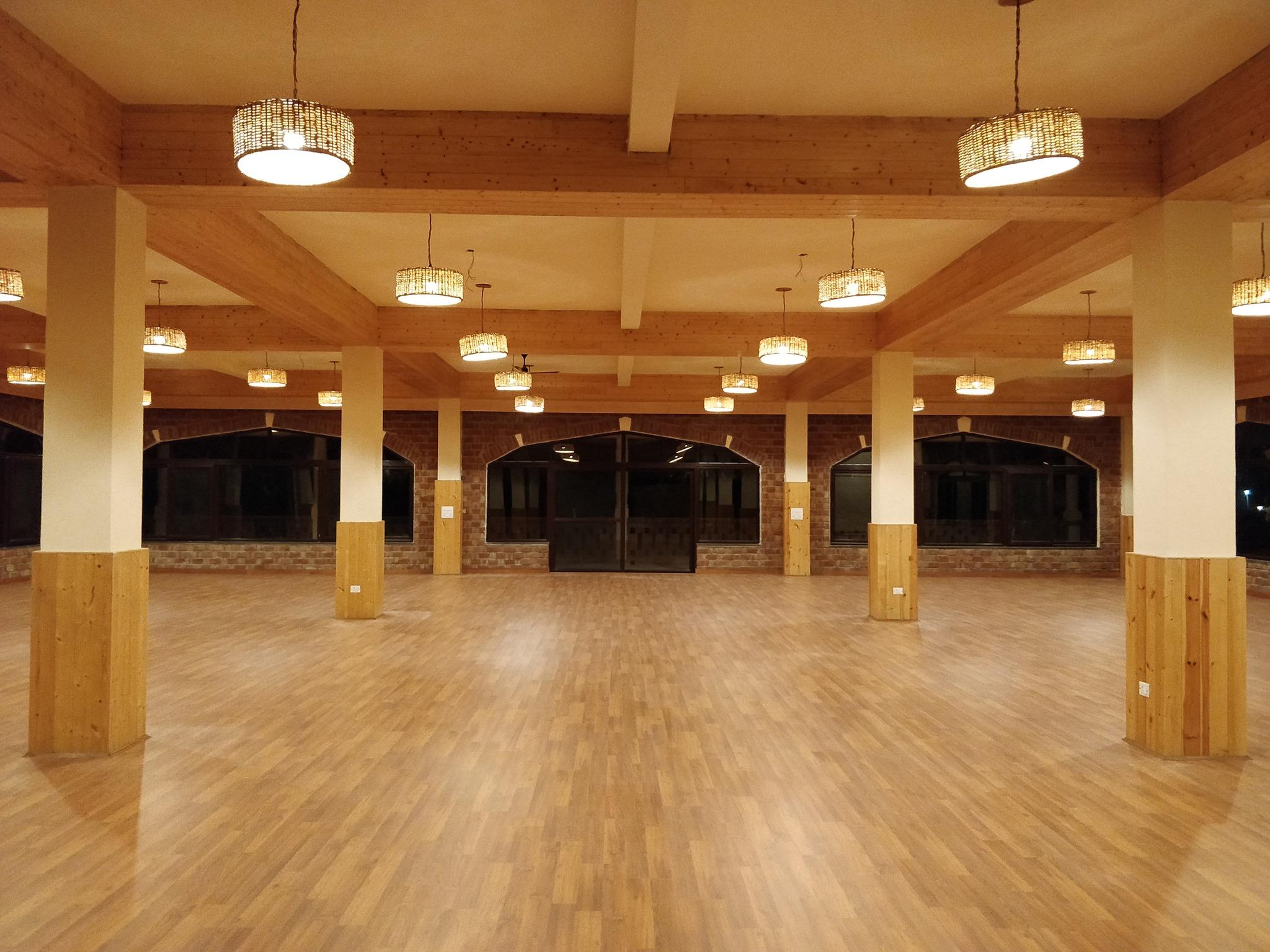
The “New Meditation Hall” is almost complete!

145824594 3956180684425990 3349529488679892369 o

As you all are aware, we began constructing a new meditation space above the existing Meditation Hall at Swami Rama Sadhaka Grama (SRSG) in the summer of 2019. While the world was forced into a ‘pause’ in 2020 due to the Covid-19 Pandemic, including the SRSG ashram, we were still able to continue the construction work for the “New Meditation Hall”. No, we will probably not be calling this beautiful meditation space – ‘the New Meditation Hall’!

We take this moment to share glimpses of this meditation space with you all here and to extend our deep and heartfelt gratitude towards the many loving and generous family members who made this possible. It was the continued support and contributions of many members of the AHYMSIN Global Sangha who helped manifest the vision we had for this Hall. Although the construction in the Hall has been completed, we still have some work left here, including furniture and furnishings.

146307187 3956180534426005 6106495889489411133 o

Moreover, we have begun a major repair and renovation of the Initiation Room upstairs. The false ceiling in the Initiation Room has been removed as it was breaking away. There are plans to replace all the aluminum doors and windows in the Initiation Room and around the Main Building. In addition to this necessary renovation work, we are happy to share that a memorial dedicated to the memory of our beloved Swami Veda has also been planned.

If you would like to contribute towards these projects, kindly reach out to Divya for donations at ahymsin@ahymsin.org.

We are grateful and appreciative of everyone, all our affiliated centers, and all the loving members of the AHYMSIN family worldwide, and eagerly await their return ‘home’, so we all can sit for meditation in this Hall together as a family.

Yours in service of Gurudeva,

Rabindra Sahu (General Manager, SRSG)

[This article also appeared in the January 2021 edition of the AHYMSIN Newsletter.]

146323957 3956183434425715 2229120197756853340 o          145007471 3956182514425807 4386191398999835090 o

Virtual HYT-TTP Workshop, March – April 2021

02 HYT TTPDear AHYMSIN family members,

We are happy and thrilled to share with the entire AHYMSIN community about the first virtual workshop organized by the Himalayan Yoga Tradition – Teacher Training Program (HYT-TTP), between March 20th and April 17th, 2021.

This 40-hour online workshop is designed for all HYT-TTP Students, Graduates and Mentors, as well as any current Yoga Teachers or serious practitioners. Participants will receive credit hours towards Yoga Alliance Continuing Education.

We are excited to announce that the following speakers have agreed to participate:
Swami Ritavan Bharati, Mary Bowman-Cline, Carol Crenshaw, Charles Crenshaw, Paul Emerson, Cynthia Gran, Gary Gran, Daniel Hertz, Nikki Strong, Savitri Jugdeo, Randall Krause, Pierre Lefebvre (Pandit Priyadarshan), Chuck Linke, Stephen Parker (Stoma), Rabindra Sahu, John Sellinger, Ashutosh Sharma, Michael Smith, Sonia van Nispen, Barb Aschettino

Senior HYT-TTP Faculty will provide 2 1/2-hour sessions including live Q&As. Here are some of the topics that will be covered:

· Adhikara: making a wholehearted effort to being a dedicated student of the Tradition
· Integrating your Sadhana into every activity of daily life
· Understanding the purpose and process of the HYT Prana Vidya Integrated Practice
· Using Internal Dialogue and Journaling to deepen your Meditation Practice
· Biomechanics of the musculoskeletal and respiratory systems
· Using Ayurveda to live a balanced, healthy life
· Swami Rama’s principles of Yoga Psychology and Yoga Philosophy
· Knowing the purpose of your life and how to full-fill that purpose
· Steps to Graduate as a 200-HR, 500-HR, and 600-HR HYT Teacher
· Panel discussion on tips for organizing, sequencing, and teaching a balanced integrated class

The sessions will be held four times a week, on Saturday & Sunday morning at 10 AM and Wednesday & Friday at 7 PM based on Eastern Daylight Time (EDT). The workshop session timings will be:

1. Saturday: 3/20/21, 10:00 AM EDT, 2 PM UK, 3 PM Europe, 7:30 PM IST
2. Sunday: 3/21/21, 10:00 AM EDT
3. Wed: 3/24/21, 07:00 PM EDT, 3/25: 8 AM MYT&Taiwan, 9 AM JST&KST
4. Friday: 3/21/21, 07:00 PM EDT
5. Saturday: 3/27/21, 10:00 AM EST,
6. Sunday: 3/28/21, 10:00 AM EDT, (Daylight Saving) 3 PM UK, 4 PM Europe, 7:30 PM IST
7. Wed: 3/31/21, 07:00 PM EDT, 4/1: 7 AM MYT&Taiwan, 8 AM JST&KST
8. Friday: 4/01/21, 07:00 PM EDT
9. Saturday: 4/03/21, 10:00 AM EDT
Sunday: 4/04/21, Easter No Session
10. Wed: 4/07/21, 07:00 PM EDT
11. Friday: 4/09/21, 07:00 PM EDT
12. Saturday: 4/10/21, 10:00 AM EDT
13. Sunday: 4/11/21, 10:00 AM EDT
14. Wed: 4/14/21, 07:00 PM EDT
15. Friday: 4/15/21, 07:00 PM EDT
16. Saturday: 4/17/21, 10:00 AM EDT

Although depending on your time zone it will not be possible for all to attend every live sessions; the recording of each session will be available to all participant afterwards to enable you for replays at a convenient time that works best for you.

To help sustain the Ashram during this difficult time, all the proceeds from this workshop will be donated to Swami Rama Sadhaka Grama (SRSG).

We are recommending a donation of $250.00 for those that live in High-Income Countries, $190.00 for those in Middle-Income Countries, and $125.00 for those in Low-Income Countries. Of course, any additional donations towards the continuity of SRSG will be appreciated.
The registration site will be on Constant Contact and will allow you to pay using your credit card or your PayPal account. Registrations will begin shortly, please stay put for updates.

We are looking forward to having you with us for this unique opportunity to study and interact with the senior teachers of the Himalayan Tradition from the comfort of your home.

In Loving Service,
HYT-TTP Administration

If you are interested in our Virtual Retreat, please send an email to: info@hyt-ttp.com.

What Is a Bhandara?

Our friends and members outside India (or outside the ancient culture areas of Asia, Africa) need the explanation below.

The Sikhs, for example, have a 24-hour ‘langar’ in their gurudwaras (the Sikh temple, literally ‘Guru’s Gate’) where anyone may come and eat. In the World Parliament of Religions that I attended in Barcelona in 2006, the Sikhs had established a ‘langar’ in a large seaside space where thousands of Parliament participants ate three times a day. Recently when Heathrow airport in London was snowed under and thousands were stranded, the Sikhs established a ‘langar’ to distribute food and drink to the passengers.

At all sacred, festive and sorrowful occasions, people are fed in a worship context and form.

It has to be borne in mind that this is not a ‘social’ celebration, but a worship offering to God whose “temple you are”. It is done with that sense. For the purpose of bhandara, that worship attitude, mood and mien is maintained. The yajamana (one offering the worship) chooses to serve the food to the entire line of ‘human deities sitting in a line’ with the help of others. If s/he cannot be present, those who serve do so on his/her behalf.

Many Ashrams in Rishikesh and Haridwar depend entirely on the concept of daily bhandara offerings by the devotee members.

A bhandara offering is made, just a few examples here,

• To commemorate the dear departed ones

• To celebrate a wedding or a birthday

• To celebrate one’s initiation anniversary

• To complete 40-or-such days of silence

• On guru-purnima or any other sacred day

• At the end of, or even every day throughout, a purashcharana by fire offerings

• And so on.

We are now encouraging all our members and friends to offer a bhandara to the Ashram on their birthdays or initiation anniversaries.

In the western countries (and some modernized levels of Indian society nowadays) a person celebrating a birthday receives gifts; in India s/he gives gifts. The kings and other well-to-do people would often do tulaa-daana (literally ‘scales donation’). One gets oneself weighed on the scales, oneself sitting on one pan of the scale, and the other pan filled with grains, coins, silver, gold or even gems – whichever of these one can afford. These, equal to one’s weight, are distributed to the poor, needy or the sacred personages.

The average cost of one meal served at the Ashram comes up to approximately three thousand rupees, that is, plus-minus $70.00. That is for nearly one hundred people in heavy season of the Ashram, fifty people in light seasons – averaged out.

If you wish to earn the punya (good karma) of offering one whole day’s meals, the cost will be, say, 9000 rupees or $210.00.

I look forward to many friends of our Ashram earning this punya, this good karma.

One may do a sankalpa (sacred resolve) to commit oneself to making such offering every year for the next five, ten, fifteen or twenty years.

Please reach out to  ahymsin@gmail.com for donation enquiry.

Action and Inaction in Bhagavad Gita

Excerpt from the Perennial Psychology of the Bhagavad Gita

4:16: What is action, what is inaction? Even the wise are confused in this matter. Therefore I shall teach you concerning action, knowing which you will be freed from the foul world.

4:17: One should learn of action; one should learn of action that is opposed to right action; one should learn of inaction. The reality of action is deep.

4:18: He who sees inaction in action and who sees action in inaction, he is the one endowed with wisdom among human beings. He is joined in yoga, a performer of complete action.

Even great leaders and heroes sometimes become bewildered in deciding between right action, action that is opposed to right action, and non-action. When faced with a decision, how is one to determine which is the best response? Perhaps the action one chooses will have an effect opposite to what is anticipated and will create conflict, disharmony, or grief. In that case is it better not to act at all? Such questions occur to every person many times each day, although the process of considering these choices is so subtle that one may not be aware of it. If one does not know what the right action is, his mind starts pondering over the possible negative consequences of the actions he is considering. That can result in uncertainty, confusion, and loss of willpower. Indecisiveness, delay in deciding, and the fear of making a decision are unhealthy and painful. In such cases it is buddhi that needs training. If one is prone to be hesitant and uncertain in deciding how to act, the decisive factor of one’s internal organization (buddhi) should be sharpened so that it can promptly and unhesitatingly advise the mind and enable one to make a timely decision. Right action, of course, is always best. Action performed in a state of tranquility with non-attachment is always the right action. Contrary to that is action committed in a deluded state of mind, but even worse is inaction. A suspicious, doubtful, and deluded state of mind inevitably leads to injurious action. Action that is undertaken without having the counsel of the decisive faculty of one’s internal state is injurious action.

Many people are overly cautious and afraid of taking action, so they become inactive. Inaction makes one inert and is worse than wrong action. During the period of inaction one appears not be performing actions, but he is actually reacting adversely to the situation he faces. He is in a sort of negative withdrawal that leads to slothful ideas: “Why do I need it; why should I do it; I can live without it; I’m not capable; therefore I should not even make an effort to do it.”

Inaction is a result of the influence of tamas. In vikarma, action that is opposed to right action, rajas and tamas join, but rajas is predominant. Rajas makes one active, but without sattva one remains deluded. It is actually the sattva quality that keeps the mind tranquil, and action performed in the state of tranquility is right action.

One who has disciplined himself, trained his senses, and attained a concentrated mind that always seeks the counsel of buddhi does not commit mistakes in performing his actions. He surrenders the fruits of his actions willingly for the sake of others. Such selfless action has two benefits: the fruits of one’s actions do not bind him, and his action becomes a form of worship, meditation in action. The yogi goes on performing actions with a tranquil mind and always remains free from the bondage of action. For him there is no self-interest. All his actions are motivated by selflessness, and he is free.


Heart of Wisdom – Mindful Generosity

Today give a little more than you have given before, and love just a little bit more.

I want to see you expand your capacities. Becoming just a little larger than you think you are and see what fun that is. Just a little larger. Love just a little bit more. Try to open the door to your heart.

Are you afraid to use your key of volition? A sweet fragrance will come and touch you. With this start, with this sweet fragrance of volition, decision, expansion, your heart center opens, and you want to open just a little bit more.

Make a start today and give a little more than you have given before, and love just a little bit more.

With blessings of gratitude, Om
Swami Ritavan Bharati


Editor’s Note:

This was also published by The Meditation Center in Minneapolis, Minnesota, USA.

Reincarnation, Karma, and Samskaras

Going back to the subtle body and reincarnation, we understand by now that the human personality is an envelope for the spiritual life-force. The force does not change; the envelopes change. Therefore, I was never born. I shall never die. What will happen is that I will come into a fresh body; incarnate, into flesh. I’ll put on a new envelope of flesh again, re-in-carnation. But I was never born. I shall never die. I cannot imagine a time when I was not. I cannot imagine a time when I shall cease to be. I came into a tiny something of sperm and ova, and they became fertilized. I remained there, so they grew. I lent them my life, radiating it throughout their bodies. So it became a fetus; it became a child; it became a woman; it became a man, remained a woman or a man. I shall go my way. This body will be dead. It will be cremated. It will be buried. It will be disposed of, but I shall remain. Now I have put on an envelope of mental personality. That mental personality rests in my subtle body. We understand by now what the subtle body is. It is not a body shaped like this. It is a composition of various forces around my being. My eye-consciousness, ear-consciousness, my pranas, my mind, my faculty of intelligence and discrimination, all of these are finer than the physical body, but grosser than the pure Spirit.

So in this subtle body we have what we call the karmashaya, the storehouse of karma. What is the storehouse of karma again? It is that aspect of ourselves into which all our actions, all our experiences are stored as the residue of experience. By now we understand that every moment we are forming an ever-new personality. At this very moment that you are sitting down, you are adding certain factors, certain elements to that personality. You are doing your karma. Sitting here listening, you are doing your karma. Lying down, sleeping, you are doing your karma. What karma are you doing? You are doing tamasic karma. One-third of the sum total of your life, one-third of the sum total of all your impressions and experiences for a lifetime is sleep. So that is why the yogis try to reduce their sleeping hours. It’s very hard, I tell you, but they do try to reduce.

So, all of this karma is gathered there. Now how does the karma operate? The kind of person you are, that kind of circumstances you attract to yourself, that kind of magnet you become. If you want to change your circumstances, change your personality. If you want to change your situations, change your personality. Changing the actions externally will not help. A total transformation of personality is required. If you are not loved; therefore, become loveable. It’s as simple as that. How do you become lovable? By changing your karma. By changing the sum total of your personality through your thoughts, through your words, through your actions, what you absorb, what you give out. Your situations, surrounding, circumstances, relationships, everything, comes to you in a given form because of the potential of the forces inside you. What you are, that you will draw to yourself.

You can ask, “How does it happen?” This is where the karma philosophy is different from the system of reward and punishment. Yoga philosophy does not believe in reward and punishment. The term we use for this is ripening (vipaka) of the seeds and the fruits. The seeds you have sown in the soil of your personality ripen and bear some fruit for you. That is why the Bhagavad Gita says, (Sanskrit) “Whatever your thoughts are, that verily you are.”

How is it that we draw those circumstances to ourselves? Do the Gods stand over our heads waving their sticks and say, “I’ll beat you if you don’t believe in this and this manner?” No, that is not so. There is one thing in you (one of the four aspects of mind) that is called the buddhi (the faculty of discrimination). Buddhi has two faces: an intellectual face outward and an intuitive face inward. Now if I cover the mirror of my mind with black soot, will it reflect light? It will not reflect light. If I cover it with tamas, will it give me clear directions in traffic as to how I should move, how I should go? It will not do that. If it is colored red with rajas, the direction it will give will be a rajasic direction. If it is covered with sattva, the direction it will give will be a sattvic direction. So the texts say that according to your karma you start your momentum in a different direction. And when you come to a crossroads where you have to make a decision, your colored buddhi becomes like that. You reach that kind of conclusion.

A sattvic person placed in a certain circumstance and a rajasic person and a tamasic person placed in the same circumstance will draw three different conclusions and will take three different directions. The sattvic person’s direction will lead him to happiness, joy, and success and love. A rajasic person will excite, agitate, create conflicts, create schisms, create differences and divisions and divisiveness for himself and for everybody else, bringing a lot of struggle, intrigue, conspiracy, all of that. And for a tamasic person, nothing will happen. He will just sit there, a dullard, and say, “What can I do? I can’t do. I’m stuck. I can’t move. I’m depressed. I’m finding no direction. The light isn’t shining. Where is that light you speak about? It just doesn’t happen. Nothing happens.” The tamasic person remains stuck there.

So buddhi is the key to your circumstances. Keep your buddhi clear. Add those things to the sum total of your personality which will make your personality a sattvic one, a clear one, a pure one, so that when the time comes, right things can reflect in it and lead you in the right direction. Although you say at that time, “I’m making a free choice,” the choice is not free as you think. It is a result of the whole momentum you have given to your personality. You could not do otherwise. Krishna said to Arjuna, “Arjuna, you don’t want to fight, but even then, what today you don’t want to do, you will soon find yourself doing.” So your nature will drive you to it. So people say, “I’m not getting along well here, let me go elsewhere. I think that will solve the problem.” But in any situation, there are two factors: the other person and you. So half of that situation you are still carrying with you wherever you go, and that half will find its complement. Only your mind will have become much more confused because of that escape. You’re not getting along well with one girlfriend or with one boyfriend, so you drop away and say, “I think I’ll go to California for six months and forget the whole thing.” You go to California and find yourself in exactly the same confusing situation. You will find a relationship that complements your personality because your choice is determined by the kind of person you are. And what kind of person are you? You are whatever you have added to your personality through your karma. This is the whole mechanism of karma. So karma is not fate. A lot of times people use the word karma as if it was predestination, as if it was fate and they say, “What can I do? My karma is like that.” Predestination is a doctrine in which you can do nothing against that destiny. In the doctrine of karma, however, you can change your personality. What you have done so far will remain there, but you can change the sum total from this moment on.

We have spoken of three kinds of karma: prarabdha, sanchita and kriyamana. Prarabdha actions are the ones already initiated, meaning initiated in a previous life. Put it this way, this present life of mine is a life after death. People ask me, “Do you believe in life after death?” Of course, I am in a life after death. And I am also in a life before birth – my next birth. So I’m living the life after my last death and the life before my next birth.

Now, there is one principle: For every action in one direction, there is a reaction in the opposite direction. This is Newton’s third law of motion, the first rule in aerodynamics: For every action in one direction, there is an equal motion in the opposite direction. Spiritually, the law is for every action in one direction, there is a reaction in the opposite direction. There are certain laws which apply to all sciences. I call them cosmic laws. And the Law of Karma is one such cosmic law.

Now, let’s say that at this time I am a very bad man. I go and blind somebody in his eye. It’s a cruel deed. I have hit him, I have hurt him, and I am here quite sound and very well and happy and healthy. Now what happens is that that action boomerangs. How does it boomerang, how does it create a reaction? In my subtle body is my eye-consciousness, my potential for sight, and I relate to all eyes in the world from that potential. It is not possible for me to relate to anybody’s eye except from that eye-consciousness. So when I resolve upon blinding somebody in the eye, I first put tamas in my eye-consciousness. I block my eye-consciousness. Through that action that went outward something happened first inward. My eye-consciousness in the subtle body became covered with tamas, with darkness, with a negation. You would say then, in that case, I should immediately go blind. The doctrine of karma answers “no,” because there is a also a previous momentum of other actions because of which I shall enjoy continued good eyesight. And that momentum toward good eyesight has to be exhausted; that karma cannot be cancelled, so I’ll continue to see. But when I blinded somebody, I also set into motion a new cycle in the wheel of karma. I gave it a new direction. I added a new factor of darkness into my personality. I have blocked my own inner spiritual eye-consciousness.

Now when a person is dying, what happens? He’s moving from his house. When you are moving from your house, what happens? You lived in a house for twenty-five years, and you start clearing the place and you see the old broken-down doll. You see a kerchief you had lost ten years ago. You find a shawl you thought you had given away. You see chairs with three legs. You say, “My God, I didn’t know all these things were lying here in my basement and in my attic.” So in the basement and the attic of your subconscious, in the basement and the attic of your karmashaya (the storehouse of karma), all this is lying from a whole lifetime. You often see when people are dying, that sometimes they say all kinds of strange things, and others say, “Well, he’s talking nonsense. He’s losing his senses.” He’s not losing his senses. He’s making quite enough sense to himself. At the hour of death, your entire life comes before you like a cinema screen, the whole sum total comes forth. Everything that was lying hidden, you come face to face with it. The kind of life you have led, that kind of death you will have. And the kind of death you have, that kind of next rebirth you will have. So the shell of your physical body is left behind, but your subtle body goes with you with the sum total of the entire karma wrapped up in it. So there is a dictum that whatever a man’s last thought is, that will be his next birth. So somebody raised a question in Esquire magazine in a very sarcastic article several years back and said there were some ladies sitting down discussing that if a person’s last thought was of his pet cat is he going to be born a cat? And the answer is “no.” The question is: What determines his last thought? Your next birth is determined by your last thought. But what determines your last thought? The sum total of your life is your last thought, is the act of packing and going away.

So this sum total now determines three things for your next life. These three things are called jati, ayus, and bhoga. The species in which you should be born is jati. Ayus is the life span you will have in that species, in the number of breaths. And bhoga is the kind of pain and pleasure that will come your way during that life span in that species. If, for example, my last life had in the sum total of the karma, let’s say, half and half of good and bad, then I have a fairly good chance of being born a human being. Not a very high class human being, not a very wise human being, but a human being – how long would I live, and during that life according to the momentum given from the past karma, what sort of pains and pleasures and circumstances I would have. Now this is known as prarabdha karma, something already initiated even before you are born in this life, already initiated from the past life – the momentum that you bring into your present life from a past life.

When the Indian astrologers, for example, prepare your chart, . . . Did you know our names in India are given on the basis of astrological combinations? Even here some initiate names are given from the moment of initiation. Not many, I don’t do that. There’s somebody else I’ve taught to do that. The moment of initiation, the astrological combination of that time determines the first syllable of the name. But leaving that aside, they will write and say this, at the time of this person’s birth, this was the planetary combination, this was passing through this phase, it was in the third sector of the phase. He has already gone through the previous two sectors of this phase in his previous life. So something is already initiated and comes into you when you are born. What kind of family you will be born in, what kind of parentage you will have, what karma your brother has, what karma your sister has, what karma you have, the combination of all those factors put together makes a family. What is a family but the collective karma of so many souls brought into balance. In this circumstance through you, your brother will receive this fulfillment of his karma, and through him you will receive this fulfillment of your karma. All the circumstances are put there, that’s called prarabdha. Some people are born congenitally blind. Why? The scientists will say, well, because of something hereditary, something in the cells, something in the chromosomes. I say that answers how, but not why.

Question: How can a very short life be explained?

It is the same thing. That was how much you had to finish, that’s all. That was what you had to give to others. That was what you had to take from others, no more. Your debt is paid. To them, their debt is paid to you. If you caused a great deal of emotional unhappiness to somebody in this life, you will have to pay it back, there is no escape. You will pay it back. So just don’t cause unhappiness. Don’t cause unhappiness. That debt will come back and visit upon you. You will say, “That’s really hopeless now! Something I can’t even remember, and I have to suffer for it.” Number one, thank God you don’t remember. The painful memories of one lifetime are more than enough that you can handle. If you could remember all the painful memories of all the relationships of all the previous incarnations, you wouldn’t be able to bear it. Reincarnation is also a purging. Let the momentum exhaust itself, but do not create a new memory, because each memory creates a momentum. So forgetting is a way of stopping that momentum. Don’t try to remember your past lives. There is no reason for you to go and visit all kinds of mediums to find out what you were the last time, what your husband was, and what he did do to you that you had to be stuck with him, and so forth. Because each time you awaken a memory, you create new momentum. So wiping off the conscious memory in the process of reincarnation is a karmic blessing. You would say then, “Do I have no other recourse then? Do I have to keep suffering and blame my previous karma?” The answer is the second category of karma which is sanchita, which is the karma you have gathered in this life so far. And the third category, kriyamana, is the karma over which you have control now about your choices. So some karma you brought from the past life, some karma you have gathered in this life up to now by your choices, and some karma you can start gathering at this very moment. I am speaking these words. I’m gathering karma. I am completely free to do my kriyamana karma now and leave the chalk and walk away. You have the same choice. So you want some things in life. Then channel your personality. You want to know what your life will be like, check on your sanchita karma. What have I gathered so far? If you don’t like what you have gathered so far, you have recourse in the kriyamana karma. Decide from this moment on to gather right things into the sum total of your karma and work on a five-year development plan: “Five years from now I want to be this kind of a person, and I want to be in such-and-such kind of situation.” Add those kinds of things to the sum total of your personality, plan it out, plan your action, plan your thoughts, plan your words, plan your tendencies, plan your attitudes, plan your handling of circumstances and take control of yourself, and you will change the momentum.

Now nature has a way of balancing itself. By those very acts with which man has threatened the extinction of other species, he has also threatened the extinction of himself and the reduction of his own number. So somewhere the balance will strike. If you will not control yourself, some forces will control you. There are mechanisms in nature. Certain animals need so many acres per individual of the species. Whenever the number reaches higher than that, either they stop reproducing or they just destroy the weaker ones, or something happens. You see that happening in history. Civilizations have been destroyed through causes unknown to those civilizations. Did Augustus Caesar or Julius Caesar ever think about how the Roman Empire would end? The forces are outside your control balance if you do not control your own forces. You made this country go so fast and have cars and this and that and everything at a grand time. Now forces outside your control are forcing all of us to cut down on the energy consumption, slow down the car, find new ways of transportation. Something has got to happen. There is one simple principle: Whatever you want to avoid getting from others, take it upon yourself by your own choice. If you know you are going to be robbed, give it away beforehand. You will at least have the happiness of having given something away. And if you are robbed, then you lost the thing and you don’t have the happiness.

The doctrine of predestination means that God might say, “Thou shall be a robber.” Therefore, in this life you are a robber. But, actually, this karmic destiny you have made yourself. And you can make a further destiny for yourself from now on because nobody else is in control of it. People ask, “Can you change your past karma?” With an average person it is very difficult, but you can do a number of things with it. You can diminish its force by using that experience for a change of attitude, by using that experience as a means for your growth. You can even impose certain expiations on yourself so you don’t have to go through that karma involuntarily. Sometimes there are mantras, and you will get a certain mantra, and you have a series of accidents, but you won’t get hurt. Or a number of such things will happen in a very short time. Many things that would have to happen over a number of years will all accumulate within a period of six months, and you’ll say, “What’s happening to me?” So there are many different ways of handling that karma. There are certain mantras, certain expiations, certain other ways. And then slowly, just as through your meditation, you gather the strength to withstand the ill effects of a bad karma. You can also reach a point where sometimes the gurus take over your karma too.


Editor’s Note

This article is a transcript and excerpt from the lecture entitled Reincarnation, Karma and Samskaras (1976) by by Swami Veda Bharati before he took Saṃnyāsa, when he was known as Pandit Usharbudh Arya.

Souls of Light & Love

 O how we have suffered
the pangs of hunger and thirst,
the sun beating down,
the darkness so thick
that you could stick a needle in it and not penetrate it.

Such darkness seems to envelop this Divine Being,
which is not meant to be enveloped by darkness –
and yet how we have suffered!

We who are Beings of Bliss,
we who are a Spark from Fire of the Eternal Joy of God.

We suffer many pains. When we are as a fetus,
we lie in darkness as though the Consciousness is asleep,
not knowing what fate is to befall us,
not knowing what shape is to be given to us.

The passage through the birth canal is painful.
Coming to the glaring lights of the world is painful,
and we cry miserably.

The process of growing is painful,
for each time we seem to have to leave a little self behind
to begin to gain a new grown up self.

How often we scrape out knees!
How often our weak ankles betray us!
How often we are baffled by the mysteries
of logic and rationality around us!
How often we suffer the pains
of uncomplete and unfulfilling relationships!

We seek to escape.
We seek to run.
We seek a refuge.
We seek a haven.

Where?
Where is there somewhere
a relationship that will be lasting,
that will be permanent,
that will be peaceful,
that will be complete,
upon attaining which, I shall seek no more?

Is there gold that I will find,
after which I shall seek no more treasures?

Is there a light,
a single flame, upon finding which,
I shall no longer be in darkness of my own nature?

Is there is source of holiness
that will make me holy,
that will make me pure,
that will free my limbs from the process of aging?

Is there consciousness
in which I am not male, I am not female,
I am of no nationality, I am of no planet, I am of no name –
but all names are mine?

From one end of human history to the other,
even from the future prophets,
even from the future sages,
there reverberates, as of the past ones and the present ones,
a cry, a shout that is loud enough for galaxies to hear,
but our hearts and souls are shut

Open the doors of your heart and listen.

They say,
“That treasure, that gold, that light, that joy that you seek,
that refuge that you would rather find
is nowhere else but within you.”

It is here!
It is now!

Only your will, your volition, has to make a resolve
to cast away this mantle of darkness
that you have artificially placed on yourself.

And as you close your eyes in meditation,
gradually a Dance of Seven Veils begins.

But all you need is aspiration.

Aspire and you will be inspired.

And where there is darkness,
where the path seems lost,
where the way seems confused,
there will shine the Light of Enlightenment.

And enjoy your Self.
Enjoy this Peace.
Enjoy this Light,
and
God Bless You.


Editor’s Note

Swami Ritavan Bharati shared this poem by Swami Veda Bharati on Diwali – 2020, along with his own Diwali Message – 2020.