Yoga Sleep

One doesn’t usually think of yoga as having anything to do with sleep. But, in the Himalayan Tradition of Yoga, an important practice is known as yoga nidra, yoga sleep. Let me tell you a story about yoga nidra.

Swami Rama’s Ashram, Sadhana Mandir, sits along the bank of the River Ganga, a mile or so downstream from the city of Rishikesh. I was there, assisting Dr. Usharbudh Arya (who later took sannyasa — renunciation— and then became known as Swami Veda Bharati) with his work. This was in the 1990s. At that time, the great Himalayan master Swami Rama was still roaming the world and lived in a two-story apartment building on the land, and Dr. Arya lived in a similar building further into the ashram. I spent many of my days and evenings at Dr. Arya’s apartment. Downstairs was the kitchen and place where we ate. Most of the activity occurred upstairs where Dr. Arya had a couple of rooms, one in which he slept and the other where work occurred and where he would meet people who came to visit him.

At that time, I often assisted him on the computer, taking dictation, writing letters for him, organizing his files and other things like that. There was plenty of work and I loved being part of it.

Dr. Arya was a master of yoga nidra. In yoga nidra, the body is completely relaxed, and the brain produces deep delta waves (which can be measured by scientific equipment) — the same brain waves as produced when in deep, dreamless sleep, except the person is completely awake and aware. When the rest of us are in that state of sleep, we are unconscious. But not the one who is in yoga nidra.

Dr. Arya would stay awake very late into the night and into the wee morning hours writing, reading, and other work, while the world slept. Then he’d go into regular sleep for about two hours. He said that that two hours of deep dreamless sleep was required to maintain the body. After that, he’d practice two hours of yoga nidra— just two hours of regular sleep plus two hours of yoga nidra gave him all the rest he needed. He would then rise and do his regular morning meditation at 8:00 a.m., followed by breakfast.

Whenever he might feel tired, Dr. Arya would again practice yoga nidra. Often, I’d come to his apartment in the afternoon and find him “sleeping.” The quotation marks around the word “sleeping” are because he was usually in yoga nidra that time. I knew from experience not to say anything near him that I didn’t want him to hear when he was in that state because he would hear everything. Not that I was keeping any secrets, but I still kept this in mind. He also asked us to not whisper to try to keep him from hearing us because he’d hear the whisper and I imagined he’d wonder what we were whispering about.

Besides being restful, the state of yoga nidra opens the inner gates to creativity and memory and one can learn very quickly. Dr. Arya said that he taught himself English practicing yoga nidra during the nights while he was in Germany at one point in his life. I personally witnessed his amazing use of yoga nidra for learning when, one time, I accompanied him (actually, by then he was known as Swami Veda Bharati) to Italy. He was scheduled to give a talk there the following day. On the evening before his talk, he lay down and went into yoga nidra and one of his students, who spoke both fluent English and Italian, read him an hour long talk in Italian. Swami Veda had written the talk, the disciple had translated it into Italian, and then slowly read it to him. He read it to him only one time. The next morning, Swami Veda stood up and gave the entire talk in Italian from memory. I was astounded.

Swami Veda’s mastery of yoga nidra was profound. One time, when he was in California leading a retreat, we were at the campus of IONS (The International Organization of Noetic Sciences), where the faculty studied the spiritual sciences and wrote books. While there, one of the researchers hooked Swami Veda up to instruments to measure his brain waves. My spiritual brother Stephen Parker (aka Stoma) was there and later related what happened: Once Swami Veda was hooked up, the researcher had a shock. Although Swami Veda was sitting there, looking wide awake and carrying on a conversation, the electronic instruments showed he was having slow delta brain waves—the waves produced in deep dreamless sleep. Swami Veda was literally conversing while in yoga nidra.

Although Swami Veda was a Master of yoga nidra, the state is also available to the rest of us. Like any discipline, if we practice, we can learn and gain in ability. Recordings in Swami Veda’s voice are available that will lead one through the practices that take one to the threshold of the state of yoga nidra and perhaps beyond. If you are interested in learning, contact AHYMSIN for information on how to obtain copies of these recordings.


Editor’s Note:

Randall Krause (Mokshadeva) is a Senior Teacher and Mentor in the Himalayan Yoga Meditation Tradition. He spent years learning closely from Swami Veda Bharati, and time personally attending to Swamiji in India and elsewhere. He has taught the Himalayan Tradition in the USA, Europe, India (at Swami Rama Sadhaka Grama), and in Thailand and Taiwan.

Tamaso-ma-jyotir-gamaya: Jyoti Meditation

Editor’s Note:

October marked the inaugural opening of Swami Rama Sadhaka Grama for all our family members from around the globe. Swami Ritavan Bharati, our Ashram Pramukha and Spiritual Guide, used this occasion, following the pandemic years, to gather an international audience with the theme of Yoga Nidra.  The weeklong retreat offered many themes and practicums on Yoga Nidra along with special meditations guided by Swami Ritavan.

This meditation was adapted from the archive of meditations by Swami Veda Bharati. The practice below is shared to offer the initiates of the Tradition a glimpse into the vast collection of special meditations guided by Swami Veda. If you would like to incorporate this meditation within your daily practice, you are requested to kindly reach out to your mantra initiator and/or the AHYMSIN Spiritual Committee for personal guidance.

Swami Ritavan also shared an audio recording of a guided meditation on “Om-jyoti”, which can be heard here:


OM; Tamaso ma jyotir gamaya…Lead me from darkness to light, lead me from darkness of ignorance to the to enlightenment! Let this become a prayer encompassing your entire heart and mind; an affirmation: jyotiraham, jyotiraham, jyotiraham. I am light, I am light, I am light!

Tamso-ma-jyotir-gamaya


Sit in your meditation posture. Your spine is the central mountain of the Universe. The central pole of the universe. The point from where you and the universe begin and end. Fix your spine – steady, motionless, erect. Bring your awareness to the asana, the seat you’re sitting on. Worshipfully surrender this seat and offer it to guru parampara, to guru lineage – may they come and meditate on this seat.

Your body, a temple of God, constructed of configurations of light. Know it to be thus. Learn to worship in this temple that is made of light – the divine light of divine Consciousness, the emanation of your Atman, your spiritual Self.

Let all your muscles & joints, your neuromuscular system relax so that no tension is blocking the free flow of light.

Established the breath from the seat of prana, at the navel center, with deep diaphragmatic breathing.

Your breath Deepening and Expanding flowing gently, smoothly, unhindered through the entire body.

The whole body breathing from the crown to the adhara and asana, this seat, and from your adhara to the crown, through this entire body.

This space, your body occupies, becoming a configuration of light.

Your breath awareness flowing through this illumined space.

Where now, within that illumined space, a resonance begins silently resounding with Om Jyotihi, Om Jyotihi, Om Jyotihi,

The sound, breath, light, filling this sacred chamber of your being.

‘Om Jyotihi, that Light’, this entire chamber as light and resonance, a single presence of illumination-Jyoti as mantra and breath flowing as one……. keeping to this dharana, moment to moment.

Now, gather this awareness of Jyoti as light and resonance into your field of prana life-force in the nabhi [navel centre], your Manipura chakra.

Within this navel center of consciousness, observe this awakened illumination as mantra-filled breath, breathing through the naval center.

And, now from the navel center to the nasagra [the point where the base of the nose bridge meets the upper lip] and upward to the center between the eyebrows.

This beam of light as mantra and breath flowing from the nabhi chakra, the navel centre to the Ajna centre [eyebrows centre] and back again.

The flow as a beam of light & soundless mantra, the jyoti-mantra ascending and descending as a streak of lightning between the nabhi chakra [navel centre] & the Ajna chakra [eyebrows centre] without a break.

No longer a body with limbs and organs, your consciousness resting in pure awareness, as the flow of this celestial and divine stream. Continue with ajapa-japa [effortless remembrance of the mantra]: OM JYOTI, OM JYOTI, OM JYOTI.

Let this kriya be easy and natural, maintaining the dharana for as long as one may.

May the guru parampara continue to bless you.

Gangotri Sadhu Seva

Om Gurubhyo Namah

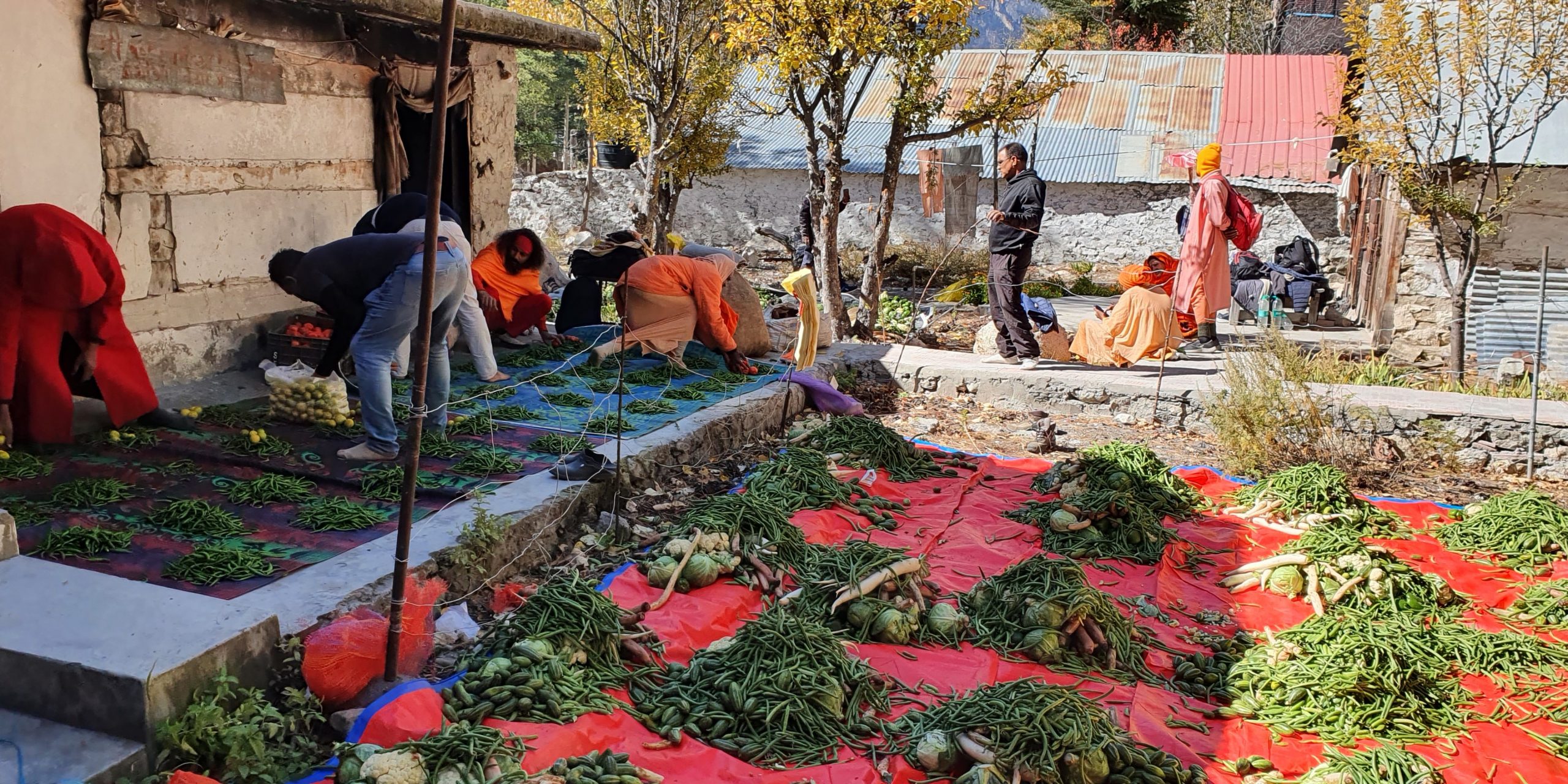
A lesser known fact to me until last year was that our beloved Swami Rama, decades back, has started the service of donating food, grocery, vegetables, clothing etc to the sadhus, sadhakas living at Himalayas to survive the winter season as they don’t get access to these during this time. This service, with so much of love and care is still continued by the ashram with greater efforts in terms of planning and execution of the service. What an endeavour it is!

On 2nd of Nov 2022, a team of 7 people started in two vans carrying all the needed stuffs from ashram to Gangotri. It was a 3-day trip in total covering 600Kms altogether.

Gangotri


In the scriptures it is said that the sadhakas keep traveling to the source of the river while they keep progressing spiritually as a sign of going to the roots. We all were travelling to the source of mother Ganga to meet those sadhus and sadhakas and offer the noble service started by Swami Rama. Ganga, the mother of all rivers, was flowing along-side the road, in between the mountains, and when eyes were closed, She was flowing inside. The scenic beauty, snow peaks were a visual retreat to one’s eyes which silences the mind without any effort and one is at peace. What a scintillating trip indeed!

We stayed at Harsil on day 1, a town known for apple plantations, 25kms ahead of Gangotri. Though it was freezing cold at night we started around 6am the next day from the hotel with all excitement for the service. Having reached Gangotri around 7.30am, we started unloading items from the two vehicles to bring them to Mauni Baba’s ashram. The ashram is shallow deep in the valley and the vehicles stopped on the road. It took almost 5 hours for 7 of us to unload, categorise and arrange the stuffs, a humongous task.

Gangotri


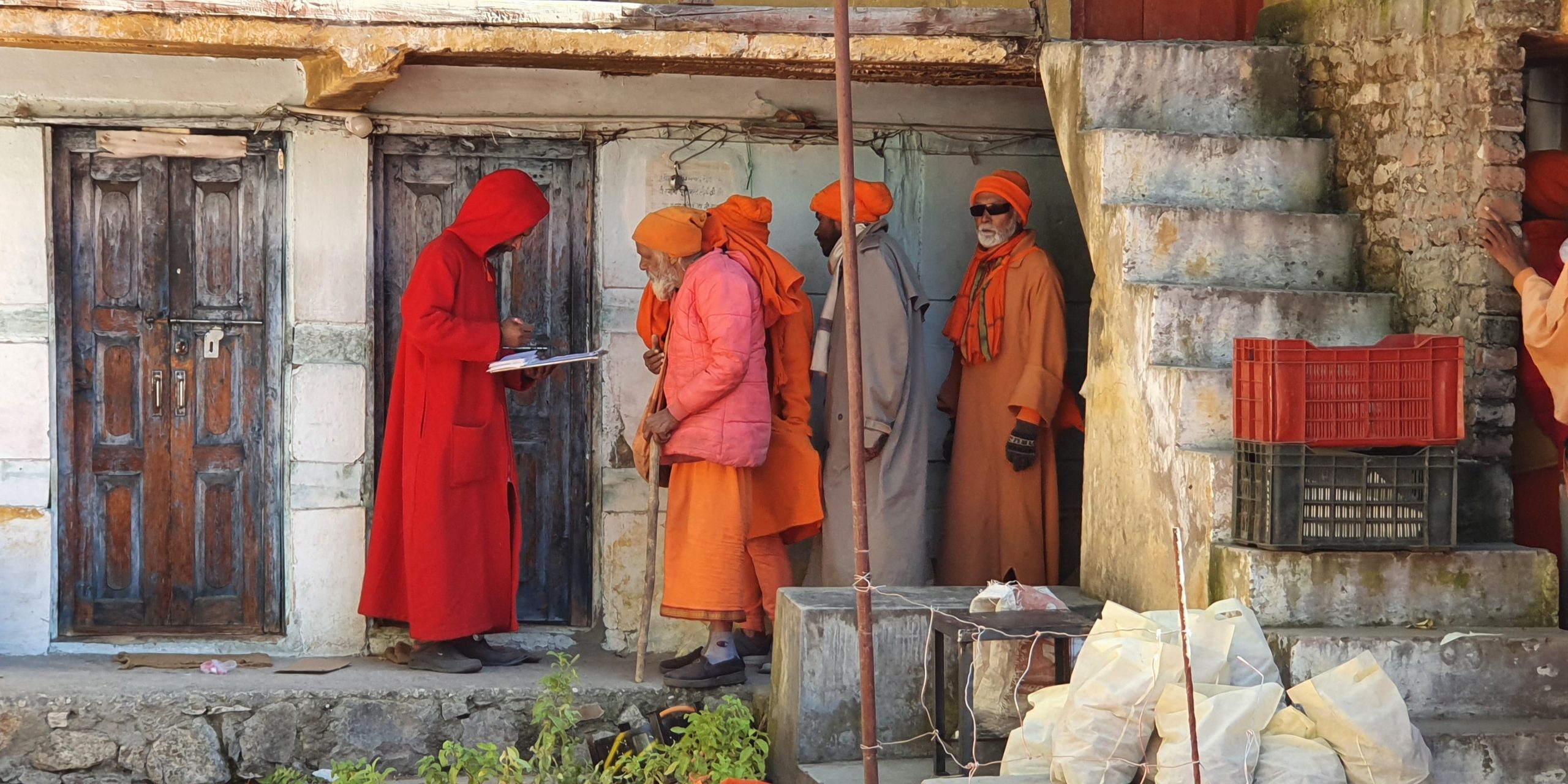
By noon, Mauni Baba in complete silence started distributing stuffs to sadhus who arrived in. He in-turn had put in tremendous effort in-terms of collecting the requirements from the needy, passing it on to ashram, distributing the same with all check and balances. Terrific efforts were put in by Rabindra Ji, Surendra Ji, Pt. Kushalananda Ji & Pt. Deepak Ji. They had all the highest level of energy to accomplish this toughest task with all smiles. What an inspiration they are!

Gangotri


On our way back, day 2, we stayed that night at Uttarkashi and the next day (day 3) early morning, we visited Kashi Viswanath temple and offered our prayers and started back to ashram.

Thoughts were still lingering around Gangotri, the snow peak mountains that surrounded us, the frequently changing weather, the soothing melody of the passing by river, a group of sadhus & practitioners, smiling, helping each other and receiving all the needed stuffs, the scent of the plants and trees in the surrounding, the prasadam etc… It was a great treat for the 5 senses for lifetime. These evergreen moments captured in the memory will be there till the last breath. Just remembering of this experience now, pulls in all the 5 sense inward takes into a deep meditative state. What an overall lifetime experience and opportunity it was!

I sincerely thank Swami Ritavan Bharati Ji, Rabindra Ji and Divya Ji from the bottom of my heart with all gratitude for this opportunity and also on behalf of my friends who joined the trip in person and on-behalf of those who contributed.


Editor’s Note:

Gopalakrishnan Venkatesan has been associated with the Swami Rama Sadhaka Grama ashram and the Himalayan Tradition for many years as a student. He lovingly offered his services to the ashram and redeveloped the new AHYMSIN and Swami Rama Sadhaka Grama websites through his web development company – SolutionChamps Technologies.


Speaking from Relaxation

Over the more than 30 years that I’ve been an initiate in the Himalayan Yoga Meditation Tradition, at times I’ve ventured out and attended hatha yoga classes at commercial yoga outlets. Often at those classes, I encountered teachers who shouted instructions like circus barkers or gym instructors. Not only did I feel agitated by those teachers’ tense voices, but I also wondered if those classes were in circus training rather than yoga. People were literally jumping into headstands and very challenging postures without awareness. I thought of those classes as Ego-yoga: yoga to expand one’s ego.

But Himalayan yoga, which I was learning, is meant lead one away from identifying with ego, and to oneness with the real Self. Expanding the ego is not part of the Himalayan program.  What is taught in the Himalayan Tradition combines both energies of hatha yoga: Ha (the solar energy of fastness, tenseness and energy) and Tha (the lunar energy of slowness, relaxation, and calm). This way of practicing brings the solar and lunar energies together so the centre stream, the sushumna nadi, the flow of energy along the spine, opens, and one drops into meditation.

Many years ago, when I was first an initiate in the Himalayan Tradition, I went to my teacher, Dr Usharbudh Arya (who many years later took swami vows and then became known as Swami Veda Bharati), and asked him if I could teach relaxation. In typically American fashion, I had just started learning and already wanted to teach. Dr Arya looked at me very kindly and said, “yes, you can teach relaxation, but first you have to learn to relax.” He was right.

So often, in those commercial yoga studios I mentioned, it’s as if the teacher was simply reading a script without being relaxed. That isn’t how Dr Arya/Swami Veda taught. He was relaxed and had a serene mind and when he spoke, those hearing his voice were induced into the relaxation and had an experience they would not otherwise have had. This is the way one learns to teach in the Himalayan Tradition. We teach Ha-Tha yoga, not just Ha (solar) yoga.

Years later, when I was endeavouring to teach meditation, again Swami Veda (he had by then taken his sannyasa vows) guided me to teach from my meditation rather than simply speaking the words. This was how he taught.

One time, when I was assisting Swami Veda in his chambers, doing some computer work for him, he brought some people in and began leading them in a guided meditation. Being in that room with them, hearing his voice, my mind was literally pulled into meditation, and I couldn’t continue working. All I could do was to sit and enjoy the inner experience.

Many people who come to yoga have never experienced relaxation or meditation. If all we do is repeat the words of a guided relaxation or meditation without actually embodying those energies as we speak, the students will not have the experience. Speaking the words without embodying the energy is like telling someone what sugar tastes like rather than handing them the sugar to taste. The words just don’t do it.

This is how to practice and teach in Himalayan Tradition. This is a tradition of practice, not just of words. When we are doing own practice, as well as when we lead others, it’s essential to go as deep as possible into our relaxation, into our meditation. The most important part of the practice and of teaching is to do so from the relaxation or the meditation. Simply reading a script while maintaining an agitated mind takes one nowhere.


Editor’s Note:

Randall Krause (Mokshadeva) is a Senior Teacher and Mentor in the Himalayan Yoga Meditation Tradition. He spent years learning closely from Swami Veda Bharati, and time personally attending to Swamiji in India and elsewhere. He has taught the Himalayan Tradition in the USA, Europe, India (at Swami Rama Sadhaka Grama), and in Thailand and Taiwan.

Blessings of the Divine Mother and a New Beginning

With the auspicious celebrations and austere practices during the 9 days of the Navaratri, we invoked the Grace of the Mother Divine at the ashram [Swami Rama Sadhaka Grama] and sought Her loving guidance and blessings for the beginning of a new chapter in our lives – the Gurukulam.

Keeping up with the traditional way of celebrating the Navaratri, this year too, we continued with the 24-hours non-stop recitation of the Lalita Sahasranaama with both the priests and the residents during the nine days. The priests did the chantings for 12 hours each day, while the residents did the chantings for the remaining 12 hours. The Navaratri days bring forth a new force of energy within all of us in the ashram. One could hear the surroundings vibrate through the chantings of the Lalita Sahasranaama, where one is naturally drawn to immerse oneself within that force-field.

On the 9th day of the Navaratri, we worshipped 9 little girls (kanya pujan), representing the nine forms of Goddess Durga (Navadurga). They are considered as manifestations of Shakti, to whom the offerings of mantras, food, clothes, and other gifts were made.

Navaratri 20221 scaled            Kanya Pujan 2022 scaled

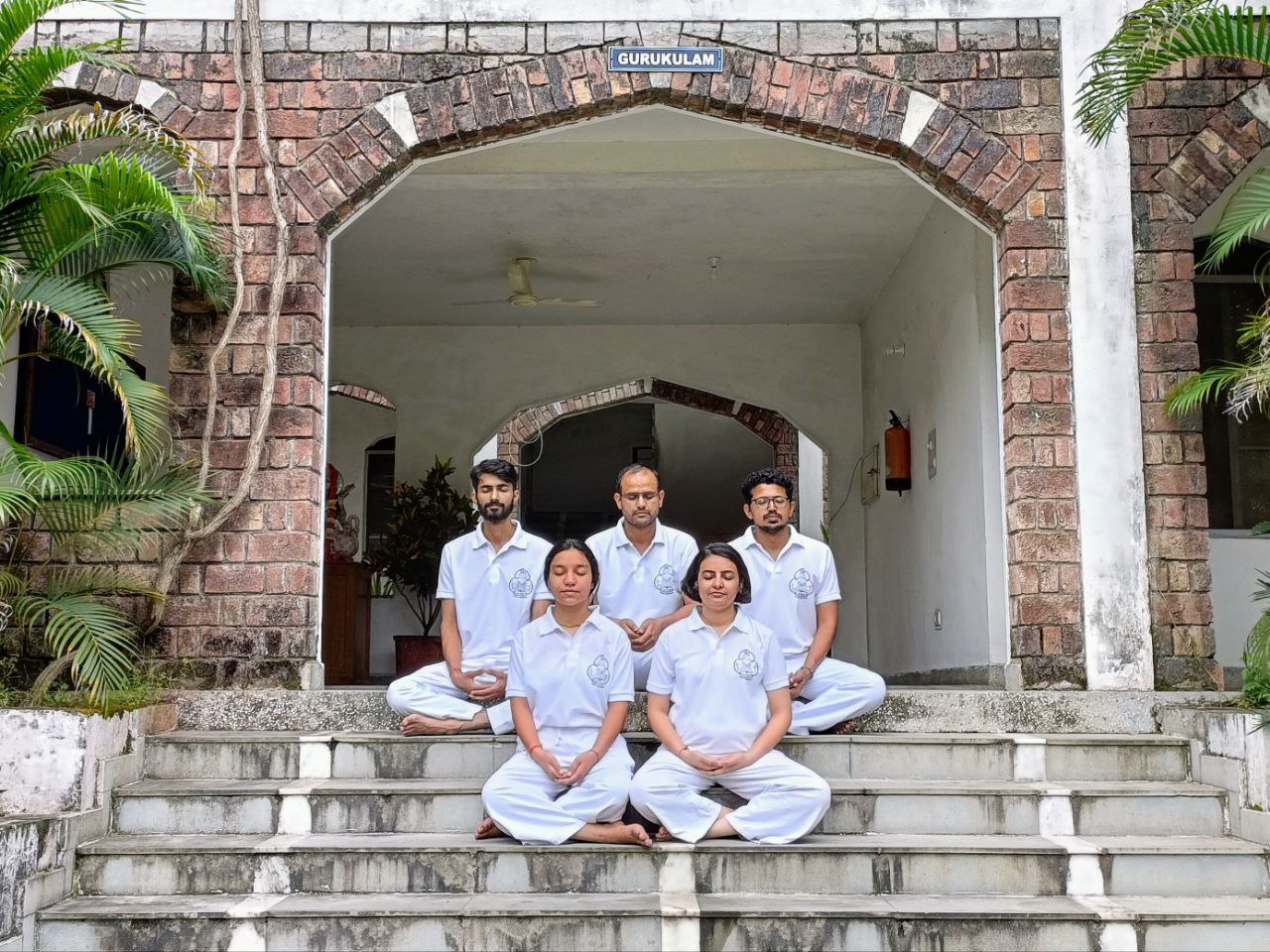
With the Grace of Gurudeva Swami Rama and our beloved Swami Veda Bharati, and with the blessings of Swami Ritavan Bharati, we feel blessed to share with you that the Swami Rama Dhyana Gurukulam accepted the new batch with five students on the auspicious day of the Vijayadashami (or the Dusshera).

Gurukulam 2022

This one-year program for the Gurukulam has been carefully designed and planned to include the teachings of the Himalayan Tradition through Swami Rama, Swami Veda, and attempt has been made to include as many aspects of the ancient traditional Gurukula systems of spiritual education and training as possible.

We began the new session of the Gurukulam with purification through the fire ritual – Virija Homam, and seeking the blessings of Lord Ganesha, the Guru Lineage, and the Divine Mother Saraswati (the Goddess of Wisdom). The blessings of the Mother Saraswati were invoked through the chanting of the Medha Suktam and the Saraswati Suktam.

The students and the faculty walked to the Sadhana Mandir, the seat of Gurudeva and sought the blessings of the Lineage. Together, we meditated in the Meditation Hall and Swami Veda’s Silence Hall.

At SRSG, students were briefly introduced to Swami Veda’s teachings on the ‘Unifying Streams of Religion’ as they paid their obeisance and prayed at all the places of worship in the ashram. The students offered flower garlands, fruits, sweets, and Dakshina (Love-offering) at the Initiation Room, the Buddha temple, the Mother Mary temple, the Adi Sankaracharya temple, the Ma Tara temple, and the Shiva Temple, and at the altars of Mahavira and Ma Saraswati.

The five young Gurukulam students, who have arrived at the ashram and joined the one-year program, brought a new force of energy with them. Our students arrived two days before the program began, and cleaned the entire Gurukulam building. They then proceeded to clean the Knowledge Center (KC) and removed the two layers of carpets from the KC. The carpets were hand-washed twice. It took them about 4-5 hours each time. They began the cleaning at 3pm and they worked non-stop until 8pm, even though they had to wake up at 4am the next morning. It was so heartwarming to see them preparing their classroom space with such enthusiasm and joy.

The program then had already begun with their loving Seva (service) towards the ashram. They are now studying Sanskrit and Vedic Chanting, along with classes on Hatha yoga, meditation, proper sitting and breathing. Their self-study plans for the first month is to study and contemplate on Gurudeva’s writings – the Living with the Himalayan Masters and Inner Dialogue.

The students and teachers adopted the system of eating meals only twice a day and will be having their brunch at 10 am and dinner at 7 pm. They will be cooking their own brunch. Once the food has been prepared and served, the students chant the 15th chapter of the Bhagavad-gita and the ashram meal prayers.

We all know that the Gurukulam was very dear to our beloved Swami Veda and he laid much emphasis on the continuity of the teachings through long-term Gurukulam studies at the ashram. We feel humbled to be able to continue his vision of the Gurukulam.

We seek the unseen blessings of the Lineage and pray at the feet of the Masters for our self-purification so that this endeavour may be successful. I am sure that the Gurukulam will provide an opportunity for all of us to learn, practice, and live the teachings of the Tradition.

We are grateful to everyone who continues to contribute towards this vision, inlcuding our DMT trustees, AHYMSIN family members, teachers, Ashram sahayakas and all well-wishers. We seek Swami Ritavan’s continued guidance on the path forward.

Om Tasmayi Shri Gurave Namah,

Rabindra

Samsāra Dancing

In Scotland the Edinburgh International Festival, the biggest arts festival in the world, is once again alive after a break of two years.  Included in the many shows, plays and concerts was a dance programme called Samsāra.

A single beam of light shines vertically down onto a naked embryo struggling to enter into the shape of a human being. With a second human they dance in strife until they find a music to align with and so discover the source of it all in a great climax of light and sound.  The dancers then defer to the gods they have come to know with puja of an extremely fluid sūryanamaskāra.  It was exciting, poignant, spectacular and well received by the audience.

There is the same sense in Swami Ritavan’s talk on Mantra Sadhana in the recent online course where he speaks of the remembrance of the Guru, Iśvara, the Tradition and the song of Atman, of finding alignment with spiritual practice.

But what is it to sing the song of Atman in the midst of a world turning in samsāra?  How to enquire into the meaning of Swami Ji’s talk?

The approach to an answer is slow, middling or quick. It’s not the idea of a great song from words revolving in the mind, but freedom from all ideas and words that matters. But how can you think about this if you have dispensed with words and thoughts?  First, we will have to climb out of our assumptions: that we can get things right with words and thoughts alone.  Yet it helps to start with words and thoughts. We know that samsāra is the turning of life as prakriti, the world of Nature making and breaking and consisting ultimately of the gunas in a perpetual state of change. They do get a rest from time to time in pralaya.

We know that the gunas make up the world and one’s self in the great material union of being.  As I am made of vritttis, of kleśas and samskāras and vāsanās and antarāyas comprising my karmāśaya so is everybody else. It is a great sea of mind and activity extending through the world. The teaching that OM is the vessel to cross that sea of samsāra makes sense when we see the karmāśaya as the shared body of suspect humanity doing their best and their worst.  In a state of ignorance of the true nature of both Nature and spirit we share our mistaken sense of individuality with every other individual. When we transcend that we are not individual.  Here understanding gets difficult.

Contemplation helps.  So instead of seeing by ideas justified by self, there is a wider sense which does not separate self from others which is how we are in fact.  Seeing the wider context of the unending field of kleśas and karma then the sense of the individual is subsumed in generality – it becomes a philosophical description of the human state.  In coming to know oneself one comes to know how others are too.

The brahmavihāras is such a contemplation: friendliness, care, delight, equanimity regarding those who are happy, careworn, good and bad respectively make a clear and pleasant mind. This attitude is not perturbed by the tossing seas of samsāra.  So, we can go out and about in a state of calm which is an accomplishment of vairāgya.  The mind is steady in itself and the senses at work without excitement.

Swami Ritavan describes this accomplishment at the start of his talk: Breathing deeply, gently and smoothly. Each exhalation releasing, letting go. Each inhalation rejoicing. Every breath guided by the prana stream.  Awakening. And that mind and prana and breath flowing together, a single stream of awareness, a single prayer that the Atman sings through you.

The brahmavihāras are presented in the Yoga Sūtras within the context of meditation methods.  The previous sūtra to it recommends the practice of concentration on a single thing and the following the cultivation of the fineness of breath until it is known by its cause in prāna.  The brahmavihāras are more than an ethical prescription, they prescribe how the meditative mind can maintain itself at all times.

The mind thus stable and freed from desire and aversion is unconstrained within and without and dances and sings and quietly rejoices.


Editor’s Note:

Jim Fraser teaches yoga in Scotland. He has received 500 hour certification through the Himalayan Yoga Tradition – Teacher Training Program (HYT-TTP).

Special Message from Swami Ritavan Bharati

Special Message from Swami Ritavan Bharati, for the newly initiated Swami, and as a message of moksha for all who aspire

Sitting in the fire of knowledge, each offering, no more mine- svaha…

Those having purified themselves through the yoga of renunciation, having completed and surrendered the fruits of their duties seek refuge in the guru, the indweller, guardian, and bestower of deliverance. Through renunciation of attachments of the three worlds, one emerges from the Ganges to live life to relieve the suffering of humanity. Having washed the doubts and fears of the worldly cycle, the renunciate receives reassurance through the Lineage in reciting their vows as the guru unties the knots and unites the soul to the parampara with a new name and yogapatta.

Swami Ameyaananda Bharati receives her assignment to the Bharati Monastic order and the seat of the great Lineage from Hiranya-garbha through Adi Shankara to our Gurudeva, and through Swami Veda. With the mahavakya now planted as a seed in the disciple’s mind, the sannyasin wears the robes of the color of the rising sun. With the command be a light unto thyself, bring peace of morning as the light of dawn, and comfort in the illuminating message from a pure heart.

As a sannyasin, one has no abode, no possessions, no relatives. Nothing is theirs but to live for the service of Om, and for the benefit of others. The fullness of the moment is their contentment. Life without dependence, allowing others to come seeking refuge with them. All the living beings of the earth are their relatives. God is their protector, and Om is one, oneself, and no other. Peace and only peace is now the life of a sannyasin. Om Shanti-Shanti-Shanti. Om


Editor’s Note

The birth of Swami Ameyaananda Bharati scaledSwami Ameyaananda Bharati, previously known as Chanchala Diggavi in her Purvaashram life, received sanyasa-diksha (renunciation) in the Bharati lineage on the auspicious day of July 21, 2022, under the guidance of Swami Ritavan Bharati, our Ashram Pramukha and Spiritual Perceptor.

Chanchala Diggavi has been visiting Sadhana Mandir and Swami Rama Sadhaka Grama since 2000 and has been associated with the Himalayan Tradition for longer than that.

Having born in a traditional Brahmin family in South India, her maternal family had a great influence on her. Three members of her maternal family over three generations had received sanyasa, including her maternal grandfather, great-grandfather, and great-great-grandfather. Her paternal family had built and maintained a temple in their hometown for over 200 years, which continues to exist even now.

During her grihasta (householder) life, she raised three children and her spiritual path steadied after her husband’s passing in 1990.

Between 2000-2008, she had received multiple initiations and personal guidance into various practices of Yoga, Vedanta, and Tantra from Swami Veda Bharati. She completed a 90-days intensive silence practice with yajna (fire offerings) at SRSG, under Swamiji’s guidance. Later, Swamiji asked her to start sharing the teachings and practices of Sri Vidya.

She has taught Sanskrit and several ancient scriptures in the past, and now spends most of her time in silence and personal sadhana at SRSG.

Historical View of the Swami Tradition (Sanyasa)

Stages of Life: Traditional Social Order for Society

The stage of life when one takes the vows of renunciation also makes a difference. In the system the four quarters of life were divided by twenty five years each; the brahmacharya, living a celibate life away from family, away from the opposite sex, up to the age of 25 and begging for alms and studying under a Guru; then the grihastha, for 25 years as a householder, have children and raising them.  When we study the laws of manu we see that the day a person sees his hair turning grey he should become a vanaprastha, a forest dweller, who is finished with the daily involvements with the world: and then sanyasa. Brahmacharya, grihsatha, vanprastha, and sanyasa. The life of a celibate student, the life of a householder, the life of a forest dweller, who may live with a spouse but as a celibate, and the life of a sanyasan, the life of a renunciate, a monk.

At what state one takes the vow makes a difference in many ways. The most highly prized are those who have taken the sanyasan vow right from the brahmacharya, right from the celibate student life. They are the most highly respected. Then one may take the vows right from grihastha, from the householder stage. One may take the vows from the vanaprastha stage, and on the other hand, one may take a vow anytime in life when one is absolutely certain that all debts have been paid, that one owes nothing to anybody and renounces.

In the theory of social organization in India, only one quarter of the population earns so that the other three quarters may be fed. The bharmacharis have to be fed by grihasthas. Vanaprasthas have to be fed by the grihasthas. Sanyasins have to be fed by grihasthas, the householder during that 25-year period when they earn and earn more. The Vedic injunction is to prosper. The Vedic injunction is not to decry wealth but to gain wealth. People have this idea that India believes in poverty. Not so; the traditions are not that way. Thou shalt prosper,” is the injunction. “Thou shalt proper so that the other three quarters of the population may be fed”. So you keep for yourself only what is necessary, and the rest is making the spiritual life of others possible. You earn, you divide your wealth just enough to keep for yourself, and the rest is for the other three quarters of the population. These are various categories of the social order.

In Sanyasa there are a number of categories. One sanyasa is the true sanyasan, the enlightening. That is the real sanyasa. Then the other one is the karma sanyasa (like kram mukti or karma sanyasa) – renunciation in the hope of receiving enlightenment. It is also known as “vidvat” or “vidvat sanyasa”. Vidvat sanyasa means that one has arrived at a certain knowledge and needs no Guru. He does not need anyone to initiate him. Just the knowledge itself is that renunciation. The other name for this renunciation is “vidyut sanyasa”, enlightening renunciation. Walking off, taking a dip in the Ganges, dropping all possessions and saying to the world, to all beings, to sun and moon, “I have renounced.”

Then there is what is called “atrua sanyasa.” Atura means someone who is desperate – desperate in the sense that one sees impending death, irreparable body, and there is a principle that many times sanyasa wards off the physical death. When the Bible, Granth Sahib, speaks of he alone lives who dies, they refer to this principle of renunciation, dying of the ego. It is a well-known principle that the Guru may decide that, by taking sanyasa, he can ward off his death because then you are no longer living for yourself. With the knowledge of impending death there is atura-sanyasa – renunciation of desperation. Not everyone does that. Not everyone is permitted to do that. Then again among sanyasans, there are two other categories that the different.

Whichever day one feels vairagya, one should walk off on that day.  One of the words for sanyasa is pravijaya or paravijarya. The Buddha also used that Pali equivalent pabbajaya. Pravaja and parivaja. The Pali form is pravija, pabbajja. Parivijaya or pravijaya is walking off, wandering off, and one of the words for a sanyasan is parivrajaka. It is an itinerant, one who wanders because, for such a renunciate, the rule is that one is allowed to stay at one place only one night and forms no attachment to any place. That has to be contrasted with the idea of establishing an ashram where you really stay. So it all depends on the particular lineage or it depends on what your Guru tells you. He may tell you to wander for three years and then establish an ashram or come back and serve in the Guru’s ashram.

Among the sanyasins there are different monastic orders. Two major branches of the monastic orders are dashanamis and udasis. It is derived from udasina but it is udasi. The dashanamis are the more highly respected. They are the ones who take the vows within the Shankaracharya tradition that reorganized the orders around the eighth century.

Udasis are those who do not fall into the dashanamis category. Throughout the history of India there has remained what is known as a Sant tradition. One may or may not be a formal renunciate. Because the words are similar they sometimes translate sant as saint. In Indian English “saint” means a sant. It does not mean somebody canonized by the Vatican. Any saintly person is a sant. In my Master’s passport, his profession was listed as saint. It is just a translation for the word sant. Anyone who is given renunciate vows has become a sant. (It is related to the word “sat” continuous participle of the verb root “sa”, to be). One who has discovered the true being, the meaning of true existence, he is holy and pure. There has been a long tradition of sants. It became very prominent in Hindu tradition during the centuries of Islamic rule to use the word sant. In the same way that the Sufi sants spoke the language of the local peoples of India in expounding Islamic faith, these saintly persons revitalized the Hindu faith.

Udasis are sadhus in the tradition. It is a non–Shankaracharya tradition. The dashanamis are called dashanamis because the word “dashanama” means ten names.

[…]

In establishing the order Shankaracharya placed them in ten different categories with slight differences in the ways of discipline, and so on. Those who can stay in a small cottage, those who can stay in an ashram, and so on. Four of these categories are known as dandin swamis or dandi. I do not use my danda anymore for a number of reason. Dandi Swamis are the holiest. Dandi Swamis are Saraswati, Bharati, Ashram, Giri. The surnames are taken depending into which of these sub orders one has been initiated – Saraswati, Bharati, Ashram, Giri, Tirtha, Sagara, Vana, Puri, and so on. Then there are six that are not the dandins. Dandins are those who are given a staff to carry, and the staff wears the saffron. If you are a dandin Swami, you may not even bow to your own Guru. The danda bows. If you have bent your danda, you pay danda pranama.

For the true dandi swamis, there are separate areas in Rishikesh where they eat. Even when we have these feasts for swamis here, we always invite five or seven or eleven dandi swamis who sit separately. That danda is the person. The world “danda” comes from the verb root “dan,” to control. It is a symbol of control, and a really good dandi swami will not eat from a plate. Whatever you put in his hand, he will eat standing up. He comes for biksha, for alms; whatever he can take in his hands, that he will eat. My friend, Swami Satyamrityanji Giri, who is a dandi swami, also walked into a Kumba Mela camp and took hot dahl in his hand. He says may I have some tea. The tea was hot, and he just took a handful of it and just drank it that way. There is no possession.

Once the strict sanyasins have taken the vows, they do not see and do not recognize any members of their previous family. The word used for the previous family is purvashrama family. In the strictest of traditions, and some still follow it, you cannot even know their pre–sanyasa name.

Today, with everything being electronically recorded, where passports, legal histories and properties and so on are done, your sanyasa has to be an internal one, a refinement of the attitude of me, mine, and I. But there are still some swamis who are not carrying out these types of international mission. They just lead the renunciate life and will tell you nothing about themselves, because the day they took the vow, that is the day they are born. Nothing exits before that; everything is totally erased, deleted like a computer file.

Among the Swamis, when we speak to each other, we do not say, ” Where are you from? We say, “Where is this body from?” We don’t ask, “How old are you?” We say, “How old is the present body? Rather than “I am not feeling well,” we say, “the body is not well.” If you do happen to meet or talk about something, such as the son or daughter you had when you were a householder, then it is expressed as the son of this body, of the current body or the daughter of this current body. These are all rules that different swamis follow with different degrees of observance depending on their own conscience, their own mission, the Guru’s orders, and so on.

[…]

In the Gita, the meaning of the word “sanyasa” is not taking the vows. It is simply renouncing the desires and fruits of actions. The word “dharma” is your duty according to your spiritual station. Be true to your dharma and do not overstep the bounds. Your dharma changes the moment you have reached a spiritual station. Your standard of behavior rises; then you are expected to behave that way. In the old days, when there was a proliferation of forests and animals, a king was allowed to hunt. But the day he renounces the throne and becomes a vanaprashtha or sanyasin, then his spiritual station has changed, and he must not hurt any living creature.

This concept of renunciation permeates all levels of society. As I said, prosper but renounce at the same time. The purpose of your prosperity is to feed others. A king should not die on the throne. He should take the vows of vanaprastha when his head turns grey. There are quite a few kings in the history of India who have done that. They call the assembly, and they propose the crown prince or whomsoever the assembly approves, and they renounce the throne. Dying on the throne, which is still the common practice, is a sort of a low standard.

In summary, when we are talking of spirituality in business we are also talking of these forms of renunciation. Earn with renunciation. Understand the purpose of that earning. It is understood as earning to support others, in an ever-expanding family. The Vedic principle is to prosper. Thou shalt prosper. Find ways to prosper. Create wealth and give of that wealth. That is the rule.


Editor’s Note

This is an excerpt from the book – Swami: A Life Beyond Knowledge, pp. 43-53, by Swami Veda Bharati, published in 2007 by the SRSG Publications.

Kindly contact the Himalayan Yoga Publications Trust: info@yogapublications.org if you would like to acquire a copy of the book. A kindle version of the book is also available on Amazon.

I Bow to the Truth-Bearing Guru

Guru Gita – Song of Guru, Verse: 89.

I bow to the Truth-bearing guru, who is the bliss of Brahman; who bestows the highest joy; who is infinite, free of the bonds of the 36 tattvas; who is One, the embodiment of Wisdom, Pure, and Eternal; and who exemplifies the great Vedantic proclamations, such as ‘That Thou art;’ the witness beyond all duality.

With bowed head, joined palms before my heart, a Reverent Salutation to Guru – “the Ocean of Mercy”

With initiates gathered in celebrating Guru Purnima and our beloved Swami Veda’s Mahasamadhi commemorations at SRSG here and around the world, we pause to acknowledge Guru’s blessing. Guru has made a very loving world and has invited his children from across the globe to embrace this Guru-family, as his gift of love.

The Song of Guru, Guru Gita, the nectar-filled words on the Guru, Master, Saviour, whose revelation fulfils the goal of life in liberation.

The mystery of Guru is the sacred boon of initiation.
The joy of Guru is mind’s beauty in samadhi.
The love of Guru is knowledge revealing Truth.
The language of Guru is mantra and yantra.
The gift of Guru is the pure pearl-bindu.
The pilgrimage of Guru is nada pulsing the 61-shrines within.
The transmission of Guru – light that dispels the darkness.
The Guru is Self and the self is Guru.

Remember the lotus feet of Guru, entering the boat that is also Guru to cross the ocean of worldly life.
Serve Guru in all thought, speech, and actions.
Surrender to Guru and put an end to rebirth.
Meditate and listen to the mantra given by Guru.
Meditate and embrace the imperishable form of Guru.

A Sanyasin is:
A child of Mother-Father Guru, serving Guru in thought, word, deed.
A child whose identity is nameless and formless Guru.
A reclining child asleep whose dreams are Guru’s sweet words.
A playful child whose possessions are Guru’s toys of mercy.
A hungry child whose cries for the milk of immortality in Guru’s breasts.
A tottering child whose pillar of stability is Guru.
A crawling child attracted to the truth-revealing light of Guru.
A muttering child repeating the same name of Guru again and again.
A crying child extending arms to infinity to receive Guru’s solace.

May our meditations acknowledge this eternal and ever-present bond of unity for the yearning hearts of humanity. May love, as an expression of Guru’s Grace be a reminder to keep that “smiling-mind” throughout life, “smera, smera, stimita.”

with joy and blessings,

Tasmai Shri Gurave Namah,

srb


Editor’s Note:

On this special and sacred time of Guru Purnima (13ᵗʰ July) and Swami Veda Bharati’s Mahasamadhi (14ᵗʰ July), the celebrations seem all the more special as the two occasions have fallen together and this is our first large gathering since covid. We are celebrating the Guru Purnima with a 9-days long akhanda patha of the Guru Gita along with daily pujas and 3 hours long yajna with the Akhandamanadalakaram mantra at both SRSG and Sadhana Mandir.

We will have a special commemoration on the 14ᵗʰ July in loving remembrance of our beloved Swami Veda Bharati. This will include special pujas, a yajna, followed by a shraddhanjali ceremony and a special bhandara for sadhus and all. More than 31 Sadhus and 11 Brahmachari Veda-Pathis from Rishikesh, along with 300 other people will be joining the shraddhanjali ceremonies.

Guru Purnima, 3 July 2012

All who are initiated in any genuine tradition gravitate towards Guru Purnima – the celebration of the Full Moon dedicated to honouring the Guru. It is the Guru’s gravity pull towards which we gravitate, for even the word ‘great’ is derived from the same original verb root from which the word ‘Guru’ is derived.

The greatness of the Guru is in that he, like a mother, gestates us in the womb of his knowledge. The First Guru, Hiranyagarbha, is the Golden Womb of the universe in that all knowledge dwells in that cosmic womb.

When the Guru takes our foetus-like, undeveloped consciousness, and keeps it in the spacious womb of his own consciousness, thereby we become his offspring.

This relationship in the Tradition is the most sacred. We may pay our debt to our physical parents by honouring and serving them. From the Guru, there is no such expectation because the value of knowledge can never be assessed.

The purpose of this knowledge in the spiritual traditions is simply moksha, liberation. Further, the purpose of passing on the knowledge is for the compassion towards all living beings, to liberate them from their suffering, to provide them with a boat to cross the rivers of sorrow.

Every time we recite the ‘tryambakam’…mantra, the central prayer in that mantra is a single word

MUKSHEEYA

May I be liberated.

This should be our aspiration and longing day and night, muksheeya!

When we have such aspiration, the Guru himself will gravitate towards us and draw us into the field of his gravity pull. He will keep us there until our wish ‘muksheeya’ has been fulfilled.

At the celebration of this Guru Purnima, I wish to assure you that those who are initiated in our Tradition do remain thus enwombed. May these foetuses grow to full maturity of liberation.

Swami Veda Bharati
Guru Purnima, 3 July 2012