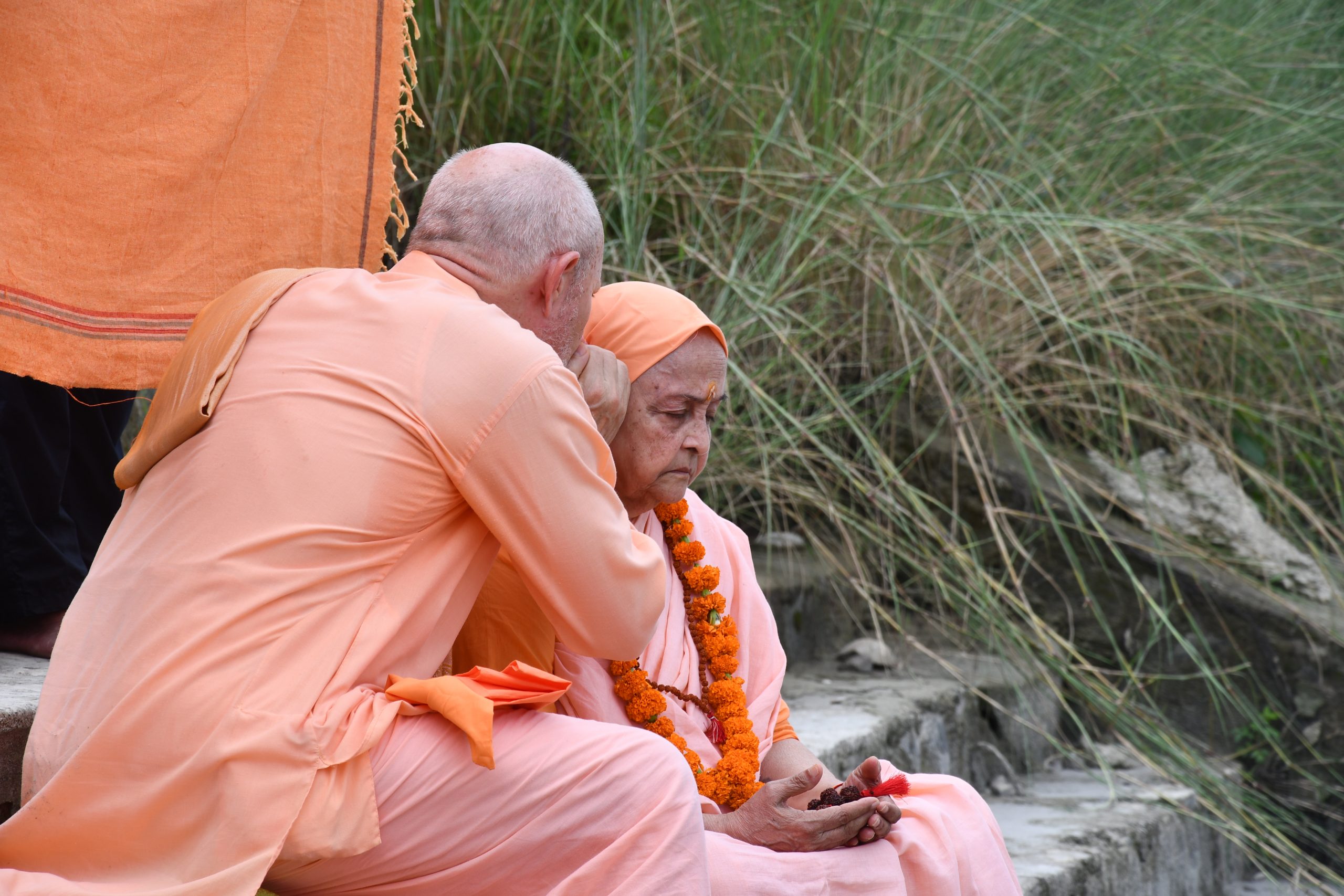
International Yoga Day Tribute – 2022

Tribute on the Special Occasion of the International Yoga Day – 2022

I pay homage to the Masters and the Saints, all gurus of the Yoga Tradition. Really, we can only pay homage to the Masters by walking on their footsteps; and not only honoring them but learning to do with our mind what they did with their mind. I have a wish for you – that you become someone that anyone who comes in your presence, any time, feels that he has entered a realm of peace. To have that ambition is yoga.

Yoga unites everybody in silence and meditation. Yoga is a tradition of discovering the inner serene silence. Yoga is not a system of physical movement. It is a system of silence and stillness from which the movement expresses itself. It is the subtle yoga, not the yoga of the body but the yoga of the inner self.

Now enter into the chamber of inner silence and discover your spine as you sit straight sensing the subtle flow of breath awareness as an energy in your spine. Your senses will naturally want to close; with your closed eyes look inward into a chamber of silence. Then, as you enter that chamber, you rest fully in being, that what you really are. You are not your eyes, ears, hands, and feet. You are not your breath, your emotions, your disturbances. You are a serene form of conscious energy that is total and pure knowledge and absolute joy. Samadhi is returning to that Self-nature. Once you have RE-discovered that Self-nature, you will never lose it again.

Resolve and carry the intention in your mind to calm the mind in this way many, many times during the day. This is only the first step, but even with this step, you will join the great disciples who for thousands of years have sat at the feet of the masters and the immortals. This Himalayan yoga is not the yoga for powers; it is the yoga for purity and serenity.

Please make a resolve that you will calm your mind by following the harmony of mind. With one single thought and with breath awareness, for however many minutes, it will keep you in this enjoying your own inner peace. I pray that someday you will sit in silent meditation, the yoga that transcends all boundaries and identities.

Om Tat Sat;
Shanti, Shanti Shanti

(In remembrance of our beloved Swami Veda Bharati, these words echo his intentions and guidance for all of us.)

Om,
srb

New Moon Meditation for World Peace

Message from Dr. Mohan Swami, President, AHYMSIN

The Asia Sangha, with the blessing of Swami Ritavan Bharati, is initiating a meditation for World Peace on New Moon days commencing June 28, 2022.

The New Moon is when the Sun and Moon and Earth are all aligned; with the Sun and Earth on opposite sides of the Moon.

Swami Veda Bharati initiated the Full Moon meditation in a global scale for us to experience the grace and guidance of the Lineage. He explained that when all sit together at the same time even in different parts of the world, we connect to the Universal Guru Mind. (ref: Ahymsin Publication: 10th March 2009)

The practice of the meditation on the New Moon days will be graced by the use of the Saumya mantra as proposed by Swami Ritavan.

ॐ सौम्या सौम्यतराशेष सौम्येभ्यस्त्वतिसुन्दरी

परापराणां परमा त्वमेव परमेश्वरी

तारे तुत्तारे तुरे स्वाहा

Om Saumyā saumyatarāśeṣa saumyebhyas tvati sundari.

Parāparāṇāṁ paramā tvameva parameśvarī.

Tāre tut tāre ture svāhā.

This mantra was described by Swami Veda Bharati and Swami Ritavan often during their satsangs. It refers to the Divine Mother as Saumya. It is a special mantra which is used to cultivate and develop our personalities into becoming a gentle and soothing individual. Swamiji was an embodiment of this virtue in its perfect sense.

In any mantra recitation, Gurudev Swami Rama always taught us to know and understand the meaning of the word, words or sounds. Only then the recitation has its full effect.

In its first half of the mantra, the word ‘Saumya’ refers to the soma or lunar attributes which are peaceful and kind.

‘Saumyatara’ means more lunar or peaceful than the Moon itself,

‘Ashesha saumyebhyas’ means even more beautiful than all the lunar-like and peaceful forces in the entire Universe.

The second half of the verse describes the Supreme One, ‘Parama’ and all things of the transcendent realities, including the experiences in this world. The Supreme Lady, ‘Parameshvari’, thou art the Supreme, thou alone art the Supreme, who transcends all immanent forces.

This mantra describes the emotional purification and balancing of the three gunas.

Let us, wherever we are in the world, join Swami Rama Sadhaka Grama in this New Moon Meditation for World Peace through the Grace of Swami Veda Bharati and Gurudev.

May all be blessed.

Aum Tat Sat representing the Unmanifest and Absolute Reality.

ms


Editor’s Note:

Saumya-Tara Mantra Recitation by Pandit Priyadarshan (Pierre Lefebvre)

One may sit for meditation at their home and know that you are not sitting alone at that time, and be aware of the connection with the Himalayan Tradition.

Food Sadhana: Expanding Mindfulness

In Part 1 of this series, we explored the benefits and practice of mindful eating. This time we will expand our mindful eating practice to include all five stages of the nourishment cycle. They are procurement, preparation, eating, digestion and elimination.

Procurement: Over the passage of time, procurement of food has evolved from simple gathering and hunting, to growing, manufacturing and retailing food as the end product of an industrialized food chain. We may have no idea where our food comes from or the conditions under which it was grown or processed.

A direct way to practice mindfulness of procurement is to grow some of our own food and watch it come into being. This deepens our appreciation of the life-giving power of nature and provides us with the freshest possible food. Ayurveda advocates choosing fresh foods to maximize prana, the life force.

Another method is to procure our food from local providers. In this way, we can develop a mutually supportive and mindful relationship with those who grow our food. Sometimes it’s possible to visit their farms and gardens so we can see first hand the conditions under which the food is grown. Ideally, the providers demonstrate their own mindfulness and concern regarding the health of the soil, plants and animals under their care.

The industrialized food chain has been criticized for using violent and unnatural methods including poisons in the form of pesticides, additives in the form of preservatives, genetically modified seeds, etc. Ayurveda warns us that we receive the negative fruits of these unwholesome actions when we eat these types of foods.

Instead, we are advised to procure natural, wholesome, fresh and pure foods. We recommend using seasonal, fresh, locally sourced and organically certified foods as much as possible, staying informed on your food sources, and learning to read the labels on packaged products.

Preparation: Ayurveda recommends preparing food with love. Our love will then pass to those who eat the food. To do this we must make an effort to remain mindful of our own thoughts and mood when preparing food. We first notice our mood without judgment. Then we introduce the intention of being loving. This becomes our focus.

Conversely, Ayurveda tells us that even the best quality food can become poison when prepared in anger. Or, if we ever have the chance to observe a kitchen staff during a retreat or at a restaurant, notice their mood while preparing the food. Then notice the mood of the dining room after the meal is served. We may be surprised to find a direct correlation.

Eating: Before eating, remember with gratitude all the elements that are coming together at that moment as in this traditional Zen reflection:

“This food is the gift of the entire universe- the sun, the earth, the rains and the work of many hands.

May we eat in mindfulness so as to be worthy to receive it.”

It may also be helpful to become aware of outer cues that may encourage over-eating. Swami Veda Bharati once said:

“Your problem in America is big cups and bowls.” Big cups, large portions, fast music and bright colors may unconsciously stimulate us into over-indulging. So take a few moments to relax your body, slow the breath, and calm your mind. Once settled, begin eating mindfully, being aware of each bite or sip.

Digestion: Ayurveda teaches that digestion proceeds in three stages. We are advised to practice mindfulness of each stage to notice our tendencies to fall out of balance. These tendencies are called doshas and there is one dosha for each stage of digestion.

The first stage of digestion begins with tasting the food and ends with the food in the stomach. If we notice a heavy feeling in the stomach, excess mucus or phlegm, nausea or gagging, we have developed kapha dosha. We can then make adjustments to our food choices and eating habits until these symptoms clear up. This usually means avoiding too much of any one thing, not falling into patterns or ruts and eating less food less often.

The second stage of digestion begins about an hour after eating when food passes from the stomach and travels through the small intestine. If we experience excess heat, heartburn, acid reflux, itching, pimples or a rash we have developed pitta dosha. By noticing the inter-connection between our food choices, our eating habits and our heartburn we are developing the fruit of mindfulness practice – wisdom. We learn that we benefit from moderation and eating calmly with thankfulness, rather than analyzing or criticizing our food.

The third stage of digestion lasts from about two to five hours after eating when food passes from the small intestine and travels through the large intestine. If we experience excess gas, bloating, twitching and restlessness we have a classic case of vata dosha. We will benefit from avoiding mindless eating and by eating smaller portions on a regular schedule.

Elimination: Being mindful of our elimination will also reveal clues as to the state of our doshas. Constipation with gas is the hallmark of vata dosha. Burning diarrhea is the sign of pitta dosha. Watery stools with mucus are the signs of kapha dosha.

Perhaps the most important mindfulness practice that follows eating is to simply notice the effect of each meal on our mental state using the three gunas – tamas, rajas and sattva – as a gauge. If the meal makes us feel tired and sluggish it is called tamas. If the meal makes our mind race and we feel distracted and unable to focus, it is called rajas. Ideally our mind feels refreshed, clear and bright. This is sattva.

To sum up, the practice of mindful eating can be expanded to include all that has come before the meal and all that will come after. By expanding our focus in this way, we can develop greater insight into our health and well-being. Or, as said by Thich Nhat Hanh: “When practiced to its fullest, mindful eating turns a simple meal into a spiritual experience, giving us a deep appreciation of all that went into the meal’s creation as well a deep understanding of the relationship between the food on our table, our own health, and our planet’s health.”


Suggested Reading:

  • Swami Veda Bharati: Whole Hearted: Applied Spirituality for Everyday Life
  • Thich Nhat Hanh: How to Eat
  • David Frawley: Yoga & Ayurveda

Editor’s Note:

Gary Gran, (CYT, DAy), is a a long-time initiate in the Himalayan Tradition and has been trained by Swami Rama and Swami Veda Bharati. Gary and his wife Cynthia are both certified yoga teachers and Ayurvedic educators, and have taught at the North American TTP retreats over the years.

Meditation as Mother

maa

Audio Recording on “Meditation as Mother” by Swami Veda Bharati

Transcript of “Meditation as Mother” by Swami Veda Bharati

Only a joyful mind immersed in the beauty of the ever-present facets and faces of the Divine Mother can meditate. A mind laden with anguish, sorrow, anger is not yet a vessel that has been prepared for meditation. Therefore, in your daily life, endeavour to make your mind joyful and beautiful, resonating to the floods of the waves upon waves of joy and beauty that touch you, course through you, pass through you at every instant. Remember that your sense of individuation is a myth to be discarded and that which you have discarded as a myth and that is the awareness of the totality and unity of the indivisible, undivided universal consciousness has to become a reality for you. Learn instant by instant to dip into your share in the ocean of joy. And the aliveness and the awareness of the universal conscious reality because of its fullness is wanting nothing. Therefore, it is all joy, all bliss, bliss, all completeness, purnam, purnam, purnam.

It is the flavourful essence, rasa, the juice of the very being of the universe, whose custodian is the Mother Deity, the Divine Mother, Shree, who is the resort and refuge of all forms and facets, of all thoughts and sentiments, of the power of will, power of knowledge, power of creativity. Lalita, the tender, the gentle one. Tripurasundari, the beauty of the three realms. She whose name is beauty, whose faces are the forms. She is not the beauty of the faces; the faces are the forms of that force called the Great Mother named Beauty.

Know yourself to be as a particle of her being, her wave, the wave of fullness, of joy, of bliss, of completeness, of totality, of consciousness, indivisibility of life force passing through you like the mother’s mind wave, prana wave. And nourishment coursing in her body passes through the foetus, so sheltered, so protected, so guided, so having no cause for anguishing fear. Be nourished on this wave. Know yourself to be the wave of the fullness of life immersed in the beauty of the ever-present facets and faces of the Divine Mother and meditate. A mind laden with anguish, sorrow, anger is not yet a vessel that has been prepared for meditation.

Therefore, in your daily life, endeavour to make your mind joyful and beautiful, resonating to the floods of the waves upon waves of joy and beauty that touch you, course through you, pass through you at every instant. Remember that your sense of individuation is a myth to be discarded. And that which you have discarded as a myth, and that is the awareness of the totality and unity of the indivisible, undivided Universal Consciousness has to become a reality for you. The wave of the ocean of consciousness and perfection, which is everywhere, as far as you can stretch the vision from your third eye in the form of a ray emanating in all directions.

Let your awareness catch hold of this breath principle, whose wave is interwoven with the wave of prana, coursing through your entire individuated continuum of the breath and prana, through your entire body and you gently bring your hands down.

And I join my palms before my heart and bow my head, with all the love of the heart, with all the power of action in the hands, with all thought in the head, I give you the love of the Himalayan lineage and worship the divinity, whose wave flows within you. God bless you.


Editor’s Note

The audio and transcript of this special meditation was shared by Swami Ritavan Bharati.

Moving Towards a Balanced Diet

“In the Ayurvedic tradition it is said: ‘If you have a good diet, of what use is a doctor? And, if you don’t have a good diet, of what use is a doctor?'” – quoted by Dr. Ballantine in ‘Radical Healing’, page 217


Many of us eat on the run or simply eat what is convenient. Others try various diet plans with varying results only to go back to our old habits. Or perhaps we consider food as a tedious chore to be gotten over with as quickly as possible. So how do we move towards a balanced diet? And exactly what is a balanced diet?

In this article we will attempt to answer these questions according to the time-tested advice of Ayurveda, the science of healthy living.

First understand that the diet plan that is right for you is unique to you. And as you change, your diet will also change.

Secondly, it is not necessarily helpful in the long run to follow a diet plan from a book or piece of paper. You could use such a plan as a guideline or a starting point, but it should not be followed blindly. The key is to slow down just enough to practice a little self-awareness. Simply watch what and how you eat, and how you feel from eating. Then introduce positive changes gradually. It is rarely helpful to change your diet all at once.

Moderation is the key to a healthy balanced diet. Not too much, not too little. Not too hot, not too cold. Avoid extremes like too much sugar or too much salt. Instead try to eat a variety of foods from all the traditional food groups.

And finally, to insure good nutrition, quality counts over quantity. So, choose fresh, wholesome and pure foods whenever possible. Avoid junk foods.

Here is the step-by-step process:

  1. Before analyzing your diet or attempting to make any changes, simply keep a food journal for a week or two. Record everything you eat and how you feel day by day. You may be surprised. For example, you may realize that you’re eating more sugar than you thought.
  2. Reduce snacking. Too much snacking between meals disrupts the normal process of digestion and prevents us from noticing how individual foods are affecting us. It is better to let one meal digest, noticing its full effects, before eating the next meal.
  3. Regulate your meal times. Your physiology works on circadian rhythms. Eating at regular mealtimes helps to reset your natural rhythms and strengthen your digestion.
  4. Simplify your meals. Eating too many foods at once also confuses the picture. The goal is to be able to notice which foods are best for you.
  5. Don’t overeat. Too much food overwhelms the digestion and the mind. It is best to stop a few bites short of being full. Chewing your food well also helps prevent overeating.
  6. Notice the effects. How do you feel? Then put two and two together. For example, if you feel sluggish and headachy after a meal, think back. Next time, eat something different. Gradually you will discover which foods are best for you. This process has been called ‘bio-food back’.
  7. Make changes gradually. It is no use to make wholesale changes in your diet, they rarely last. Besides, if you change many things at once, there is no way to separate the effects.

In this manner you will begin moving towards a healthy balanced diet. Slowly discover which foods have negative effects and reduce them. Notice which foods leave you feeling well and accentuate them. Ultimately, you can learn to choose your foods intuitively on a day-by-day basis. What do I need today to feel more balanced?

Now that you understand this process, we can take a look at the six traditional food groups that are recommended for a balanced diet. If you find one is noticeably lacking, you can slowly introduce foods from that group into your diet.

  1. Whole grains. There are many nutritional advantages to whole grains over refined grains. However, some people have trouble digesting whole grains. So be sure to try different preparations until you find a few dishes you enjoy. Start with one serving a week, and move towards at least one serving per day.
  2. Beans & legumes have many health protective benefits and combine well with whole grains to form complete proteins. As they can also be hard to digest, cook them well, try different preparations, and remember that the smaller the bean, the easier to digest. Split or ground beans are also easier to digest. Keep the portions small. Try for two to four servings per week.
  3. Fresh cooked vegetables are essential for a healthy balanced diet. Try for at least one cooked green or yellow vegetable every day. Also, try to find a cooked leafy green vegetable, which are nutritional power-houses, to enjoy from one to four times a week.
  4. Raw food is also important. Ayurveda recommends primarily cooked foods, but raw foods are essential for their vitality and their enzymes. Fruit digests quickly so it is best eaten alone. Salads and fresh juices are other excellent choices. Try for one serving per day.
  5. Animal foods are considered as supplemental protein. Vegetarian protein requirement is split between vegetable sourced proteins (mainly whole grain and bean combos) and animal sourced proteins, such as dairy. Small portions are best. Vegans, who choose not to eat any animal foods, must find a reliable source of vitamin B-12 as a substitute.
  6. Essential fats. Many people are deficient in this category. Traditionally, this category is filled by eating a variety of nuts and seeds and the oils derived from them. One of the best vegetable sources of essential fats is flax seed.

In summary, remember to go slow, notice the effects, and make only gradual changes. Enjoy the process. Take an interest in your food, but don’t become obsessed. Simply try little experiments by adding foods or taking foods out of your diet. Remember the goal is not to eat a prescribed diet from the outside, but to develop a diet that is personal, flexible, and intuitive.


Suggested Reading:

Rudolph Ballantine: Diet & Nutrition, Transition to Vegetarianism, & Radical Healing


Editor’s Note:

Gary Gran, (CYT, DAy), is a a long-time initiate in the Himalayan Tradition and has been trained by Swami Rama and Swami Veda Bharati. Gary and his wife Cynthia are both certified yoga teachers and Ayurvedic educators, and have taught at the North American TTP retreats over the years.

From one sadhaka to another

I haven’t visited SRSG since the pandemic began. It feels like such a long time ago, but also like I never left. While I haven’t been able to gaze at your face, or touch your hand, you and our Tradition have been a source of guidance, love and support every day.

I don’t really understand a lot of what happens in my own life, let alone the machinations of our complex world. I have learned through the Tradition that these circumstances and the difficulties I have with them directly accord with my karma and capacity. And I can rest in this knowledge when seemingly impossible challenges arise. The Tradition has also given me the tools of the eight limbs and the wisdom, experience, presence, examples, and companionship of all of you to help me live a meaningful life. I make lots of mistakes and get many, many things wrong, but the Tradition and our community never fail me.

One of the truly beautiful things to come from this pandemic and the isolation it has imposed is a heart lifting digital community. It has been a revelation how far our Tradition extends. I have started to see its branches and connections and the rich reservoirs of knowledge and guidance that they offer. I get to see you and hear you from all over the world. Just like when spending time at SRSG, meaningful connections occur, when we all have the time and exposure to deepen our practices together.

Knowing you, stories from far away have become much more important to me because they affect you and your home. I marvel over the photos and stories you share on online and read books and watch movies set in your country, because I think you are wonderful and interesting, and I want to understand you and your life more. In this way I learn more of the beauty and details of your life. It has also made me a devoted consumer of international news.

I guess news, by its nature, is negative and I learn of desperate situations, the pandemic, turmoil, war, climate change, natural disasters and the brutality and ignorance of humanity. I know that there are lies and propaganda that I don’t understand and know that I will never know the truth of these situations. I also realise that there are so many layers, and such complexity to these troubles, that maybe there is no possibility of truth. But I also know that you are there. I know that you live in these places and just like me you are living your karma and practicing to the best of your capacity. You are working the eight limbs; using the yamas and niyamas to guide you.

I am content and cosy here in our Tradition with you. But sometimes in pursuing the tenets of our Tradition I rub up against other traditions both within the teachings of our Tradition and in my daily life as I endeavour to grow my spirituality in my physical home far away from the heartland. I can begin to see the value and beauty of other Traditions and how they help and guide their adherents.  I realise how similar the foundations of their teachings are to ours. I know that in their lives, in their places, they are also practicing their Traditions’ versions of the eight limbs and, just like me, relying on their cohort for love, guidance and community.

So, while I have missed SRSG and the beautiful souls who live and visit there. I have learned a lot in my time away. Our Tradition and you, my kalyana mitras, are all still here and everywhere. A source of joy and richness in my life, and a blessed place of refuge and succour during life’s storms. With this new perspective, my mind’s eye conjures a vast web of souls guided by spiritual traditions plodding away striving for good and diminishing evil, increasing in influence whilst growing and strengthening the kindness, love, and compassion of the mindfield.

May the force be with us my dears 😉


Editor’s Note:

Joanne Moran from Australia is an initiate and a level-2 HYT-TTP student.

A loving invite for the Swami Rama Dhyana Gurukulam

Few seek, and the fewer find.  The burden of Truth once found is heavy and teachers seek the seekers to whom to give.  When, dear seeker, you sit in your daily meditation, the blessings of all the great Himalayan masters are with you even if you do not know it.” Swami Rama

We are pleased to announce the starting of “Swami Rama Dhyana Gurukulam”, which will not only convey the message of great Rishis but will also pave the way to realize the truths of life.

Today, confined and defined by worldly achievements, and material development there is fear and much instability. Thus, there is a renewed search to understand the purpose of life. Now is the time to make mindful efforts to help such seekers so that peace, mutual understanding, spiritual awakening and knowledge may dawn upon this troubled planet of ours.

With the Grace of Gurudeva Swami Rama and Swami Veda Bharati, under the auspices of “Swami Rama Dhyana Gurukulam,” our sankalpa (resolve) endures and extends the ancient heritage of our founders: “May all people of this living planet follow the path of Truth and universal love. May they live with a purpose in life sincerely practicing through compassion and understanding.”

Such a goal in life teaches us not to be swayed by attachment to things of the world, nor caught in this web of ignorance. Use your Gurukulam intensive studies and practices to refine and clear your mind to guide your thoughts, and use your kind thoughts to guide your speech and actions. Your very life will be transformed through ahimsa; and by santosha (contentment) you will live in harmony with all situations of life. To you, dear seekers on the path of this inward journey come join us, and may you receive the blessings of the Himalayan Lineage.

Food Sadhana Part 1: Mindful Eating

Dedication

Food Sadhana in four parts is dedicated to all students of yoga in the Himalayan tradition.

Blessed by Swami Veda Bharati for publication, this series details various food practices as passed down to us in the traditions of Yoga and Ayurveda. If you find the suggestions helpful, please pass them along so other students can benefit. This writer’s hope is that you will be inspired to be more mindful of your food choices, and you will thereby create a strong foundation for good health, happiness and long life. In gratitude to the many fine teachers who inspired these offerings.

Om shanti, shanti, shanti.


“The yoga approach to health is extremely simple, logical, and practical. It lays stress on the words Yuktahar viharasya – eating and living as they should be done. By simply studying one’s own capacity and learning how to regulate one’s dietary habits, external activities, and thinking process, it is possible for one to gain control over his life and remain healthy. This does not mean that one must do anything unnatural or impossible; there need not be restrictions, but given the information in these lessons, one can decide what is best for himself, and implement whatever changes he chooses, practicing them according to his own capacity.” – Swami Rama, A Practical Guide to Holistic Health, pp. 5-6


Part I: Mindful Eating

Been feeling rushed lately? Do you find yourself eating at your desk or grabbing a bite as you run for the train? Or maybe, you’ve been feeling bored. So you sit on the couch watching TV with a snack, and before you know it, you’ve eaten the whole bag. Maybe you’ve been following a diet plan but your heartburn is still acting up and your energy level isn’t what it used to be. What can we do?

Ayurveda teaches us that how we eat is as important as what we eat and when and where we eat. We can make better choices and improve our relationship with food through the practice of mindfulness.

Modern research concurs. The practice of mindful eating has been shown to reduce over-eating, provide better weight management, improve digestion and help prevent chronic disease. Mindfulness training is currently being prescribed for people with eating disorders, type II diabetes and for cancer survivors. There are many excellent resources on-line for anyone wanting to incorporate the practice of mindful eating into their daily lives.

When individuals begin to practice mindful eating they report better digestion, better energy and more enjoyment. They find it easier to make healthy choices and manage their weight without resorting to the latest diet fad. Overall, mindful eating can lead to a healthier relationship with our food, with ourselves and with our world, as they are all interconnected.

To get started, try the following experiment. Set aside about 20 minutes when you will not be interrupted and you are hungry but not starved. Choose an apple (or one of your favorite foods) and place it on a table. Sit down, close your eyes and become aware of your breath for a short while in order to relax and clear your mind. Then open your eyes and look at the apple. Notice and appreciate its appearance. Then reach out and touch the apple, feeling its texture. Bring the apple to your mouth but pause to smell the apple. Now take a bite, noticing the sound it makes. Then be aware of the taste sensations in your mouth as you begin to chew. Does the taste change as you continue to chew? Continue eating the rest of the apple with mindfulness. Then rest and reflect on this direct experience. What happened? How did you feel? Did you enjoy the experiment?

The next step is to eat an entire meal with mindfulness. Here are some tips on how to practice:

  1. Eat sitting down in a settled environment. This means stop multi-tasking, turn off the electronics, and clear away clutter. The idea is to reduce distractions and create a pleasant environment.
  2. Take a few moments to relax. Sit down and practice breath awareness for a few breaths. Be aware of your surroundings. Relaxation is a prerequisite for good digestion.
  3. Set your intention. You are choosing to practice mindful eating.
  4. Be grateful. Say grace or thanks for the food you are about to eat.
  5. Be mindful of all the senses as you take your first bite.
  6. Chew your food well. Notice how the taste changes as you chew.
  7. Set down your utensils between bites. The idea is to savor your food.
  8. Proceed at a moderate pace, not too fast and not too slow.
  9. Notice when you first begin to feel full. This is a good time to stop eating.
  10. Rest after eating. Rest for a few minutes at the table before moving on to the next activity.

The beauty of mindful eating is the focus on direct experience, not some abstract idea of what we should be eating. Over time we begin to notice things. We connect to our inner wisdom. We realize that how we eat affects how we feel. There is no rush to make changes. The advice is to just notice without judgment. Let the process reveal itself.

It may seem difficult to maintain your mindfulness throughout the whole meal. When you realize that your attention has wandered, simply bring it back to the next bite of food and begin again without judgment. When finished, take some time to reflect. Then decide how often you want to practice. Some people choose to practice just once a week, or once a day at first. Others practice just at the beginning of each meal. However you proceed, you are following your own wisdom. After some time, you may find yourself altering your food choices or eating less. Let the process proceed naturally. Follow your gut!

The science of Ayurveda recommends that we eat when hungry after our previous meal has been digested. The rationale is to honor our digestive capacity. If we eat too often, we can overwhelm our ability to digest. The same goes for overeating or eating on the run. Here is a mindfulness practice to help us gauge our appetite.

Before selecting the food for each meal, check in and gauge your appetite on a scale of 0 to 10 with zero being famished (empty of food) and ten being stuffed (full of food). The same measurement is then used to gauge when we’ve had enough to eat. The idea is to eat when the appetite is around 2 but stop when the appetite is around 7 or 8 (when we are approximately 70-80% full). This is called staying within your comfortable capacity.

At this point, let us recall the five-fold method advocated by yoga science (see Yoga Sutra I.20) as can be applied to mindful eating:

  1. Faith – Hearing the benefits of mindful eating increases our faith or conviction.
  2. Effort – Next we set our intention and give it a try.
  3. Mindfulness – The whole process is facilitated by mindfulness.
  4. Concentration – Over time mindfulness becomes relaxed concentration. We learn to focus on our direct experience without being distracted. According to Swami Veda Bharati, when we are “mindful of each bite or each sip, then each sip can be samadhi.”
  5. Wisdom – Our inner wisdom grows as we make new insights. We are continuously refining our relationship with food.

“Thus one casts suffering far away by the continual close application of mindfulness.”

– Tibetan Blue Beryl Medical Tantra


Suggested Reading:

A Practical Guide to Holistic Health by Swami Rama, published in 1999 by the Himalayan Institute Press.


Editor’s Note:

Gary Gran, (CYT, DAy), is a a long-time initiate in the Himalayan Tradition and has been trained by Swami Rama and Swami Veda Bharati. Gary and his wife Cynthia are both certified yoga teachers and Ayurvedic educators, and have taught at the North American TTP retreats over the years.

Love and Prayers amidst Conflict

May our peace filled hearts extend with prayer to all those suffering during these stressful times in displacement and injury within Ukraine. Let our sankalpa for our Ganesha Gayatri japa be repeated before each meditation that the fruits of such actions be offered for “Harmony with Mother Earth and all Her sentient beings with a resolute commitment to ahimsa in all forms.”

On behalf of the Sangha our loving appreciation to all to those involved through the Tradition’s Budapest Centre, who are working together at this time to provide all the necessary love, support and shelter for displaced families for the past 3 weeks.


Please read below the message shared by our Hungarian family about the relief efforts carried out by their volunteers:

On the afternoon of 3 March, we received a call that some young people from India, who were fleeing the war in Ukraine, needed our help. That evening, the twenty frightened-eyed Indian students of medicine arrived at the Himalayan Tradition’s Budapest centre.

Allow us to quote from the words of one of our dear fellow practitioners, Agnes, who, among other things, welcomed them that evening:

“They are slowly starting to talk, I wish they wouldn’t. It took them five minutes to get out of the metro and the bombs came, three of their companions died right  there, and they don’t know anything else. The people of Kharkov were told to flee three hours before the attack, but they are coloured people, nobody really cared about them. They had enough time to take their passports with them, they say in perfect English. They are 24 years old, but they already know everything about life and now ….death, and this knowledge is evident in their every mature movement as they make themselves a bed from the mattresses and blankets in our Himalayan yoga studio.”

We now know with absolute certainty that all 20 young people have successfully arrived in their Indian homes, so it is with great pleasure that we write these words to you: their situation is now resolved!
But there are many others who, unfortunately, are not in such a blessed situation.

Hungary, as a neighboring country, has a special role to play in the care and shelter of refugees, and has experienced the second largest refugee influx to date. Since the beginning of the crisis, over 300,000 refugees have crossed the Hungarian-Ukrainian border, and this number is expected to rise further in the coming weeks as fighting nears Kiev (the capital).

In light of this sad fact, we have decided to provide shelter for those in need at the Himalayan Yoga and Meditation Association’s Budapest centre for the weeks of crisis.

A very well organised team of volunteers -all practitioners of our Tradition- will take care of the asylum seekers who come to us.

The Ukrainian families that arrive are mainly women and children who have been forced to leave the male members of the family at home. In addition to accommodation, we provide warm meals and good words to the first arrivals, and we have equipped the room with games, art materials and activities for the children to help them forget the difficulties of fleeing.

We would like to thank everyone for your caring love and support at this time; we are very grateful.

2022: The Year of Mantra

By way of the blessings of the Lineage, we are introducing 2022 to be the Year of Mantra.

The entire title for the Observance this year is: 2022, the Year of Mantra: Language of Soul, Mind, and Word.

Recently, the Ganesha Gayatri mantra was received and instilled as a Sangha initiation with a one-year observance for 2022. The sankalpa, the mantra, and its pronunciation along with the introductory purification prayer are all explained in our previous newsletter and can be read here – https://ahymsin.org/ganesha-gayatri-mantra-2022-new-ahymsin-sangha-practice/

This special mantra practice along with your daily meditation practice will be complemented by this Svadhyaya (self-study) practice that is being introduced for the Sangha members. The book we will use is “Mantra and Meditation1 by our dear Swami Veda. Since it was published many years ago, you would already have it in your personal library, or are using a translated version in your language.

Each month you will have a theme or chapter to read, study and contemplate. Then you will test the principles in your meditation and apply them in your daily life.

Your homework for this coming month is:

After reading the forward and introduction read, study and contemplate upon the chapter 7 “Subtle origins of Sound”. Test these in your meditation, and then submit a sentence or two of your experiences and insights to me (SwamiRitavanBharati@gmail.com). Remember, if it is still a question, then you must test it, contemplate upon it, and resolve it until it becomes an insight for you.

Mantra and Meditation

Introducing our theme:

In the multitude of spoken words, in numerous Mother-tongues over millions of years, the source of language is traced to its origin in pure love.

Love is the language of the soul, and knowledge is the language of the mind.

Love that bursts forth the energy of light transforming pure knowledge into the thought becomes spoken words. The articulated speech, given meaning when heard, is limited in conveying understanding of the intention, and much more. When examination and judgement of the spoken word rests in an assignment of meaning to “words”, one is unable to grasp the language of the soul.

Throughout this year, our AHYMSIN Sangha will devote energies to studies and practices that awaken the light of love through experiences of meditation and meditation in action.

Each month our Full Moon Illuminations newsletter will share observations and insights from members across the globe.

Where does language come from?

Swami Veda, in his book – “Mantra and Meditation” explained a verse from the Shiksha of Panini, a 7th century B.C grammarian; and further interpreted it in the writings of Bhartṛhari in his Vakyapadiya:

atma buddhya sametyarthan mano yunkte viwksaya

manah kayagnimahanti  sa  prerayati marutam

marutas turasi caran mandram janyati svaram

“Atma, bringing together its purpose (intent) with the help of buddhi, gives a command to the mind by producing a desire (intent) to speak. The buddhi instills the desire (intention) to speak in the mind. The mind awakens the fire in the body from the navel center. That agni impels the prana and air. The air moves through the lungs and through the vocal cords, comes into the mouth and becomes a sound [that is articulated].” (pg.90-91, Mantra and Meditation)


Sankalpa and Intention for the Ganesha Gayatri Japa as the collective Sangha mantra for 2022

Collectively, as the Sangha, we vow towards a pillar like stability and stillness in mind and emotion, perseverance in asana, daily meditation (same time, same place), removal of obstacles and sadhana and in daily life and in relationships, purification of buddhi, resolved on enlightenment, harmony with Mother Earth with a resolute commitment to Ahimsa and non-violence (Mother Earth has suffered enough and we can play our part, even more so now), protection and security through freedom from all fears. Everyone is seeking security from the unknown, from the complex, from the animosities, the greed, the hatred. That protection, that security is necessary for us to feel grounded and stable, to be able to move into our higher realms of life, with relationships and our service to humanity.


Q & A on Mantra Japa

Question: If I am experienced in japa and have a standard and consistent daily practice, and I usually complete 4 malas in 40 minutes; can I count the amount of my japa to be the same when I do not use the mala beads?

Answer by Swami Ritavan Bharati: The mental level of speech or madhyama stage of japa has multiple levels. When an experienced meditator becomes adept at identifying those levels within the ekagra (one-pointed) state of mind, they will experience a rhythm and frequency of the japa that can be tested and measured. Using the mala, you remember the mantra 108 times with each bead, maintaining the same level of experience for the same duration of time.

For example, in your meditation, you can observe your japa on three different levels2:

  1. You do a mala with the breath. Exhale the mantra, inhale the mantra, and watch how long that takes.
  2. Then you do a mala with the ordinary repetition that you do; many people do it somewhere between the articulated word and its thought in the mind.
  3. Then you do the mala at a deeper level, where mantra is like a heartbeat, the mantra arising deep in the mind like a pulse beat.

Work out how long it takes you to do the mala at those three levels over a long period of time. The experienced meditator is then adept at noting the level of japa in the mind and knowing the amount of japa within that period of time.

Try to be consistent with the same length of meditation and the same level of concentration during that period to gage your count of japa. Test yourself again, especially during moments of emotional ups and downs. When this is tested repeatedly as consistent, then you can infer the same number of japa even when not using the mala beads.


Editor’s Note:

1. The book – Mantra and Meditation, was written by Swami Veda Bharati before he took Saṃnyāsa, when he was known as Pandit Usharbudh Arya. The book is available on Amazon and Amazon India. It may also be available at your local center and bookstores.

2. For further reading, please refer to Swami Veda’s writing – https://ahymsin.org/guidelines-for-spiritual-living/