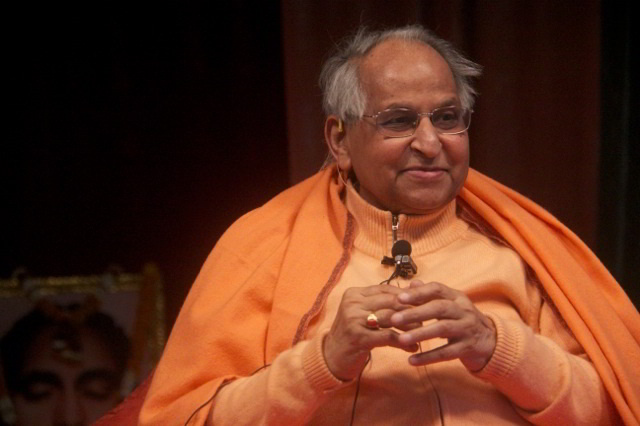
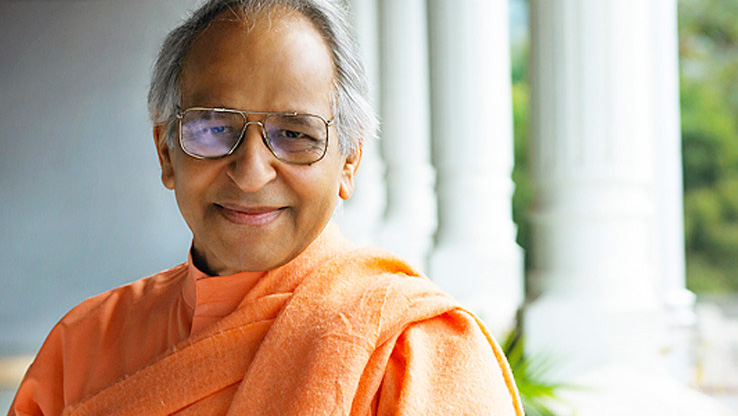
SVB Birthday Blessing 2009

Swami Veda Bharati
…just this tremendous amount of love everywhere from people I did not know. And I’ve found that God has made a very, very loving world, and my prayer for you is that you find your world to be the same, and my prayer for myself is that whether someone throws roses at me or throws mud at me, I should remain the same and there should be no change in the level of my love. That’s my prayer for myself, and for you, may you find the world to be as full of love as beautiful as that I have found in traveling around to strange places, new places. Everywhere may you find the same.

I don’t know, thanks is not enough. Songs from Greece and poems from Italy and from Holland and from Surinam and something I had composed sixty years ago has been sung for me today. One thing has been in my life. Whichever country, whichever society, whichever group of people I am with, it feels to me that they are my people. Whichever country I am in, I feel this is my country and this is my language. Their literature is my literature, and their customs are my customs, and their philosophers are philosophers of my lineage. So, I’ve enjoyed sitting at the spot where Plato’s academy is in Athens, the ruins of that. When I was sitting there, I felt I was making an ancient connection just as I feel in the temples of the Himalayas.

I wish you all, there is nothing else I can give you in response to what you have given me, I wish you all, wish for you all, always a very beautiful and loving world. God bless you.

75th-Birthday Blessing-2008

svb

It was beautiful. Someone whom I have known from the age of 7, I’d never thought in those years of 1956-57 that we will be meeting here. Such a touching occasion for me. The whole history from that country where I was serving Guyana to this day here in Rishikesh. And tonight, Hungarian song-hymn sung to the tabla rhythms in Rishikesh. What can be a better demonstration of a world culture. And here we are creating this world culture so beautifully expressed. Those things make me blush.

I’ll share one secret with you. When I first moved to India, I said to my mind. This is too much. I can’t take it. Such reverence, every composition you have presented tonight. I surrender to my Guru. It’s his. Long, long, long ago, 2~3 years after I first met him in 1969, 1970-71, in a little yellow house in Minneapolis, in the USA, he said to me, ‘Teri sari ichayein puri karunga.’ I fulfill all your desires. I didn’t even know what my desires were.

And I missed those days and those countries, the flow of Ganga, the singing of Gita Govinda in Sanskrit. And today, by Guru’s grace and really by Guru’s grace and truly only by Guru’s grace, all that is present here, Ganga is flowing. I can go and have the darshan of Mother Ganga any day I want. And “Gita Govinda” is sung and my beloved disciple Jyoti and her students, and their coming up give us hope for the future that this song and dance tradition, this culture-tradition will continue. And when they did the prakriti puja, offering, as worship and appreciation to Nature, I cried. You may not understand the symbols of the hands and the facial gestures. But my heart cried, overfilled with joy. You filled me with such love.

But I have one desire yet unfulfilled. If you really wish to honor me, wish to love me, do two things for me. This, I am saying to my students. First, love each other. All those here at SRSG, you love this Swami, but you don’t love each other. If you want to love me, love each other. Secondly, make yourself adhikarin so that the knowledge coming down from thousands of years of tradition can be passed on and can continue.

Everything that you have given me tonight, I will keep it filled inside me. Allow me to take this occasion to thank all those who have played a role in creating whatever I have been. The sacrifices that they have made so I could reach where I’ve reached, yet, still short of my goal. I give them my appreciation. I thank you.

And the third condition, if you want to love me, meditate. That is our true relationship. Silent love is the best love in the universe. And my master, Swami Rama said “Love is the Lord of All.” And today you have shown that love. But I would be happy when you show that love to each other. That I want to see here.

I thank you all, thank you all from the depth of my heart.

God bless you.

Swami Veda Replies to His Friends’ Birthday Wishes

svb


Dear Million-string Harp,

Each day the sun is born a new

Each soul has a new dawn upon waking from sleep

Each mind is born to new realities every moment

Each turning of the atom is an infinite span in which

your consciousness has taken births as many times as

your atoms have turned in all bodies of all your incarnations – and mine.

All this truth came bubbling, gurgling, spilling, streaming, flooding my heart and mind as I received your ‘happy birthday’ wishes for me.

Each time a Lily withers, drops, mingles with dust and is re-born, all the leaves of the forests all sing to her a ‘happy birthday’ ——–so have you, a beautiful phenomenon of Nature, sung to me.

And all the Ashramites gathered in my meditation room upstairs reciting ‘tryambakam…amrtaat’ ‘tryambakam…amrtaat’ ‘tryambakam…amrtaat’

and the fruits I shared around to all afterwards

were fruits that all my friends’ wishes have borne for me in the 77 years and nine months of the current body.

Would that I could remember here in my autumn the names of all those en-formed amities I have been loved by in these 28375 days, but I will remember yours fondly

because you have reminded me of Lilies’ recurrent re-births, adding beauty to my heart and mind and balm to whatever might ever ail me.

May each day, too, be a happy birthday to you in which ever new melodies of the music of wisdom are born again and again  —  in you who are one of the harps angels hold to their bosoms and play the Vedic hymns on into the rishi ears.

May you celebrate your own birthdays with you hearing you who are eternal and uncountable melody-lilies.

Swami Veda Bharati

Swami Rama Sadhaka Grama

Rishikesh

24th March 2010

SVB Birthday Blessing 2005

svb


I have been given the good fortune in this incarnation to have three birthdays in a year. Yes, this day (24th March) identifies the birth day of this body. But when you receive yoga-diksha, the real yoga-diksha, you are led through dying and rebirthing. That body doesn’t exist anymore and then you are reborn. This is a secret among the yogis. You were body-bound, outward identified, now you have become inward. Your senses ordinarily flow outwards, from the moment of yoga-diksha, there is a “pull” and your senses develop the inclination of an inward flow. You operate in the world but you remain an “insider”. So that is the real death and birth of a yogi. Death is not unconscious, death is a conscious process. And the yoga diksha is a rebirth, so this is one of my birthday celebrations.

The third birthday is on the day this one received the diksha of sannyasa. On that day, one too does shradha to one’s self. One celebrates his own funeral and purifies the 7 generations of his family heritage through that act. So I am happy that I can have three birthdays to celebrate. Everybody gets one birthday remembering the birth of the body. In this body, with the time given, one uses their life situations, and relationships within a lifespan to pay off whatever karmas, karmic debts that we owe. And if you keep this goal in mind, the day all the karmic debts are paid off, that day renounce. By renouncing your desires, you are free. Whatever desire you seek to fulfill, you become attached to their results, to the fruits. Then it becomes a karma, then it binds you, then it ties you. Whatever desires i have had, my Master has fulfilled them. It’s just unending grace of the Master presented to me. Yet, if a yogi or a sannyasin becomes attached to the enjoyment of that desire then fresh karma begins again. So I watch myself and question, “Am I getting attached to this desire, or grasping this fulfillment I am receiving.” The moment I see a sign of attachment I do “something” inside me.

Along with attachment to the fruits of desires, there develops pride. It is a culture in India, a tradition in the sense that one learns to make ones self small. Keep yourself small and you will become big. So my blessing would be, may you know how to make yourself small. I wrote a poem at one time in which I sent a blessing. May Guru grant you a meditation shawl under which everyone shelters. I pray that my shawl be so extensive like that of my Master, to shelter everyone who seeks freedom from their attachments, pride, greed, and fears.

Now Feel the flow and the touch of the breath in the nostrils.

Breathing-out and breathing-in with your mantra with no breaks between the breaths. Observe how mind, mantra and the breath are flowing as a single stream of awareness. Let your entire mind becomes an even flowing stream, and without breaking the flow of the stream gently open your eyes. May God and Gurudev bless you all.

Light

Swami Ritavan Bharati shared the below writing by Swami Veda Bharati during 2023 AHYMSIN Sangha Gathering. The theme of 2023 Sangha Gathering was “Aapo Deepo Bhava – Be a Light unto Thyself”. 

Swami Ritavan read the poem at the Gathering, followed by members of the Sangha who read translations of the same in their own languages.


Light

The earth is a light. The sky is a light. The beauty of your skin, the softness of your child’s cheek, the love in your eyes is a light. The light has become a leaf, a twig, a tree. Light flows as a river from a mountain of light. Whatever you do not experience is not light. All the rest is waves in a sea of light, the light that is the infinite delight, the bliss of God. The lake of Truth and mirage of falsehood is all light.

The song you hear is a light to your ear. The sweet taste is a light to your palate. Love is the light of your heart as meditation is the light of your soul. Light wears many garments, and of these your prayer is the brightest. The sound that is the wave of the universe, the word that is the soul of God, is your inner light wearing the body which is an outer layer of light.

Why would you worship darkness when your eyes are made to see only light? Set aside your dark angers and deep depressions. Hold still for a moment, fellow wave of light; be still. Do you see how the winds of your agitation calm down and the resolute light illumines your mind again? On the altar of the light of True Knowledge, then, burn the light of Love.

From this day may you walk as a being of light. Wherever you tread, leave your footprints of light. Let light alone be your delight. Light.


Translation in Chinese (Mandarin)

地球是光, 天空是光, 你美麗的肌膚, 如孩子般柔軟的兩頰, 你眼中的愛, 是光。
那光已經化成那片葉子, 那個枝條, 那棵樹木,
從那光之山顛, 光如流水般傾瀉而下
在那光之海中, 光是永恆的喜悅, 神的至樂
真實之湖與謊言之鏡, 通通都是光…

歌曲是你雙耳之光
那甜美滋味是你味覺之光
愛是心之光, 如同靜坐是你靈魂之光
光有著不同的衣裝, 它使你的祈禱閃閃發光
那宇宙波浪的音聲, 那神之靈魂的世界
都是你的內在之光, 穿著一件叫做身體的衣服,
而這個外在的身體之衣, 同樣也是光

當你的雙眼注定只能用來看到光時, 為何你要信仰黑暗?
將你暗黑的憤怒和深沈的沮喪擺到一旁
靜定下來
感受那光的波浪
靜定下來
你看到自己內在焦慮之風如何平靜下來
那磔磔光芒再度照耀你的內在之心
在那實相真知的光之祭壇前
燃起那愛的火光

從這天起, 你是光之行者
行走之處, 都留下你光的足跡
讓那光成為你的喜悅泉源
喔, 光


Translation in Dutch

LICHT

De aarde is een licht. De hemel is een licht. De schoonheid van je huid, de zachtheid van de wang van je kind, de liefde in je ogen is een licht. Het licht is een blad geworden, een twijg, een boom. Licht stroomt als een rivier uit een berg van licht. Wat je niet ervaart is geen licht. Al de rest zijn golven in een zee van licht, het licht dat de oneindige verrukking is, de gelukzaligheid van God. Het meer van Waarheid en de fata morgana van onechtheid is allemaal licht.

Het lied dat je hoort is een licht voor je oor. De zoete smaak is een licht voor je gehemelte. Liefde is het licht van je hart zoals meditatie het licht is van je ziel. Licht draagt vele gewaden, en daarvan is je gebed het helderste. Het geluid dat de golf van het universum is, het woord dat de ziel van God is, is je innerlijke licht dat het lichaam draagt dat een buitenlaag van licht is.

Waarom zou je duisternis aanbidden als je ogen gemaakt zijn om enkel licht te zien? Zet je donkere boosheden en diepe depressies opzij. Sta eventje stil, mede-golf van licht; wees stil. Zie je hoe de winden van je onrust kalmeren en het vastberaden licht je geest weer verlicht? Op het altaar van het licht van Ware Kennis brandt dan het licht van Liefde.

Dat je vanaf deze dag, mag wandelen als wezen van licht. Waar je ook gaat, laat jouw voetsporen van licht achter. Laat licht alleen jouw vreugde zijn. Licht.


Translation in Hungarian

Fény

A föld fény. Az ég fény. A bőröd szépsége, a gyermeked arcának puhasága, a szeretet a szemedben, fény. A fény levéllé, ággá, majd fává vált. A fény folyóként árad a fény hegyéből. Bármi is legyen a fény tengerében, a fény, amely végtelen gyönyör, Isten áldása. Az igazság tava és a hazugság káprázata is mind fény. A dal, amelyet hallasz, fény a füleidnek.

Az édes íz fény az ajkaidnak. A szeretet a szíved fénye, a meditáció pedig a lelkedé. A fény sokféle gúnyát visel és ezek közül imádságod a legfényesebb. A hang, a világegyetem hulláma, a szó, Isten lelke, a te benső fényed, amely viseli testedet, a fény külső megnyilvánulását.

Miért istenítenéd a sötétséget, amikor szemeid arra termettek, hogy csak a fényt lásd? Tedd félre sötét haragodat és mély lehangoltságodat. Állj meg egy pillanatra, társam a fényben, nyugodj meg csendesen. Látod, ahogyan fájdalmad lecsillapodik és a fény ismét megvilágítja elmédet? Az igaz tudás fényének oltárán gyújtsd meg a szeretet fényét.

Mától kezdve járj úgy, mintha fény lennél. Bármerre is jársz, hagyd ott fényed lábnyomát. Engedd, hogy a fény legyen egyetlen örömöd. Fény.


Translation in Italian

LUCE

La terra è una luce. Il cielo è una luce. La bellezza della tua pelle, la morbidezza delle guance di tuo figlio, l’amore nei tuoi occhi sono una luce. La luce è diventata una foglia, un ramoscello, un albero. La luce scorre come un fiume di una montagna di luce. Qualunque cosa in un mare di luce, luce che è infinita gioia, benedizione di Dio. Il lago della Verità ed il miraggio della falsità, sono luce.

La canzone che senti è una luce per il tuo orecchio. Il dolce sapore è una luce per il tuo palato. L’amore è la luce del tuo cuore così come la meditazione è la luce della tua anima. La luce indossa molti abiti, e di questi la tua preghiera è la più luminosa. Il suono, che è l’onda dell’universo, la parola, che è l’anima di Dio, sono la tua luce interiore che indossa il corpo, un livello esteriore di luce.

Perché vorresti onorare l’oscurità quando i tuoi occhi sono creati per vedere solo la luce? Lascia da parte le tue rabbie oscure e le tue profonde depressioni. Rimani immobile per un istante, cara onda di luce; rimani immobile. Vedi come i venti della tua agitazione si calmano e la luce sicura illumina di nuovo la tua mente? Sull’altare della luce della vera conoscenza, brucia la luce dell’Amore.

Che da questo giorno possa tu camminare come un essere di luce. Luce.


Translation in Japanese

地は光。空は光。
肌の美しさ、幼子の頬の柔らかさ、目に灯る愛は光。
光は葉となり、小枝となり、木となる。
光の山からの川は光り流れる。

光の海にあるものはなんであれ、神からの恩恵、無限の喜びで
ある。
真実の湖と偽りの蜃気楼でさえ、全て光。

耳がとらえる心地よい歌、味覚を喜ばす甘み。
愛は心の輝き、瞑想があなたの魂の輝きであるように。
光は幾重もの衣を纏い、あなたの祈りは最も眩く輝く。
音は宇宙の波、言葉は神の魂。それらは光の外輪であり、内な
る光は体を纏う。

目は光のみを捉える為にあるのに、なぜ闇を賛美するのか?
危うく暗い怒りと深い落胆は捨て、静けさを保ちなさい。
光の波と共に、静けさそのものでありなさい。

どのように確たる光が、さざなみがたったマインドを静め、再
びマインドを照らすのかが、わかりますか。
真の知識の光の祭壇に、愛の光を灯しなさい。

光となって日々を歩みなさい。歩みはどんなものであれ、光の
足跡を残しなさい。
あなたが光そのものとして輝きなさい。
光として。


Translation in Korean

지구도 빛이고, 하늘도 빛이다.
그대의 고운 피부도,
그대 아이의 부드러운 뺨도,
그대 눈동자에 어리는 사랑하는 마음도 빛의 하나이다.
그 빛이 다시 잎사귀 하나, 잔가지 하나, 나무 한 그루가 된다.
빛은 빛의 산에서 흘러내리는 시내이다.
몸을 적실 수 없는 빛이라면 그런 건 빛이 아니다.
다른 모든 것들은 빛의 바다에서 일어나는 파도들이다.
그 빛은 무한한 기쁨이자 신의 축복이다.
진실의 호수도 빛이거니와 망상의 신기루도 빛이다.

그대가 듣는 노래는 그대 귀의 다다른 빛이다.
그대의 혀로 맛보는 달콤함은 그대 입 안에 다다른 빛이다.
사랑이 그대 마음의 빛이라면,
명상은 그대 영혼의 빛이다.
빛은 숱하게 많은 옷을 입지만,
그것 중 기도의 옷이 가장 밝게 빛난다.
우주의 물결인 소리, 신의 영혼인 말씀이 그대 내면의 빛이다.
육신은 내면의 빛이 입는 빛의 외투이다.

그대의 눈은 빛을 보도록 되어 있거늘 어찌 어둠을 떠받드는 것인가?
잠시나마 어두운 분노와 심각한 우울은 제쳐놓고,
빛의 친구인 침묵에 몸을 맡겨라. 그리하여 침묵하라.
그대는 소란스러운 바람을 잠재우고 무엇이든 밝혀주는 빛으로
마음을 다시 밝히는 법을 알고 있지 않는가?
이제 마음이 밝아지면
빛의 제단인 참 지식 앞에서 사랑의 빛을 활활 불태워라.

오늘부터 빛의 존재로 걸어갈지어다.
어느 땅을 딛든 빛의 발자국을 남겨야 한다.
빛만이 기쁨이 되게 하라. 빛을 발하라.


Translation in Russian

Свет

Земля – Свет. Небо – свет. Красота твоей кожи – свет, нежность детской щеки, любовь в твоих глазах – свет. Лист, ветвь, дерево стали светом. Свет льётся, как река, стекающая с горы света. Когда ты ничего не чувствуешь, это отсутствие света. Все остальное – это светящиеся волны моря,  отблески бесконечного восторга, благословение Бога. Озеро истины и мираж лжи  – это свет.

Песнь твоего сердца – это свет для слуха. Сладость – это вкус света. Любовь является светом твоего сердца, как медитация светом твоей души. Свет одет в одеяния и твоя молитва, из них самое красочное. Звук, как волна вселенной, слово, как душа Бога, твой внутренний свет, как тонкий светящийся слой, стал твоим телом.

Отчего ты должен поклоняться тьме, когда твои глаза созданы чтобы отражать только свет? Отдали от себя темные стороны и тяжесть грусти. Остановись на мгновение, следуй волне света и будь неподвижен. Видишь, как порывы волнения успокаиваются и свет, приносящий спокойствие, вновь освещает твой разум? На алтаре света истинного Знания, горит свет Любви.

С этого дня, куда бы ты не ступал, ты сможешь передвигаться, как создание света, оставляя светящиеся следы. Позволь только свету быть твоей радостью. Свет.


Editor’s Note

From the book The Light of Ten Thousand Suns, p 7, by Swami Veda Bharati, published 2001 by the Full Circle.

For published works of Swami Rama and Swami Veda Bharati, kindly email hyptbooks@gmail.com

Guidelines for Spiritual Living

I have some spiritual advice for this group also. Would you like me to give it? I’ll give the advice only if there are enough people to follow it – or even if there is one person to follow it all the way through. There are in all disciplines little practices which help you gauge the depth of your other practices. I’ll give you some of these very simple things.

One: Take half a day of total silence every week. Total silence means also mental silence. Half a day of silence a week.

Two: intentionally skipping a meal once a week – not for pregnant women. Intentionally skipping. not because you are too busy, but doing it on a pre-planned basis.

Each one of these things are done on a pre-planned basis, not because of external circumstances. When you do it because of external circumstances, that is like giving a donation to The Meditation Center to get a tax deduction – which is not a donation; it is a convenience. See. So, half a day of silence once a week, and skipping one meal once a week.

Three: setting for yourself a special time once a week dedicated to extra meditation or japa.

Four: omitting from your life some one item of comfort. It could be a soft bed. It could be a pillow. It could be a plate – anything. Not omitting something without which would make you sick, but omitting something that you can omit, that you can leave out. So omitting from your life some one source of comfort, some one item of comfort.

Five: Set at least one night in the week when you definitely will not have sexual thought. Wednesday night is good for that because Thursday morning you come here for meditation – those who do. And I didn’t say “sex,” I said sexual thought.

Six: Once a month, take a day of only fruits and juices.

Seven: Check on your habits, and drop one unnecessary habit by a firm resolve. And when you no longer have that habit, then go back to it. That way you will not become a fanatic. I did that with coffee. I like coffee. I don’t like tea. One morning suddenly the ashram people said, “No coffee? Today you didn’t ask for coffee.” I said, “No, I don’t need it.” Now I take it, or don’t take it; it doesn’t matter. So take one habit and drop it. Watch yourself for a while, and then go back to it without a habit. It could be a habit of speech. It could be a certain manner. It could be a habit of thought. It could be a certain type of emotional reaction that you are used to – any kind.

Eight: Resolve for one year to learn to control one of your emotions, and watch it with care. For that one year you work on that one, and after you have succeeded, go back to it as a tool. After you have succeeded in controlling it, then go back to it as a tool which is under your control. Well, if it’s really a bad habit, then you have no reason to go back to it. But no habit is altogether bad. Let us say anger, you see. You stop learning to bite, but you don’t stop hissing – if you are a snake. You know the story?

Once upon a time there was a snake, and the snake used to go around biting everybody in the village. So one great saint, sadhu, yogi, came wandering into the village as they do and saw that everybody very morose and worried and so on. He said, “What’s the matter?” They said, “Sir, we have a snake in this village who goes about biting everybody in the night.” So the saint said, “Oh, that’s nothing. That’s alright; we’ll take care of that.” So by his mental power he called the snake. In India they have special mantras by which snake poison is controlled. It is so. It’s known.

So he called the snake up and petted the snake on the head and said, “Snake, it’s no good. You shouldn’t bite” – like St. Francis telling the wolf. So the snake went his way and bit no one.

The saint was returning back to his ashram after nine months, and this time this miserable looking creature of a snake comes crawling up to the saint’s feet. And the saint sees his body, bruised and broken and bleeding, and he says, “Snake, what happened?” He said, “Sir, what happened? I took your advice and that’s what happened, see. After you went away, everybody said, ‘This snake doesn’t bite.’ So all the little kids of the street, they pick me up and they wrap me around their necks, and they pull me, and they make little balls of me, and throw me against the walls. And this is what you have done to me.” So the saint said, “What did I do? What did I tell you?” He said, “You told me not to bite, so I don’t bite anymore.” “So,” the saint said, “but Snake, did I ever tell you not to hiss?”

So you watch your habits.

Nine: Keep a diary. Now there are three kinds of diaries people keep:

1. Diaries of events relating to others. Some people keep those kinds of diaries: “Someone did this today.” “Someone did that today,” and “The roses are blooming, nice.” It’s fine. Those diaries-of-interest are of interest to your great grandchildren once they get into the attic after many, many, many years – “Hey, grandmother’s diary! Let’s see what she did.” “Oh, the roses were blooming nice.” “They are blooming nice even now.”

2. The second type of diaries people keep are the diaries of their emotions, those are the diaries of lonely people. How I felt, how I felt miserable: “Dear Diary, I have no one to talk to, so I talk to you, dear Diary.” “When is my misery going to end?” “Today for a change, I felt a slight happiness, but it wasn’t long lasting.”

[Responding to a comment.] Yes, those are also the patients of Dr. Rudolph Ballentine. Those diaries are advised to be kept for therapeutic value – that you write them down and then destroy them. Those are letters written to yourself, to bring out your emotions and say, “Okay here.” I have been talking about that kind of diary in the psychology course that I’ve started.

3. Then there is a third kind of diary, and that is the diary of a sadhaka, a spiritual aspirant. Do you know this word sadhaka? A sadhaka is one who is practicing sadhana. And one who has finished practicing sadhana becomes a siddha, a master. So a sadhaka is an aspiring practitioner of sadhana, an intense devoted practice of anything. It could be sadhana of archery. It could be the sadhana of a mantra. A sadhaka is one who is aspiring to perfect it and is putting his whole being into it. And when he has done it, then he is a siddha, an accomplished, adept, a master. So the third kind of diary is the diary of a sadhaka. And the diary of a sadhaka is a careful record of his progress, his failures and his successes in his spiritual and emotional progress. It is called the diary of introspection. It is called the diary of self-examination. And every person who has the long range goal of self-realization and self-improvement should keep such a diary. And you watch yourself, and you learn to recognize all the hidden motivations – where your ego is active, where you did something good apparently outwardly, completely unselfishly, but where deep in your mind you know it did not bring the desired result, it did not bring a positive response because somewhere in your mind there was a hidden motive. Or that you had resolved to do something or that you had resolved to overcome a certain habit, but here you have not succeeded.

From time to time you may declare your weaknesses to others. As a result, when you write your diary, you try to find your own ways of how you may improve. One of the ways is to expose your weaknesses deliberately to others, to declare your weaknesses deliberately to others. They will take advantage of it. You do that with that knowledge, and you leave yourself defenseless. That is one of the ways of karmic expiation.

There are many other ways. I have a friend, a very, very close friend. He’s just like a brother. I have no brother, but from my teenage years he has been like a brother to me – by only one year’s difference of age. We are completely opposite in temperament, but are still very fast friends. He is a total atheist, and I am totally devoted to God, but we are still the closest friends That’s possible in the world because he is completely honest – and atheists are the most honest people I have ever met in my life. I have great respect for an atheist. Not for an agnostic. For an atheist I have a great respect, and I have always had that respect – and then I heard my Master say that too. He said, “I have great respect for an atheist. He has some firm belief and is honest about it.” And they are! Atheists in their personal lives are very honest people.

So anyway, you know every language has curse words. Now in India an owl, unlike in the west, is regarded as a symbol of foolishness because he can’t see in the light. The Goddess of Wealth is said to have the vehicle called the owl – She can’t see whom she goes to, deserving or undeserving. So to call somebody “the son of an owl,” would be like you’d like to call somebody “the son of a donkey” or something here.

So my friend, this young man formed the habit of just using this curse word, “son of an owl” – “Where is the tape recorder? Son-of-an-owl!” And he and I used to speak from the same platform. He used to live in a building much larger than this, which was a place of worship. And one day in the middle of a lecture he used that word, and everybody was shocked! And he came upstairs, and I said, “What are you doing? Why don’t’ you drop this habit?”

So he used to write the diary too, and I used to write my diary also. I wrote a regular diary up to the age of twenty-three, but then after that, I didn’t feel the need for it. So he said, “Alright, I’m going to drop this habit. And every time this word comes out of my mouth I’m going to slap myself.” So he watched himself carefully, and next time, next Sunday he sits down on that stage and he is giving a lecture, and in the middle of the lecture he says “son of an owl,” and he suddenly slaps himself, and everybody looked. “What happened?” But he never used that word after that. So there are all sorts of ways. If you have basic humility, you have no problem overcoming your bad habits or your ego. You always learn to compensate for your ego by some special honest act of humility and modesty.

Ten: japa. There is nothing like japa – and people are avoiding japa. People are avoiding to undertake the 125,000 repetitions of the mantra. They are avoiding it. They have no knowledge of their own strength. They have no recognition of their own strength. They are avoiding it – not aspiring for that which will come after. If you cannot undertake 125,000 initially, start with 11,000, or 15,000, or 21,000, or 25,000, or 27,000, or 33,000 or 41,000, or 51,000. Give yourself a chance. Set a date, make a resolve, take a good morning shower, practice the previous night celibacy, and say to yourself truthfully, “For my purification and for the pleasure of my guru, seeking no other benefits, I undertake this resolve.” And when you have completed that resolve, you will find that “Hey, I did it, and it was good, and I have completed it.” Give yourself a little time, and then undertake a bigger resolve. Go to it slowly if you don’t want to jump at it.

You will come across rebellions of the mind at different stages of the resolve to do japa. You will come across these rebellions of the mind – all kinds of emotions arising, all kinds of thoughts arising, the desire to get up. If you have undertaken japa of 11,000, by the time you have completed 1,000, you will say, “Ah well, it’s not doing me any good. How much of the mala is left?”

Treat your mind like a child that is having a tantrum. People ask me at times what should we do to bring forth a beautiful, aspiring, spiritually developing child? For pregnant mothers, all the other exercises are very difficult, but japa, japa, japa – see? My mother, when I was expected, did fifty malas of Gayatri every day.

So japa is the secret of purity. Japa is the secret of aspiration. Leave out all other techniques. Do nothing. No relaxations are necessary. No concentrations are necessary. Perfect your japa and you’ve got everything, you see. All the other things should be helpful, but japa is the core. And you perfect your japa to a degree where each heartbeat is mantra. I counted this way for five minutes tonight. I just counted my heartbeats – each heartbeat a mantra, each heartbeat a mantra. When you have done five minutes of that unbroken mantra with the heartbeat, you have done five times 72 repetitions of your mantra. So, I said, “Everyone here has done over 450 repetitions, see. So, do it with a resolve, do it with an undertaking.

You can count this as the eleventh step or you can count this as the first step, with all the rest after – you do them with a resolve declared to yourself beforehand, not at random, because at random you will not follow through. It will not give you recognition of your strength. Do you follow? And that is one thing. Set the date, set the time. You understand? Set the date, set the time, and keep to it. On the other hand, don’t’ be a fanatic. But on the other hand, don’t try to find excuses for your laziness.

So there is a careful balance of personality. When your child is falling down the steps, are you sitting doing japa?! Your husband has driven for twelve hours coming from out of town. He’s hungry and tired, and you are sitting doing your japa?!

So, balance it. Watch it. A little failure is not bad. Remember that. A little failure is not bad. And only one who can break a rule gracefully can observe the rule gracefully. Only someone who can break a rule gracefully can observe the rule gracefully. Otherwise you become guilt-ridden. That is always a problem. And you will have all these ten rules in front of you, and then you will say, “Panditji told me to do this!” – and all the harm that comes from fanaticism, all the harm that comes from legalism will come to you. Do you follow? So don’t do it with fanaticism, don’t do it with guilt, don’t do it with legalism, but do it.

Do you want me to give you some more general thoughts in life? These things I have said before, but I’ll repeat for you.

[A question is asked.] Okay, what’s the breakdown on 125,000? How many a day? Watch your capacity. You decide how long, how many months you want to take. You sit down and do a mala and see how long it takes you.

Now you might want to watch the mala on three different levels. You do a mala with the breath. Exhale the mantra, inhale the mantra, and watch how long that takes. Then you do a mala with the ordinary repetition that you do; many people do it somewhere between the mouth and the mind. Do it on that level. Then try doing it at the deepest possible level where mantra and the heartbeat are one, mantra and the pulse beat are one. Work out how long it takes you to do the mala at all those three levels. And then you decide at which level it is most convenient for you and how much time you have available every day. So if you have one hour available and it takes you fifteen minutes to do a mala with the breath, you are only able to do four malas a day. See. On the other hand, with the heartbeat or something, it takes you – what? – one and a half minutes to do a mala? So you decide how much time you have available every day, and then how many months it will take you to do. Alright? Traditionally we start these kinds of good observances on Mondays or Thursdays, the day of the Moon or the day of Jupiter.

[A question is asked.] Okay, how do you count 125,000? You count one mala as one hundred, and forget the eight. Those eight you give away because you are likely to skip a bead somewhere … at least one. The mind wanders off. Before you know, eight or ten repetitions are gone, and you haven’t repeated the mantra, you’ve only moved your hand. See? So, give away eight. At least eight you just don’t count.

[A question is asked.] Okay, the question asked is this: “Sometimes the repetition gets so fast that the hand won’t move fast enough; so can we count three or four repetitions for one bead?” The answer for a very good reason is “No,” although at times everyone goes to a finer level in the mind where the hand cannot move fast enough. Those occasions are few and far between, or at least are not regular. And what we do – and I’m saying this from experience. I had this problem myself at a certain time, and then I found that it was best if I did it on a slightly slower speed and firmed that up and made that my plateau so that that would become absolutely natural. See? Later on someday you will rise from that plateau to a higher ground. So, firm that up. It’s fine! It’s good to do it that way.

Now, do not count the malas that you do while traveling around, sitting around doing other things. When you do japa as part of the resolve, you do it sitting down at a fixed time and a fixed place. Okay?

Now you should remember also that you should not go home tonight and suddenly sit down and say, “I resolve, number one this, number two this, number three that, number four, number five, ten, eleven, twelve, thirteen, fourteen, resolves all at once,” and next Thursday, next Wednesday morning you say, “I haven’t been able to keep that up. I don’t think I’ll go to The Meditation Center this Thursday night.” It’s unfair to you. Start with something that you can easily handle. Put this in the first page of your diary: You may do it one at a time – even one resolve a year.” Firm that one up, complete that, perfect that – See? – and when you find that you are able to handle more, then you add. Don’t over extend your psychic strength, don’t over extend your psychological power; work slowly. Whatever you choose to work with, work with that perfectly. And once again I’ll repeat, a little failure is not bad. Let it go. Give that one away too, gracefully give it away. But don’t keep giving it away, you know; keep coming back to the right thing.

There are other things also which are not part of this kind of a discipline, but the beauty of a spiritual person lives in the joy from within here. Just surging joy, happiness for no reason whatsoever. His happiness does not seek a reason. Just be happy here, arise from in here inside. “What are you happy about?” What do you mean? If I had to have something to be happy about, I would never be happy because there’s always something missing. Happiness is from in here. It’s a joy, a surging joy – ananda, which has no antonym. There’s no reason at all in the world to be unhappy. The problems you have those are over there in the outside world; handle them there. Don’t bring them in here. And one more principle: this is happiness here; this is just surging joy from the heart for no reason whatsoever. You see? Laugh! Sing!

And always try to find opportunities to make yourself small. Always try to find opportunities to make yourself small before others in humility, mental humility – not always trying to assert your bigness, not always trying to assert your thought that “I am right!” Say, “I’m wrong.” Then you will grow. “Yes, I’m wrong, my mistake, my fault. Yes, my fault.” And sometimes say this even if it is not your fault.

There is the story of an Indian king, a mogul king who was one of those people who never took anything for himself from the treasury. So, even though he ruled over a whole empire, he made his living by copying manuscripts. In those days there was no printing press, so books were just manuscripts. And so you used all the art of calligraphy to copy them.

And one day he was sitting in the court and a great scholar came. And the great scholar came and picked up the book he was writing in. You know, people have a habit of coming in and just picking up something on your table and looking – can’t keep their hands to themselves. So he started looking and said, “Oh, excuse me, Sir, this passage here. It shouldn’t be this way; it should be this way.”

So the king picked up the correcting fluid that they used at that time – that was very essential for calligraphy – and he corrected the passage.

And the scholar was very happy – he has corrected the king! The scholar went his way, and the king picked up the book, put the correcting fluid there, and replaced the scholar’s correction with the original.

Doing that didn’t harm him any – and it made somebody else happy. That is a fine art. So find the opportunities of making yourself small provided thereby you are not going to do any harm to anyone.

Or you can do something philanthropic or something that is for the good of others. See. Another principle is give away ten percent of your time, or wealth, or resources, or strength, or money, or words, or something – ten percent, give it away. Give it away in such a manner that you derive no income tax deductions from it. That alone is giving. The rest is not giving. Do you understand? And I don’t mean give money to The Meditation Center. But give somewhere.

Another principle: if someone is present, do not eat without offering food, even if you have to live on half of what you need. Do not eat if someone is present. Do not eat without offering, sharing beforehand – or, if someone is likely to be there, save some food for him or her. And then leave it and be happy – and forget it. Do you follow? Be happy about it and forget it. Forget that you did it. Forget that you didn’t eat enough because you have to leave food for somebody else. This also applies to other things of comfort in your life. You have only one comfortable mattress and the other is a lumpy one. Use the lumpy one for yourself, and give the comfortable one to the other person, and you will be happy. And don’t make the other person feel that you did it. And you can work out other similar principles. Watch around you. What needs to be done for someone? Forget about this: “My growth, my knowledge, my improvement, my success.”

Okay, we didn’t go into deep Vedanta philosophy. I had promised to teach you various techniques of the art and science of contemplation. Shall we postpone that for the next time? This is not time wasted, is it? And whatever we have done here, watch. Do it slowly. Absorb it. Assimilate it. Understand the reasons for it, and then move towards it.

And don’t be afraid of discomfort and pain in life. Don’t be afraid of discomfort and pain. The majority of your emotional problems arise because you are running away from discomfort and pain. Face your discomforts fairly and squarely, and go through them. It’s like meeting a ghost at night. You know, people see a ghost – “Ghost! Ghost! A spirit!” – so they run. They turn their back, and they think the spirit is following them. But you go towards it, and all there is is some cloth hanging. So go towards it. Examine the cause of fear.

Fear is nothing but weakness in the energy-field called the mind. Do you understand what I am saying? Mind is an energy-field. When it is not tuned up, then it says, “I am not capable of handling this,” so I run away; I am afraid. So people are afraid of responsibility. People are afraid of taking the blame. People are afraid of failure. People are afraid of guilt. People are afraid of all kinds of imaginary things from others – all the paranoia!

People are afraid of death. You know I told you that I just understood, about two years ago, that there was a thing called a guilt complex. And this last week Wednesday I understood that there is such a thing as really fear of death. It was at this class that I just finished teaching at the Minneapolis Athletic Club. And a week before that, I just mentioned in passing that meditation is also like sleep, and that it is also like death. “Ah!” The reactions!!! I don’t know who was more shocked, I or they. I never realized that the word “death” could bring such a response. I suppose in a system of beliefs were there’s only one life, it must be a horrible thing to die – and it’s like people hide away from death. But how can you hide away from it? It’s there all the time. You are going towards it. Every minute that is passing you are going towards it. So people are afraid of death. They have all kinds of fears, imaginary fears.

When you have an object of fear, walk towards it. When you have a discomfort coming, walk towards it. Choose it with your own right hand, and juggle with it, and watch yourself juggling with it, and get the feel of it, and handle it. A conflict, a crisis, a difficulty, a difficulty with a relationship, a difficulty with a process – handle it, juggle it, go to it, examine it: “What is in it that is scaring me? What is in it that is frightening me.” Go and throw it away, and you will march happy. You’ll be surprised. Once you have handled this kind of discomfort or pain or conflict or difficulty in your life that you were going to run away from, once you’ve handled it, your expertise, your skill in handling those things increases. See. Next time another discomfort comes, another pain comes, you don’t run away from it. Now you have greater confidence, and you know you can handle it. See?

So consider these principles of life. Consider them, go over them in your mind over and over think about them. Really think about them. See what you can assimilate. Don’t leave it here – “Oh, I attended an initiate meeting, and it was a nice lecture.” That’s not the idea. Then there’s no point to giving all these lectures. Giving lectures – once I sat down to count all the lectures I’ve given in my life. If you count thirty five years, on the average of one lecture a day, what’s the use of all of those words, verbosity unless somebody picks up an idea and uses it. Okay?

I can’t suggest a book on this subject but consider, consider. You see this is karma yoga; this is the yoga of action. And pick a few things at a time

You don’t have to remember all the meditations conducted. But I will say do three things.

One is be regular with your meditations.

Two, is to watch – if you follow nothing else. No technique is necessary. No relaxations are necessary. They are useful. They are helpful. Do them. And don’t say tomorrow “Well, Panditji said not to do anymore relaxations.” That’s not what I am saying. But all the techniques come under one heading, and that is – watch. Learn to watch yourself. Watch. What are you watching now? What is more there to watch? What is there to watch? What is it you are not watching? Search out what you are not watching in yourself, find that. If you are watching your outer skin, are you also watching your blood flow? If you are watching your blood flow, are you also watching the state of your skeleton? If you are watching the state of your skeleton, are you also watching the state of your stomach? Are you watching your digestive tract? Are you watching the taste in your mouth? Are you watching the smell in your nostril? Are you watching the state of your eyeballs? Are you watching the brain, what is happening in the brain? Are you watching your diaphragm? There is always more to watch. This body is a galaxy. There are more cells in your body than there are stars in the galaxy. And some cells are dying. And some cells are being reborn … by billions right now at this moment. Watching is no easy matter.

So watch more and more and more. And that watching alone will take you to the mantra. When you are doing the mantra watch yourself doing it, watch your mind doing it. So do the japa. Let the japa come that’s the third thing. Do the japa. Let the japa come through that watchfulness. Okay! So just watch yourself.

And God bless you all. Thank you.


Editor’s Note

A transcript from the Series: “Training on the Spiritual Path I,” The Meditation Center, Minneapolis, Minnesota, USA. 1976. This talk was given as Pandit Usharbudh Arya before Pandit Arya became Swami Veda Bharati.

To make inquiries about recordings of Swami Veda Bharati’s talks, contact Himalayan Yoga Publications Trust at info@yogapublications.org

Thank you to Michael Smith. We are also grateful to the members of the Transcription Team and the work they have been doing over the years.

A Giant Roped

A disciple waited on the guru for twelve long years but received no secret knowledge. Impatient, finally, he protested and threw a tantrum. The Guru agreed to teach him some serious and deep mystery.

One astrologically auspicious morning, the guru whispered into the disciple’s ear the mantra whereby the latter may call a giant to serve him on command. The disciple was overjoyed at having gained such power as a reward for his services to the Master. “But”, said the Master, “do not rush to use the mantra yet, not until I have taught you all the controls. Do promise”.

The disciple promised not to use the mantra until the Master gives his final consent. The Master said: “It can be very dangerous to use the mantra without the controls.”

But the disciple could not wait. As soon as the Master left his forest cottage on some errand, the disciple recited the mantra and evoked the giant’s promised presence.

The giant appeared and bowed deeply, “I am at your command, my Master” – said the giant.

The disciple was ever so elated. “Controls-shuntrols, ungh! What danger? The giant is under my command” – thought the disciple.

The disciple ordered the giant to take him on his shoulder and transport him in a few strides to his village home. The giant obeyed.

Soon a series of commands followed. Cook my food; serve the food. Clean up my house and garden. The giant obeyed the commands in short order.

Finally, the disciple ordered his bed made which was done in a few seconds flat. “Well, it has been quite a day, giant; I am tired and will rest. Why don’t you, too, take some rest now?” – suggested the errant disciple.

“What, Master? Me? Rest? I don’t rest. I exist only to carry out my master’s tasks,” – replied the giant.

“Well, I will, however, rest; you are free for a while” – the disciple told the giant.

“But,” said the giant, “your Master must have told you the terms on which I am called to serve one who evokes my mantra. I have to be kept constantly occupied with my master’s chores. Whenever I have nothing to do, I get dreadfully hungry and usually eat my master. Sorry, master, I cannot help it. That is how the Nature has made me. In fact, I am now getting very very hungry and must eat you”.

At that, the disciple panicked. Imagine the scene. The disciple running towards his master’s hut and the giant confidently striding behind with his mouth wide open to swallow the disciple.

“Help, help, Master!” – shouted the disciple as he approached the Master’s hut.

The master came out and saw what was happening.

“Hmm! So you did do what I forbade !” – the Master scolded.

“I am so sorry, Master. Forgive me this once. I will implicitly obey you in the future. Just save me this once, please!”, and he fell at the Master’s feet.

The Master relented; whispered another secret into the disciple’s ear. The latter beamed. Turned around and told the giant, “Giant, I do have something for you to do”.

The giant bowed deeply again. “Thank you, master; that is all I wanted. I did not mean any harm, really”.

Well, a second time, the disciple was transported to his village home on the giant’s shoulder.

“Okay, Giant, go into the forest, strip the tallest and sturdiest tree of all leaves and branches and bring me the post.” The giant obeyed and was back in just a short while, lightly lugging the heaviest of the smooth logs he could create.

“Fine, Giant, dig a hole in the ground and set this tree trunk therein to be firm and steady”. The giant did so in a few seconds.

“Okay. Shake it to see if it is truly firm and unshakeable”. The giant pushed against the post a few times and found it to be very firm.

“Right, now bring the strongest sturdiest rope you can make or find.” The giant produced one.

“Tie it to the top of the trunk and do fasten it well.” The giant obeyed.

“Hold the lower end of the rope” – the giant held it.

“Now climb up”. The giant climbed up.

“Now, come down” – the giant came down.
“Up again,” – the giant went up.

“Down again” – the giant came down.

“Up. Down. Up. Down. Up. Down! Keep doing so until I have something else for you to do.”

So did the disciple bring the giant under control.

Mind is the giant. It will eat us if we give it no commands.

The spine is the tree trunk firmly placed in a meditation posture.

The breath is the rope.

The mind and the breath ascending and descending along the path of the kundalini in the spine is the meditation exercise that brings the mind-giant under full control.

That is one truth of the story. The other is: do not be in a rush to use half-baked spiritual powers or they will destroy you.

2011

Mantra for Freedom from Fear

abhayaṃ naḥ karaty antarikṣam abhayaṃ
dyāvā-pṛthivī ubhe ime
abhayaṃ paścād abhayaṃ purastāduttarād
udharād abhayaṃ no astu
abhayaṃ mitrād abhayaṃ amitrād
abhayaṃ jñātād abhayaṃ parokṣāt
abhayaṃ naktam abhayaṃ divā naḥ
sarvā āśā mama mitraṃ bhavantu
oṃ
dṛte dṛṃha mā mitrasya mā cakṣuṣā
sarvāṇi bhūtāni samīkṣantāṁ
mitrasyāhaṃ cakṣuṣā sarvāṇi bhūtāni samīkṣe
mitrasya cakṣuṣā samīkṣāmahe
oṃ śāntiḥ śāntiḥ śāntiḥ

Abhayaṃ means no fear because there is no danger. If all are friends to me and I am friends to all, from whom have I any danger? Whom may I have cause to fear?

May the sky grant us abhayaṃ.

May the heaven and earth both grant us abhayaṃ.

May I have abhayaṃ from behind.

Abhayaṃ from the front.

From above and below, may there be abhayaṃ for us.

Abhayaṃ from the friend,

Abhayaṃ from the foe.

Abhayaṃ from what is known to me.

Abhayaṃ from what is beyond the eyes.

Abhayaṃ in the night.  Abhayaṃ in the day.

May all directions, all quarters, be friends unto me.

O Divine Mother, upholder of the universe, grant me strength that I may see all beings with the eyes of a friend.
May all beings look at me with the eyes of a friend.

May they all, all of us living beings, look at each other with the eyes of a friend.

For when all is friend, there is abhayaṃ.

Om.  Peace. Peace. Peace.


Editor’s Note

(Audio can be downloaded here approximately 3.6 mb)

Story about Lala Babu

I heard this story in 1950 when I was living briefly in the holy twin cities of Mathura-Vrindavan.

Before the western banking system took over in India there used to be banking houses in which the business went on from generation to generation. They were true power houses of the city.

The story is about a scion of one such banking house in Mathura. He was known as Lala Babu. He was spiritually inclined and the Guru claimed him.

Slowly, slowly, as is usual with the Gurus, he was dragged over the hot coals of purification. After his duties were done for his family he began the process of renunciation, spending his time in spiritual pursuits and meditation.

He built himself a small mendicant’s hut and lived like a monk begging for alms for his daily food.

hut


All this, because he kept on asking his Guru for the next steps for his progress, and each time he was told ‘you are not ready. You have not done the required ascetic practices’, but, as it often is with the Gurus, no practices were defined!

So the poor disciple was left to his own devices, devising his own level of asceticism and renunciation, perhaps keeping only one set of clothes instead of two. Perhaps eating once a day instead of twice or whatever.

Like all disciples he kept racking his brain as to what more purification or ascetic practices were required of him.

You see, there had been two powerful rival banking houses in the city, and they were not on speaking terms with each other.

When Lala Babu took to the life of an ascetic mendicant begging for his alms for daily food, he begged at all homes but that of the owner of the rival banking house. How could he appear at the door of the owners of the rival banking house begging for food!

After a long hard struggle he finally decided to renounce this last bit of arrogance and pride and one fine morning he actually went and begged at this home.

He was, of course, received not as a scion of a rival banking home but as a mendicant and given all due honours.

That not only ended the rivalry but that afternoon the Guru came to the disciple’s hut and said “Son, you have passed all the tests. You are now ready for the next initiation”.

That’s a true story I heard.

Swami Veda Bharati

18 April, 2015

On the First Maha-samadhi Anniversary of H.H. Swami Rama

On the First Maha-samadhi Anniversary of H.H. Swami Rama
Phone Address by Swami Veda
The Meditation Center, Minneapolis, Minnesota USA
November 2, 1997

OM! OM! OM!

The days become sacred when a sacred being imparts a special grace or energy to the forces in the universe. All the annual cycles of celebration and commemorations are built around those occasions. In our present day society and thinking, the human being is no longer a unit in the universe; he views himself as something outside the universe, trying to control the universe as an outsider. This view is incorrect, we are part of the universe, the energy and life that flows through us is the same one through whose rhythms and waves, all the planets, stars, constellations, breath patterns, respond. That enlightenment is not an individual event; it is a cosmic or ultra-cosmic event. The coming into body of a sacred being, an enlightened being, also is not an individual event. It is not something over which only the immediate physical relatives rejoice; it is something of universal importance. It is a universal event. It is beyond the category of the birth of planets. It is said that when an enlightened being sits for his final enlightenment session all the saints, past Buddhas, and enlightened ones attend upon him. And thereafter, his rhythms are not the rhythms of an individual. Those of us who were fortunate to see the Master walking, who recall at times walking with him and feeling as though we paced together with the universal force, with some unseen, unknown magnet – those of us who experienced that phenomenon will never forget it, because it was not an individual but the condensation, the convergence of an unknown number of universal forces passing through that particular space, time, matter coordinate that we call an individual.

I’ve said, “The days become sacred.” Those of us who have been taught to be in tune, even to a minor degree, to be attuned to those rhythms, to the beat to which a master walks, find that on those sacred days, certain special waves touch us. These are not the waves of a physical energy, but rather something happens within the consciousness. We do not realize that it is all synchronized, that the events of consciousness are synchronized with the events in the universe. Or rather, to put it more correctly, the events in the universe are projections of the events in consciousness.

Some of us who are sensitive to these rhythms, have chosen to commemorate this occasion here on this date, on the 3rd of November, 1997, because, as I said in my letter, published in the Newsletter of the Sadhana Mandir, Rishikesh ashram over the Web, the Julian calendar that you all follow is the least scientific contribution of the West. Neither Julius nor Augustus were constellations. Nothing happens on the first of January. In planetary events, we note exactly what the position of the planets and the constellations are on a sacred day and we expect that when that position is again achieved after a year, certain rhythms will be felt, certain waves will touch us. This year, the commemoration is on the 3rd of November by the Julian calendar. Next year it may be on a different Julian date according to the positions of the planets and the constellations at that time, because as I said, the events of consciousness are not individual events.

Now this brings us to a question that so many of us have been asking. Where is he? Where is the Master? Soon after his departure, I said there would be many, many, many, many tall claims. People always ask, “What happens to the soul after death?” And I’ve always said that the question does not apply. “Where” means a place, a limitation of space. The soul has no limitation of space. “To go” is movement; the soul has no such locomotion. “After” indicates time; the spiritual forces are not subject to time. “After death” – whose death? That remains a puzzle because a spiritual being never dies because it is never born. Those who understand this elevate themselves to that consciousness, to that realm of awareness where these kinds of questions really become irrelevant, not merely in theory, but in their very being. The question, “Where does a Master go after he leaves the body?” Such a question is irrelevant.

Today I’ll share a secret with you. In your study of the subtle body and the causal body, in your study of the constituents of personality, you have heard that corresponding to the individual subtle body, linked to the individual subtle body, is the universal subtle body. “Corresponding ,” “linked to,” these are all incorrect terms. The individual subtle body is a wave in the universal subtle body. The individual causal body is a wave in the universal causal body. We who are so attached to being waves cannot comprehend the extent, the depths, the joy, the completeness, the bliss of the entire ocean. So we keep thinking of the fate of this little wave that arose and that subsided. But it is not so in the case of the master. A liberated soul may choose to keep a subtle body, may choose to drop the subtle body and remain only in the causal body. The Master may choose to drop the subtle body and the causal body the same way that he chooses to drop the physical body and, thereby, let the wave of the soul merge into Brahman. So the soul may merge into Brahman, or may remain a wave wrapped only in the causal body which is merged into the universal causal body, or that may remain wrapped in the subtle body which merges, as a wave merges, into the ocean of the universal subtle body. And it is in that universal subtle body that they dwell as universal subtle beings. That is why, in so many religions, saints are asked to intercede with the divine spirit. And that being the case, being one with the universal subtle body or universal causal body, they are free to make an appearance anywhere: in your wakeful state, perhaps – if any of us can be that fortunate – in your dream state, in your sleep state, in your consciousness, or in your super-consciousness.

Those who have been blessed with a mantra or a higher initiation within the tradition are linked to such a universal subtle body. They are linked to the entire lineage of saints, sages, rishis and beings, the chain consisting of these links reaching up to infinity. And whether the individual master is in the physical body or not, through the agency of the little particle of the universal mind, the tiniest possible particle, your mantra, they have left their presence in you. They will guide you. A wave will come occasionally when you least expect it. And, that wave will leave an indecipherable samskara, an indecipherable impression. And, over the next months or years, you will find yourself doing something. But watch out. Watch out. The great temptation in the ego is to say, “I am guided by the master” when you are being guided only by your own unconscious desires, impressions, samskaras. Therefore, be careful not to make claims to the rest of the world. The masters, by their signs, let themselves be known.

Many of you might recall seeing him play tennis on the lawn in Honesdale. Many of us, who did not have the opportunity of having his individual instruction at that time, would rush and gather around the tennis court. Richard Kenyon tells me that one day, as he played tennis, after taking a stroke, he turned around to a bunch of people standing in one corner. Very angry, looking at them, he said, “Stop thinking of me as a sexual being, I am neither a man nor a woman.” He went back to his next stroke.

I recall in the very early days of my sitting at his feet, one day he asked me to shut the door of my meditation room, and he sat on the seat and said, “I will show you something.” He lifted his garment and said, “I will withdraw the entire prana from the right leg.” Within a fraction of a minute, the leg was dead. It was cold to the touch, like that of a dead body. It was white flesh. He said, “I have transferred all of the prana to this leg.” And the other leg was cherry red. He said, “I will reverse it now.” The other leg went deadly white and the right leg became cherry red. And, then he said, “changing bodies is only the next step from here.”

Now are we going to just sit back and, once a year, be satisfied with commemoration? There is work to do. We have become students and disciples to be instruments of divine will that comes through the saints. We have work to do on ourselves. How many of you, in honor of the bequest passed on from the lineage, made your next five year spiritual plan? Where do you wish to be spiritually five years from now? That is one question.

And in the process – all the work that the master has left behind; do we find in ourselves the dedication to serve, to complete that work, to help complete that work, the work that is to be done within ourselves, and, as an extension of that, in our surroundings. I wish and I pray that each one of us not merely become a vessel recipient of the grace, but an active participant in the grace, to respond to the presence of grace, to respond to that deep inner guidance that comes in response to our own internal urge toward divinity. And, I pray that your wish to become a pure being in this very life be fulfilled by that grace. Our homage to that grace that once walked on earth in flesh, and, now is, perhaps, merged with the universal subtle body or the universal causal body which continues to guide us. I pray that our response to that grace will be in the form of our daily turning toward the Source, to the daily attuning of ourselves.

Once more, please, let me remind you, especially as the master is no longer in the body. Let me remind you. We spoke of the universal rhythms; those universal waves do not return only once a year on a specific sacred day. For you, they may return each day. Each day become the recipient of a wave. If the wave knows, if the wave of grace knows where to find you, at what hour to find you, and you are there to keep that appointment, over a period of time, you will begin to feel a response arising within you. Receive the wave. That will elevate you, uplift you, guide you, purify you.

Now that the master is no longer in the body, it is even more important that we keep that daily appointment in commemoration, in celebration, in reception of the wave of consciousness that is ever, ever passing through you, but whose presence we neglect to respond to because we have drawn dark curtains over our minds. Pull the curtains apart, sit there daily, and remember to serve, remember to serve. May your spiritual journey continue to work under that guidance. He is not physically visible, but very, very much present – very much so.

Once again, I extend an invitation to you to come to this ashram in Rishikesh. Those of you who have been here, I assure you, the presence is still here. The energy is still here. The sanctity remains, the flowers bloom the same way. The Ganga flows with the same rhythm. And, those who come, do not feel that they want to leave. Right now, the ashram is full. And, those who are here tell me they do not wish to leave because the presence that heals the body and the mind is still very much here. I hope to see you here on one pretext or another. And, I am sure the master hopes to see you daily in the subtle body of the universe, wishes to commune with your subtle body daily at your meditation seat. May all the saints continue to bless us and may we remain ever linked with him. Thank you. God bless you. God bless you all.

Om! Om! Om!